A family in motion

Two families.
One unfolding story.

Watch the Pope and White lines emerge, cross oceans, divide into new branches and finally meet in New Zealand.

WhitePopeJoinedConstellations are symbolic, not literal population counts.
Prologue
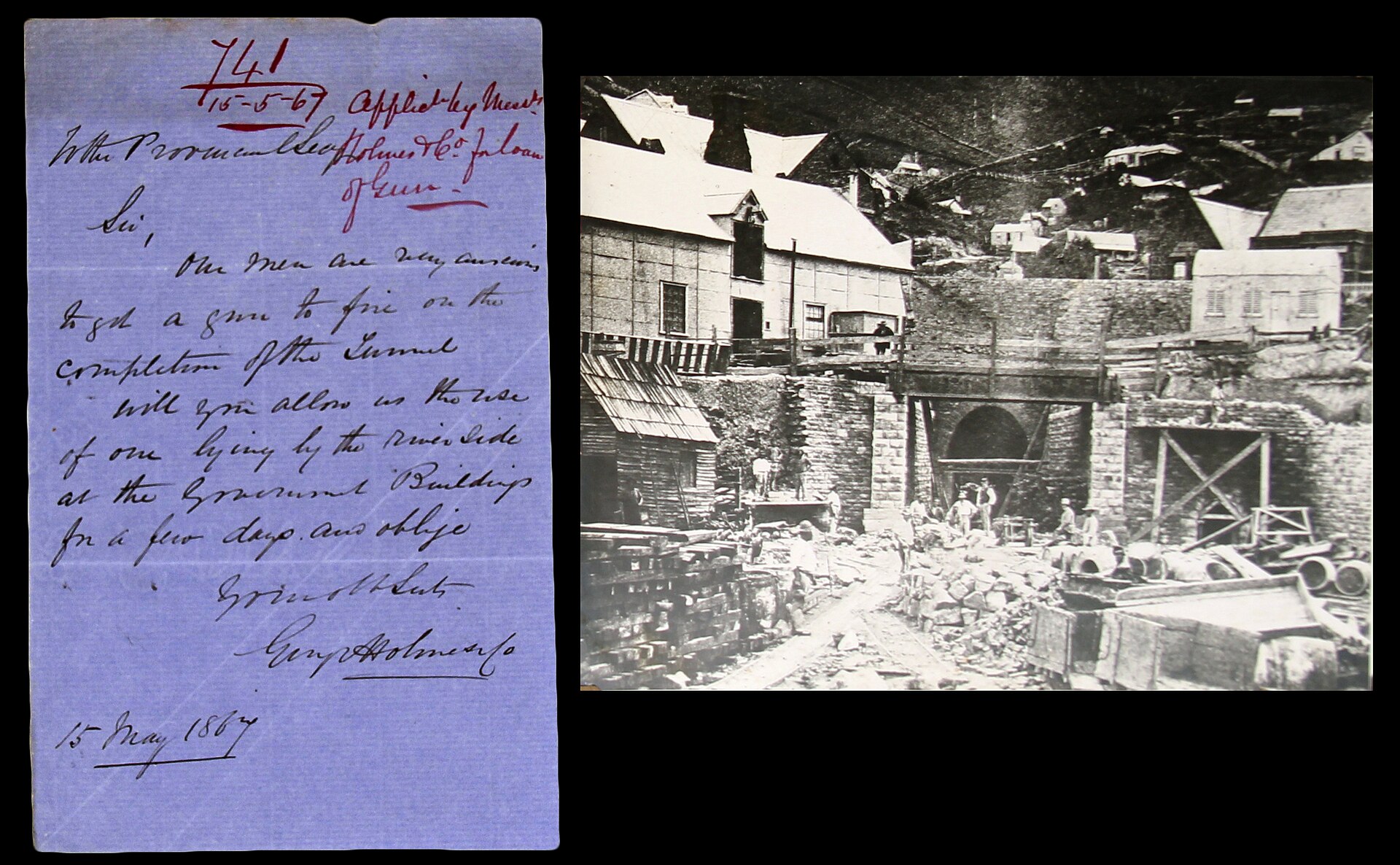
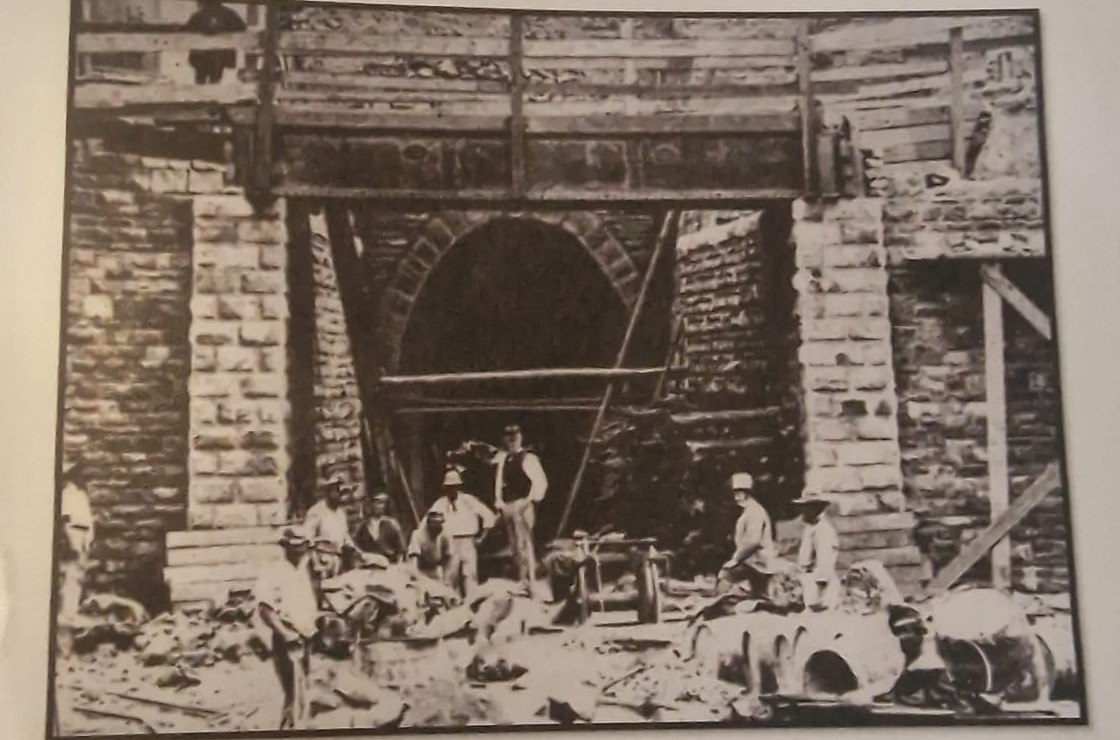
Historic photograph of workers at the Lyttelton rail tunnel entrance
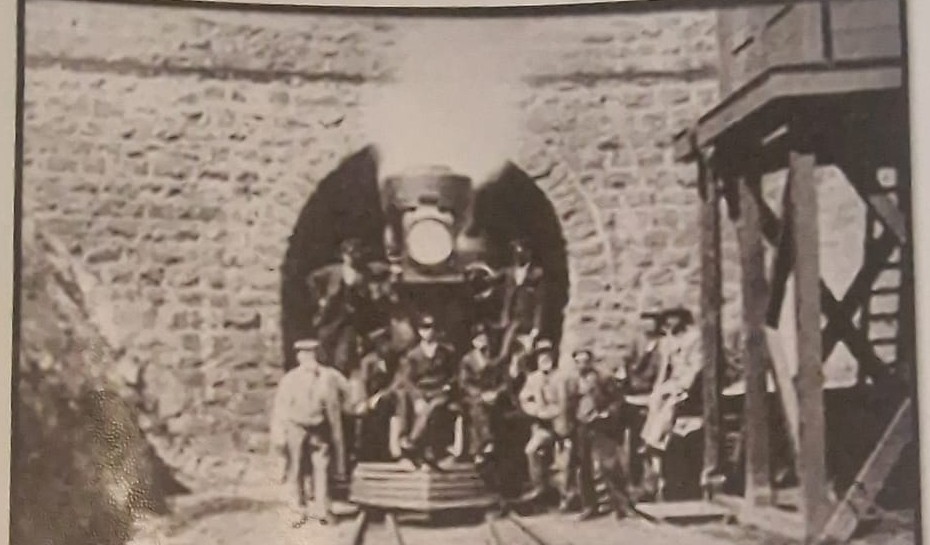
The tunnel workforce at Lyttelton—the railway threshold of the Pope family’s New Zealand story.

The family story begins

Working lives, divided households and journeys across the world.

The White story begins beside the Thames at Egham in Surrey, England, about thirty kilometres west of central London. The Pope story comes into view in Belfast in north-east Ireland, then Glasgow in western Scotland, before ships carry successive members of the family to Canterbury. Neither line travelled in a straight ascent: they worked with horses and iron, kept shops and hotels, endured separation, and built new forms of independence.

What follows is the story those lives leave behind—in names, addresses, occupations, voyages, photographs and the rare moments when an ordinary person entered the public record.

Episode one

Before anyone
crossed an ocean.

One line begins in the fields and roads around Egham. The other emerges through a Belfast marriage and a Glasgow household. Both begin with working families whose lives were recorded only in fragments.

WHITE1784Egham, Surrey
Confirmed by records

Anthony and Sarah White are living in a Surrey parish west of London.

Hannah White’s birth, followed by her baptism five years later, places the couple’s household in Egham by 1784. The parish register then follows their children to Anthony White, born on 11 October 1798 and baptised at St John’s on 4 November. He is the earliest ancestor in this branch whose birth date and parents are both confirmed by the surviving records.

Two records may take the family further back: a 1787 marriage to Sarah Hing and the 1833 burial of an eighty-two-year-old Anthony White. Neither includes enough family detail to prove that these are the same Anthony and Sarah.
Open Hannah’s record Open Anthony’s record
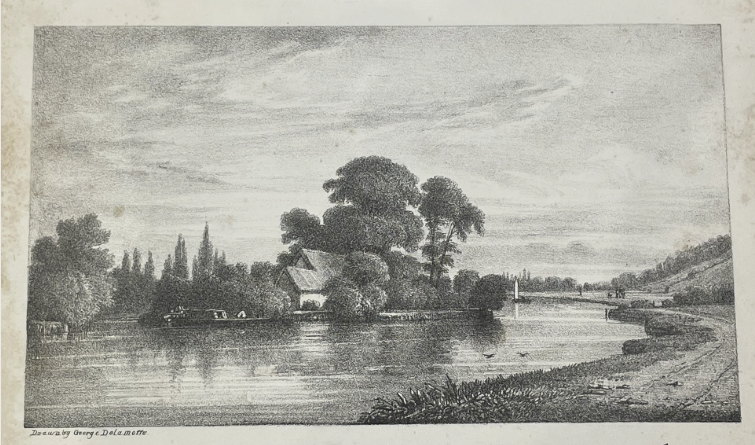
George Delamotte lithograph of Magna Carta Island near Egham in 1829
Runnymede · Egham’s ancient meadowThe Thames landscape, 1829

George Delamotte drew this quiet reach during the lifetime of the early White generations: water, trees, cottage and towpath before the railway accelerated the town’s growth.

Older ground. Magna Carta was sealed—not signed—at Runnymede on 15 June 1215. The meadow formed part of the manor of Egham and was still used for grazing and hay. The exact sealing place is unknown; the island pictured here acquired a later charter legend, but should not be mistaken for the proved site.

Egham Museum PR97A · image and island history ↗ · Runnymede history ↗
POPE1852Ireland → Scotland
Recorded fact

A marriage in Belfast; lodgings across the Irish Sea in Glasgow.

Patrick Pope and Ellen Benson married at St Patrick’s, Donegall Street, on 8 August 1852. Belfast is a port in the north-east of the island of Ireland and is now the capital of Northern Ireland. Their daughter Elizabeth was baptised there the following year.

By the mid-1850s, sons were being born around Glasgow in Lanarkshire—the historic county at the heart of west-central Scotland’s industrial belt. On census night in 1861 the five Popes were lodgers in Ann Madden’s nine-person household in Hutchesontown, just south of the River Clyde.

Open the 1852 marriage register Open the 1861 census record
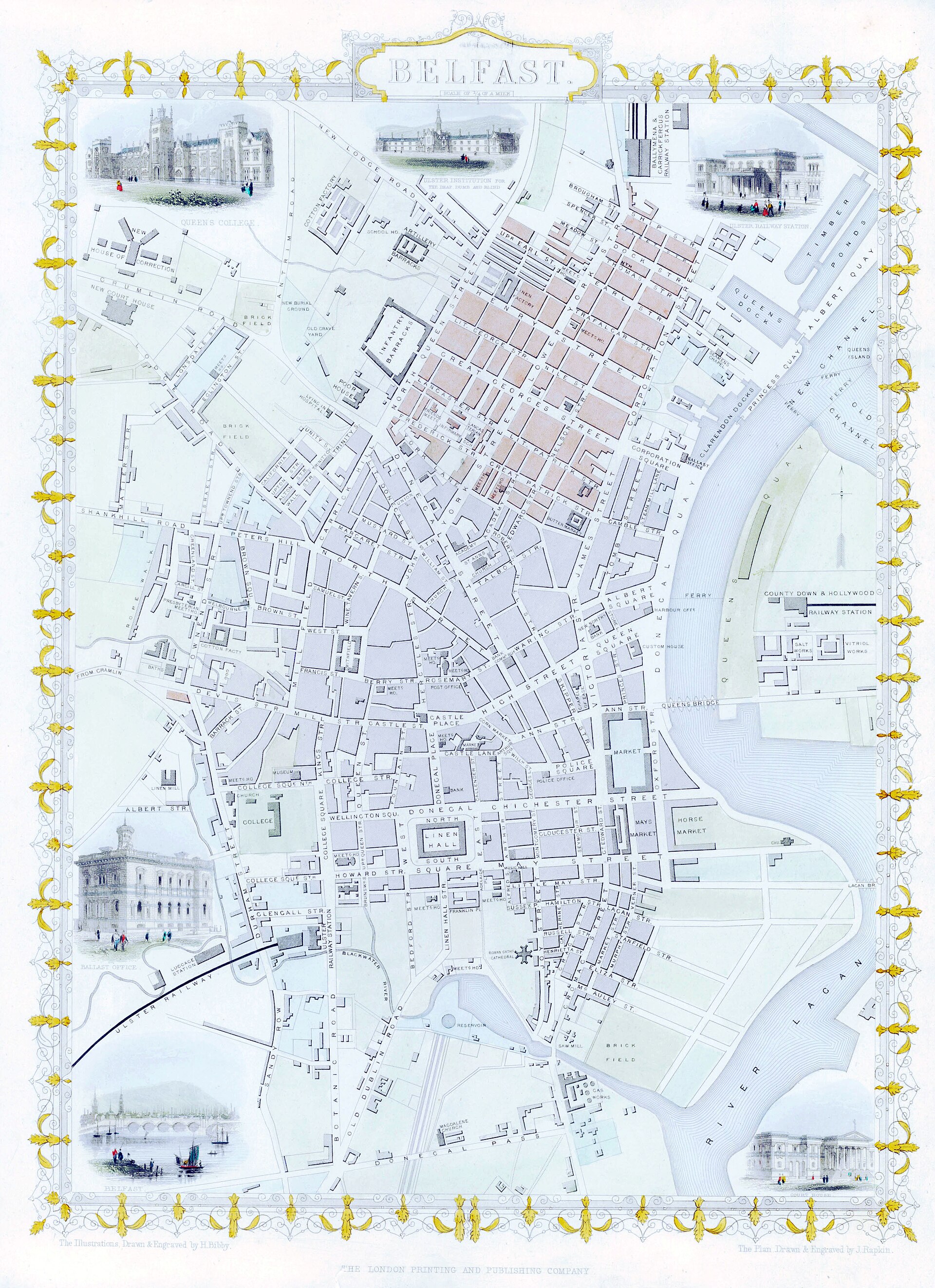
Illustrated street map of Belfast published in 1850
Belfast at the moment of the marriageA city plan published in 1850

The map fixes the streets, river, docks and public buildings of the town Patrick and Ellen knew two years later.

John Rapkin, with H. Bibby illustrations · public domain · open map ↗
Glasgow, Scotland · census night, 7 April 1861

Nine people behind
one recorded door.

The census gives us one address in Scotland’s largest industrial city—and shows that the Popes did not live there alone. Maps and local histories reveal the district around them, while the census shows a small group of Irish migrants sharing a home and depending on wages.

The geography of the move

Across the Irish Sea
into industrial Scotland.

  1. North-east IrelandBelfast

    A port city on Belfast Lough. In 1852 the whole island of Ireland formed part of the United Kingdom; Belfast is now the capital of Northern Ireland.

  2. West-central ScotlandGlasgow & Lanarkshire

    Glasgow stands on the River Clyde. Lanarkshire was the surrounding historic county and industrial belt of collieries, ironworks, railways and workshops.

  3. Inside GlasgowSpringburn → Hutchesontown

    Springburn lay north of the city centre and became famous for locomotive works. Hutchesontown, within the Gorbals, lay just south of the Clyde amid dense tenements and industry.

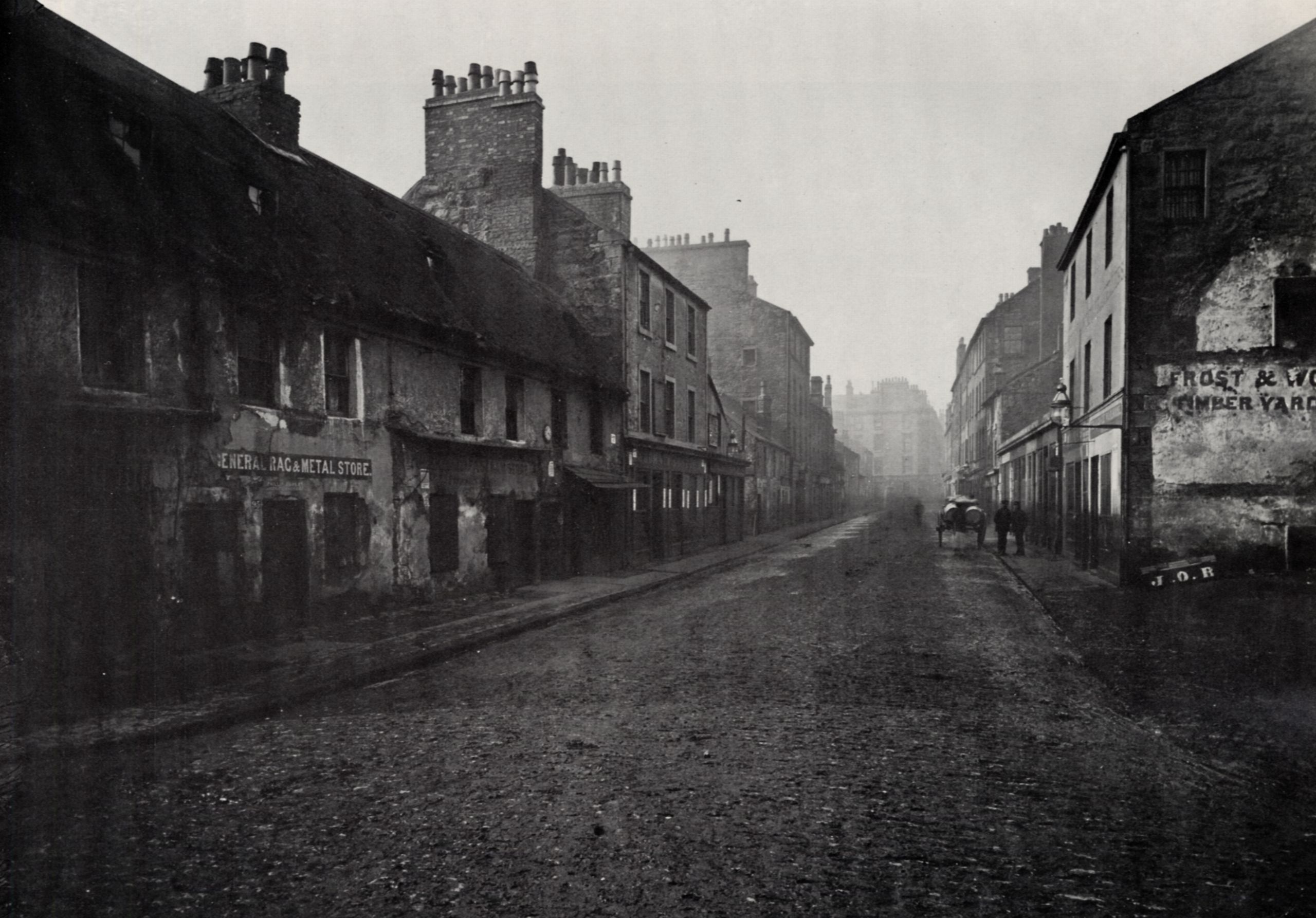
Gorbals Street in Glasgow photographed by Thomas Annan between 1868 and 1877
Gorbals Street, looking south.Thomas Annan’s 1868–77 view carries us into the stone, smoke and crowded street life of the district in which the family lived.Open the image record ↗
ANN MADDEN’S HOUSEHOLD · THE POPES LISTED AS LODGERS

40 St Ninian Street

Ann Madden · 50head · housekeeper · born Ireland
James Madden · 22son · labourer · born Ireland
Helen Madden · 22daughter-in-law · born Ireland
Martin Madden · 19son · labourer · born Ireland
Patrick “Hope” · 27lodger · labourer · born Ireland
Ellen / Helen · 27lodger · born Ireland
John · 5lodger · born Glasgow
Patrick · 2lodger · born Springburn
Francis Joseph · 8 monthslodger · born Glasgow
Open the 1861 census record
01 · THE STREET

Four storeys, a close and a court.

Hutchesontown was laid out in regular streets of largely four-storey housing. A common stair or close led to flats and often to a rear court with drying space, ash pits and shared lavatories. Work, washing, children and neighbours spilled through these semi-public spaces.

Hutchesontown’s growth ↗
02 · THE SKY

Iron made its own night.

Tradeston, the railway and Dixon’s great Govan Ironworks brought furnaces, hammering, wagons and smoke to the south side. Contemporary histories describe the glow of the ironworks after dark. This was the industrial sky above the part of Glasgow where Patrick was recorded as a labourer.

The industrial Gorbals ↗
03 · THE WATER

A municipal revolution, unevenly felt.

Glasgow Corporation acquired the Gorbals water system in 1855, and Loch Katrine water began transforming the city in 1859–60. New supply did not sweep overcrowding, damp or shared sanitation away at once. The Popes lived through the first years of that uneven transition.

Glasgow’s public services ↗
04 · THE HOUSEHOLD

Irish adults; Scottish-born children.

Patrick, Ellen and the Maddens were Irish-born. The Pope boys were born in and around Glasgow. One census page therefore catches migration becoming settlement: adults carrying Irish memory into a household whose children were beginning life in Scotland.

Ireland to Scotland · the world behind the move

When a labour route
became an escape route.

Irish people had long crossed to western Scotland for seasonal and industrial work. The Great Famine turned that continuing movement into an immense human flight—and changed Glasgow.

1845–50the Great Famine
18.2%of Glasgow was Irish-born in 1851
1,000Irish arrivals a week in early 1848
WHY PEOPLE LEFT
It was more than a failed potato crop.

Potato blight destroyed the food on which much of Ireland’s rural poor depended. Poverty, insecure tenancy, rent demands, eviction, disease and an inadequate British government response turned repeated crop failure into catastrophe. About a million people died and many more left Ireland.

WHY GLASGOW
The city was hungry for labour.

The Clyde’s docks, foundries, building sites, mines, railways and factories offered wages within reach across the Irish Sea. Irish settlement pre-dated the Famine, but the steady stream became a flood in the late 1840s. By 1851 almost one Glaswegian in five had been born in Ireland.

HOW THEY WERE RECEIVED
Needed at work; resented in public life.

Industrial Glasgow relied on migrant labour while many newcomers were pushed toward its lowest-paid, least secure jobs and poorest housing. Irishness was often confused with Catholicism and met with anti-Irish and anti-Catholic prejudice—blamed for pressure on wages, housing, poor relief and public health.

HOW COMMUNITY FORMED
Family, parish and fellow migrants mattered.

Hostility was real, but “the Scots” were not one hostile bloc. Workplaces, streets and marriages also created ordinary ties. Catholic parishes expanded, charities responded, and relatives or fellow migrants offered an arrival network. The Maddens’ Irish household, taking in the Popes as lodgers, is the family’s own glimpse of that support system.

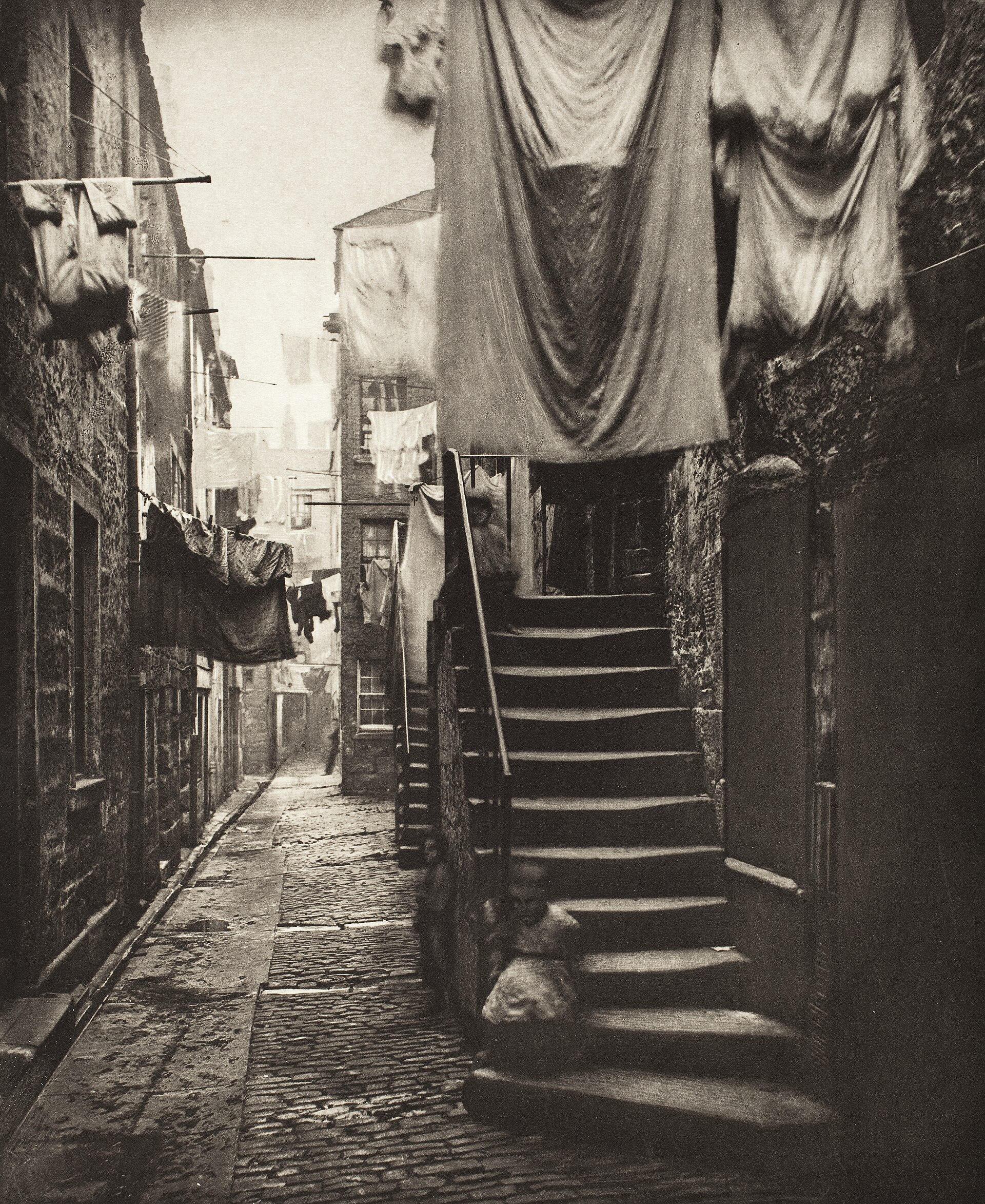
A narrow Glasgow close photographed by Thomas Annan in 1868
Behind the street frontageA Glasgow close, 1868

Thomas Annan’s photograph makes the word lodger physical: rooms reached through a common stair, washing suspended in the narrow light, domestic life pressed into courts and passages, and little private outdoor space.

Thomas Annan · Close No. 193 High Street · LACMA M.2008.40.98.9 · public domain · open image ↗
The White family line confirmed by recordsSix connected generations
01Anthony & Sarah White

Egham household

Open the record ↗
02Anthony White

m. Sarah Cam, 1820

Open the record ↗
03William White

m. Elizabeth Ashman, 1856

Open the record ↗
04William White

m. Sarah P. Q. Woods, 1883

Open the record ↗
05William Anthony White

m. Charlotte Mountford, 1909

Open the record ↗
06Sylvia Mary White

later Sylvia Mary Pope

Open the record ↗

The fourth White generation · Egham, 1891–1911

William White, carman

In 1891 and 1901 William Anthony’s father was a carman at Alexandra Road; in 1911 he was retired. A carman drove a horse-drawn cart or van carrying goods. The job combined the work of a modern delivery driver, haulage worker and horse-handler. Unlike a cabman, he did not carry passengers.

Open the 1891 census Open the 1901 census Open the 1911 census
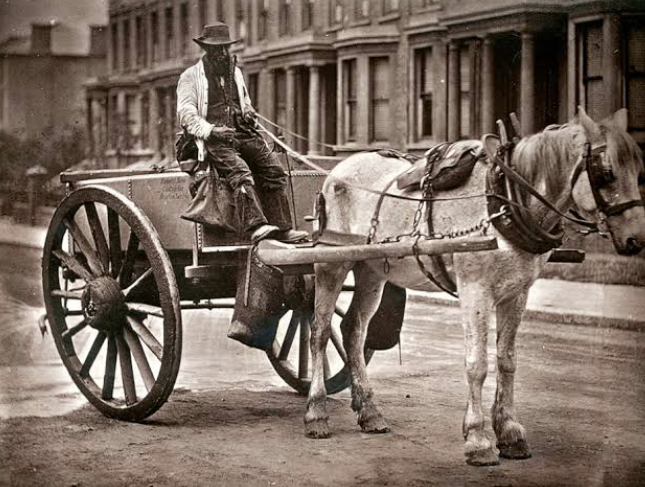
Period photograph of a carman driving a horse-drawn two-wheeled cart
The job made visibleHorse, harness, cart and road

A period carman at work shows what William’s occupation involved.

BEFORE THE ROADCollect the horse and harness it.

Accounts of the occupation describe a driver collecting his horse from the stableman, harnessing it and bringing the vehicle into the yard. The exact division of work varied from one employer to another.

AT THE YARDTake instructions; help load.

The carman checked the load and delivery sheet and might also help with loading. Carmen carried parcels, coal, building materials, shop stock and almost everything a town needed. We do not yet know what William carried.

ON THE ROUNDDeliver, guard and obtain signatures.

He controlled the horse, vehicle and load through traffic and bad weather, watched them while stopped and collected signed receipts. He might be held responsible for a breakdown, injury or damaged parcel.

BACK AT THE YARDReturn the horse, vehicle and paperwork.

The day ended with the delivery sheets and receipts handed back and the horse returned to the stable. One water-carman interviewed in 1877 described working from 5 a.m. until 7 p.m.

What the census suggests

William probably drove an employer’s horse and cart rather than owning them. The 1891 census marks him as employed and the 1901 census as a worker. His job required skill and responsibility, but the records do not show that he owned a carriage or haulage business.

Dictionary of Occupational Terms: carman ↗
Was he also the publican?

A William White held the licence of the Prince of Wales in Bond Street in 1892 and 1903. The name, place and dates fit the family story. However, the census records for Sylvia’s grandfather still describe him as an employed carman. He might have had a second occupation, but we need a rate book, licence-transfer notice or another record to prove that the two William Whites were the same man.

Open the 1892 licence record Open the 1903 licence record

A visual journey

Stand where
the story happened.

Historic photographs, maps and surviving buildings show places that have been rebuilt many times. They help us picture the streets, distances and workplaces hidden behind the names in the records.

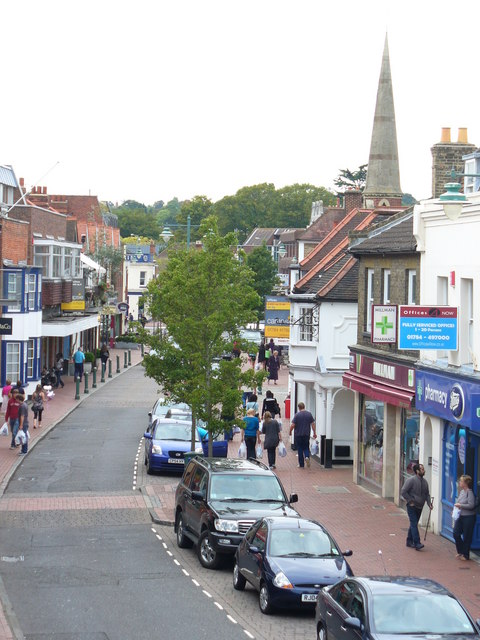
Egham High Street
EghamThe White family’s Surrey landscapeModern view · the historic street pattern survives

Records place the family in and around Egham for more than a century, while the town changed from a mainly agricultural community into a centre of railway-linked trade and growth.

Photo: Colin Smith / Geograph · CC BY-SA 2.0 · source ↗

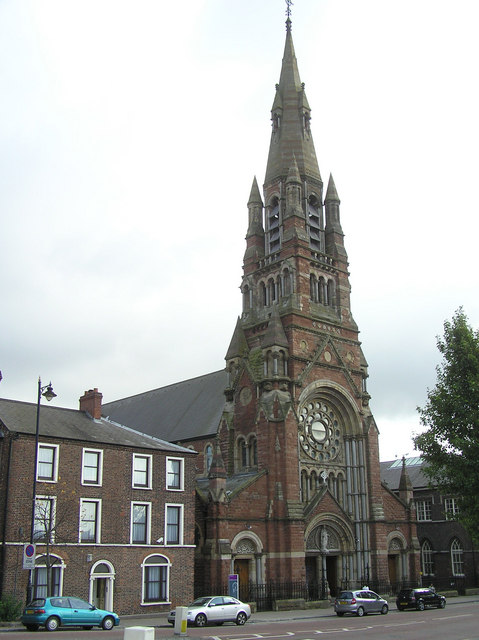
St Patrick's Roman Catholic Church on Donegall Street, Belfast
Belfast · Northern IrelandSt Patrick’s, Donegall StreetThe present church rose on the site of the smaller building the couple knew

Patrick and Ellen entered the register of the 1815 church. The larger building, completed in 1877 on the same Donegall Street site, reflects the extraordinary growth of Belfast’s Catholic population.

Photo: Kenneth Allen / Geograph · CC BY-SA 2.0 · source ↗

Lyttelton rail tunnel under construction in 1866
Lyttelton, Canterbury · 1866The tunnel under constructionPatrick’s obituary remembered him as part of this work

For six and a half years, men drove through volcanic rock to join Christchurch with its harbour. Patrick’s later obituary placed his blacksmithing life inside that defining Canterbury project.

Archives New Zealand CH519/506 · CC BY-SA 2.0 · source ↗

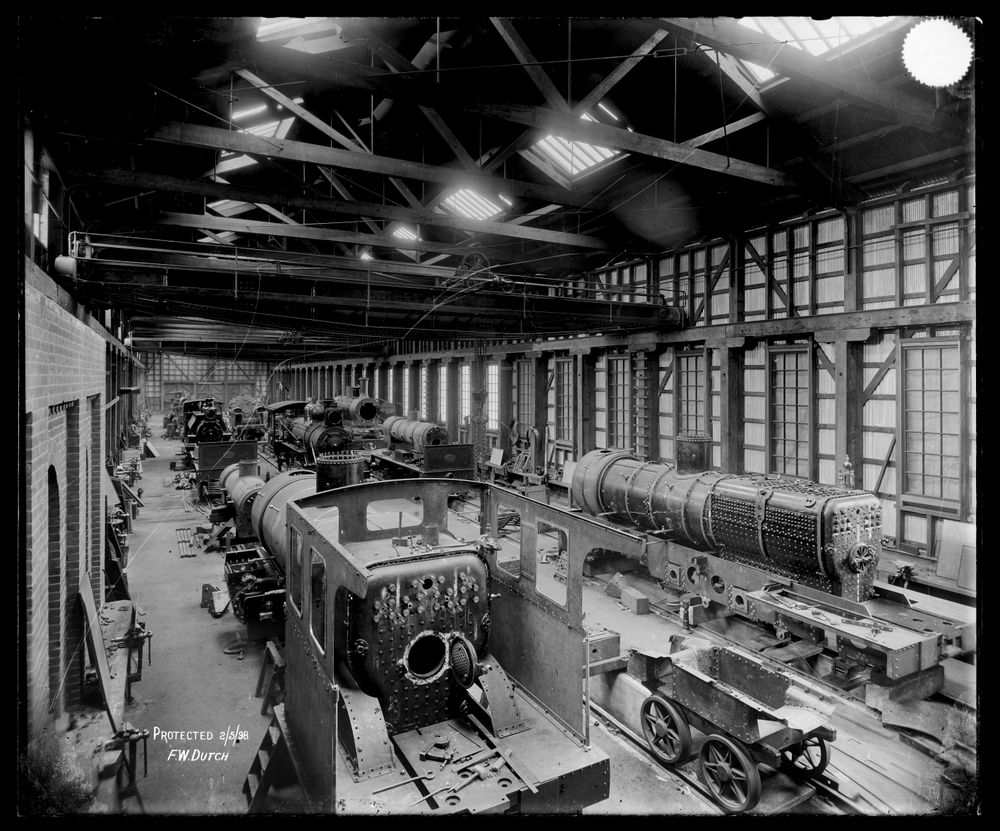
Interior of Addington Railway Workshops in 1898
Addington · 1898Inside the railway workshopsHeavy components, timber roof and an industrial shop floor

This is the environment that makes “blacksmith department” tangible: scale, machinery, lifting, heat and many trades working alongside one another.

Francis Dutch · Te Papa D.000662 · no known copyright restrictions · source ↗

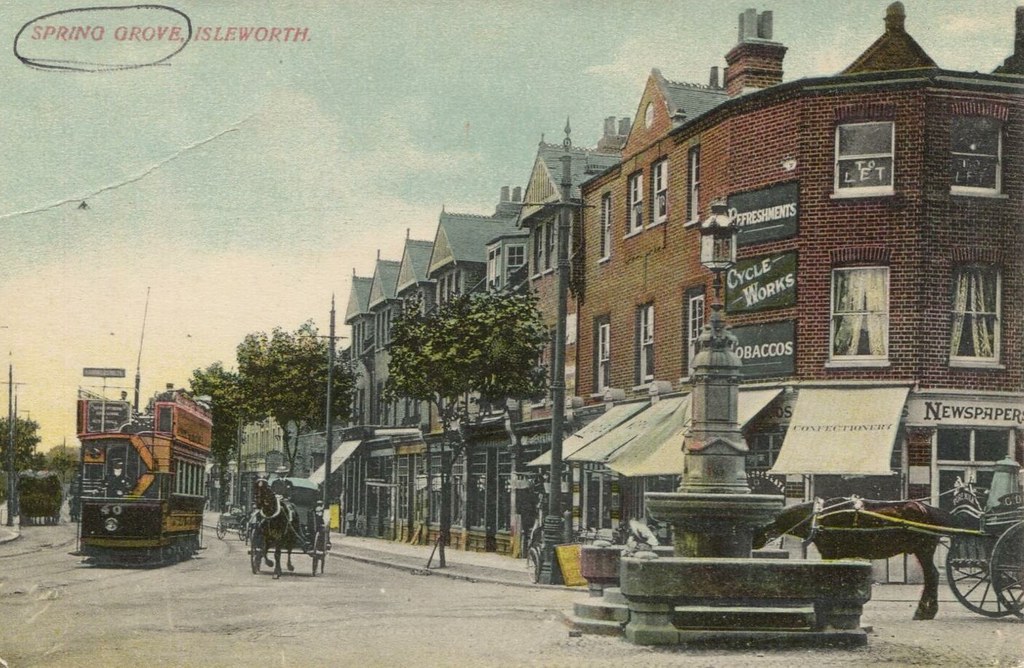
Historic postcard of Pears Fountain at Spring Grove, with a tram, horses and a newspaper and confectionery shop
Spring Grove · early 20th centuryThe strongest view of the White shop sitePears Fountain · London Road at Spring Grove Road

At the right of this postcard, beside the horse trough, a shop advertises newspapers, sweets and tobacco—the same kind of business William ran at 18 Pembroke Terrace, London Road. The place and trade match closely. We still need a rate book or a period street plan with house numbers before we can say that the shopfront in the photograph was definitely his.

Public-domain postcard via Mark Crombie / Flickr · open the original ↗

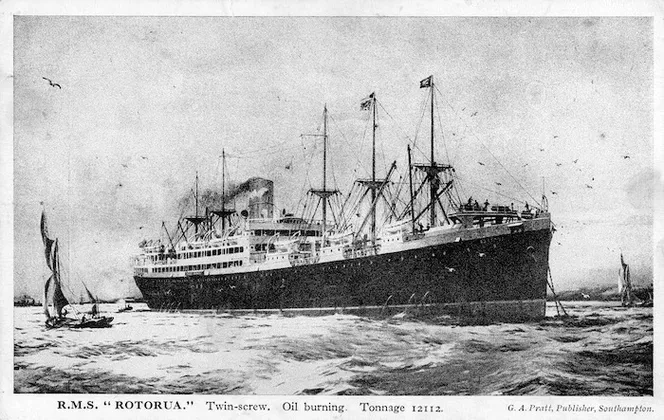
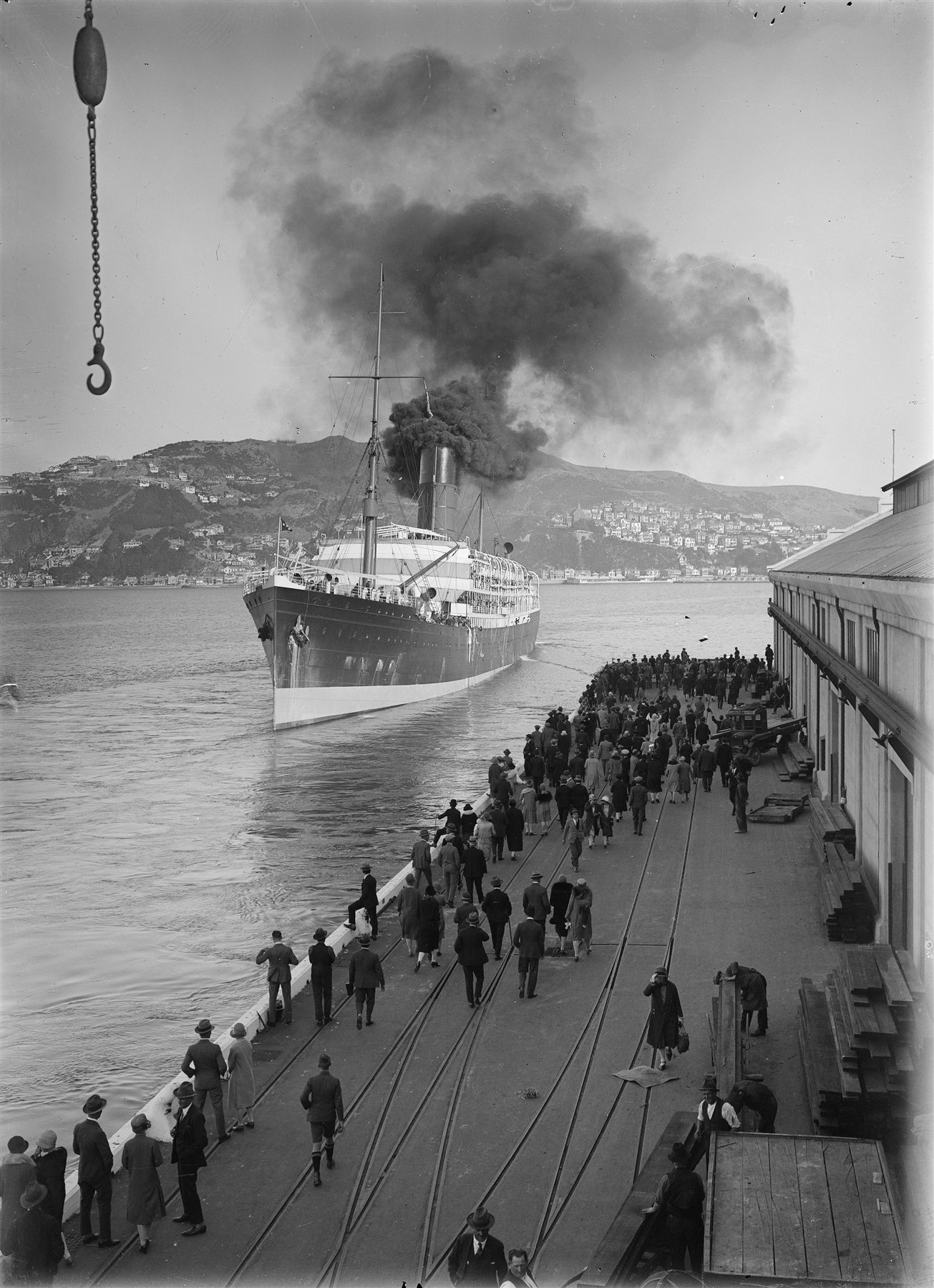
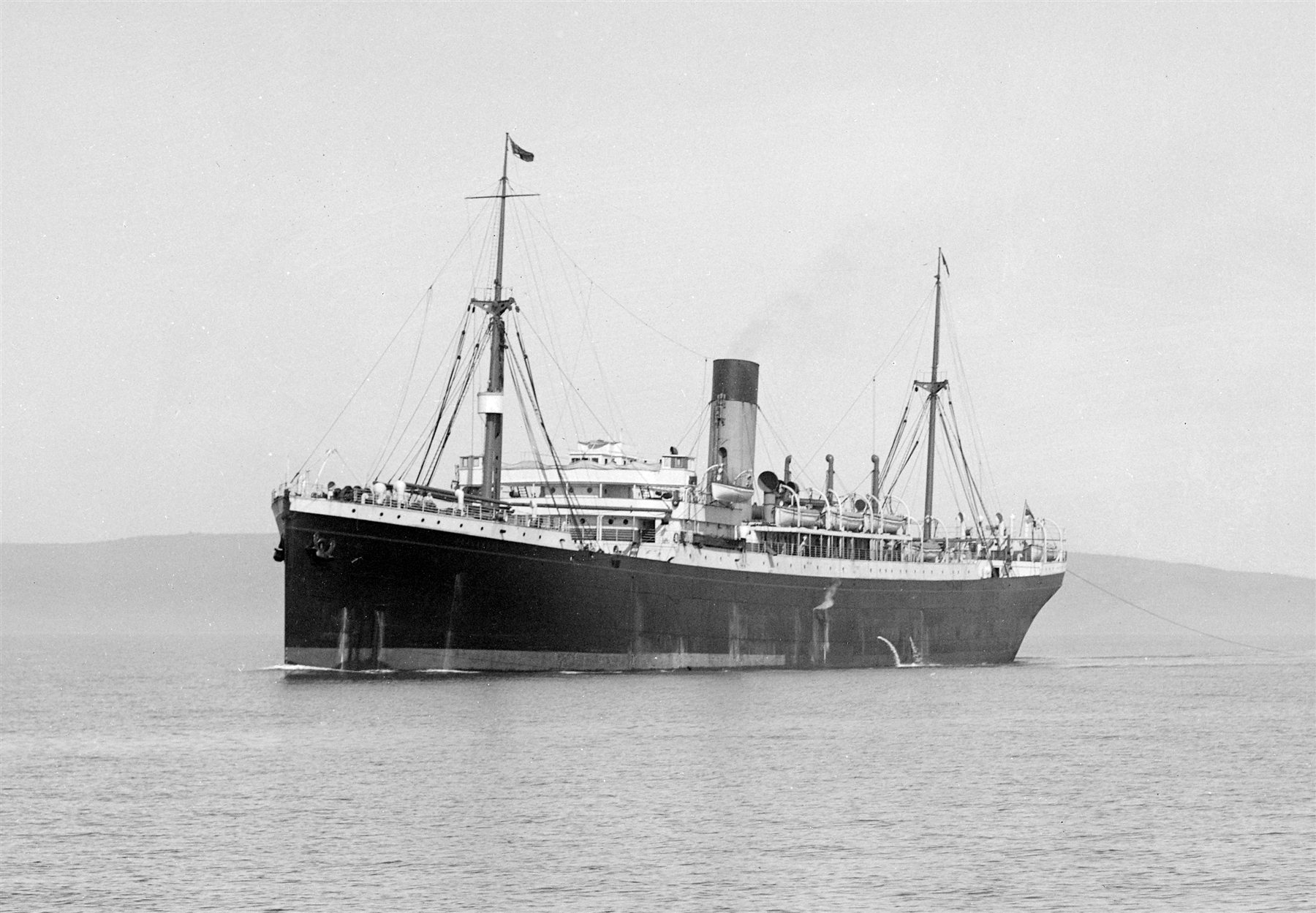
RMS Rotorua, formerly Shropshire, in service from 1923
Rotorua · 1923 voyageThe ship that carried the White householdThe former Shropshire, refitted and renamed in the year they sailed

William, Charlotte, Dorothy, Kenneth and Sylvia appear consecutively on the manifest, leaving England together on 6 December 1923.

Alexander Turnbull Library PAColl-5471-028 · permitted for non-commercial website use · image uncropped · source ↗

Likely White shop site

Pears Fountain, Spring Grove

The records give the address as 18 Pembroke Terrace, London Road—not Pembroke Place. The postcard places Pears Fountain and a newspaper-and-sweet shop at this junction, now occupied by Heston Fire Station. It is our best location, but a period map showing the street numbers is still needed to prove it.

Open the present-day junction ↗
Confirmed pub location

Prince of Wales, 33 Bond Street

The pub stood here from 1871 until about 2000, when it was demolished. We know the location and the names on the licences. We have not yet proved that the licensee called William White was Sylvia’s grandfather.

View the exact 1997 photograph ↗
The vanished street

40 St Ninian Street, Hutchesontown

Later clearance transformed this part of Glasgow. The National Library of Scotland’s town plans, surveyed in 1857–58, preserve the streets and buildings around the Pope household as they stood in 1861.

Explore the 1861 Glasgow plans ↗
40ST NINIAN STREETHutchesontown · Glasgow · 1861
Later White landscape

Grehan Valley, Akaroa

Later records place William first in Fendalton and then near Akaroa, where he farmed. This map shows the valley, but we need a land-title record before we can identify his particular house.

Open full map ↗

People and places

Faces, homes and
the railway world.

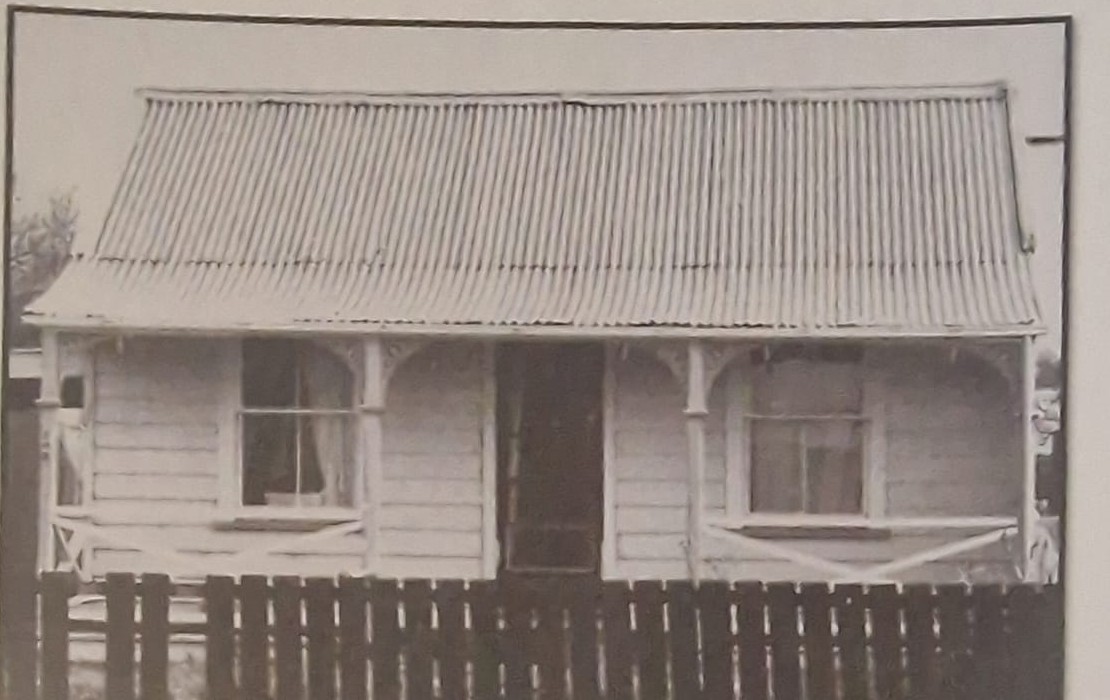
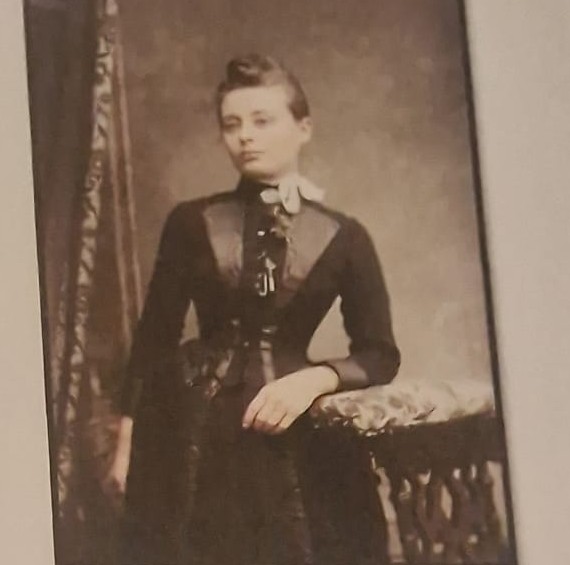
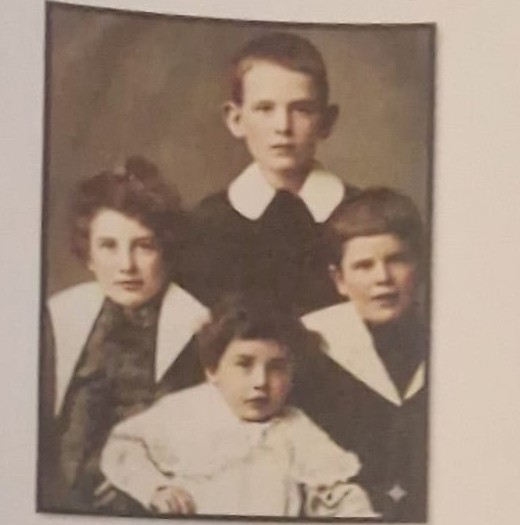
Four surviving images bring the migration story into view: the tunnel that opened Canterbury to rail, the modest housing around the workshops, Sophia Gilkes, and the children who carried the Pope name into a new generation.

The first train posed at the Lyttelton tunnel entrance
Railway thresholdThe first train at the tunnelThe route between port and Christchurch opens
An Addington railway worker's cottage
Home after the shiftA railway worker’s cottageThe domestic world beside the workshops
Historic portrait of Sophia Annie Elizabeth Gilkes
A face returnsSophia Annie Elizabeth GilkesPortrait preserved in the family archive
David, Augustus, Frederick and Ellen Benson Pope as children
The next generationDavid, Augustus, Frederick & EllenThe Pope children in Canterbury

Episode two

The decision
to leave.

Migration appears as a single line on a family tree. In life it meant separation, risk, money, waiting—and the possibility that those leaving would never see home again.

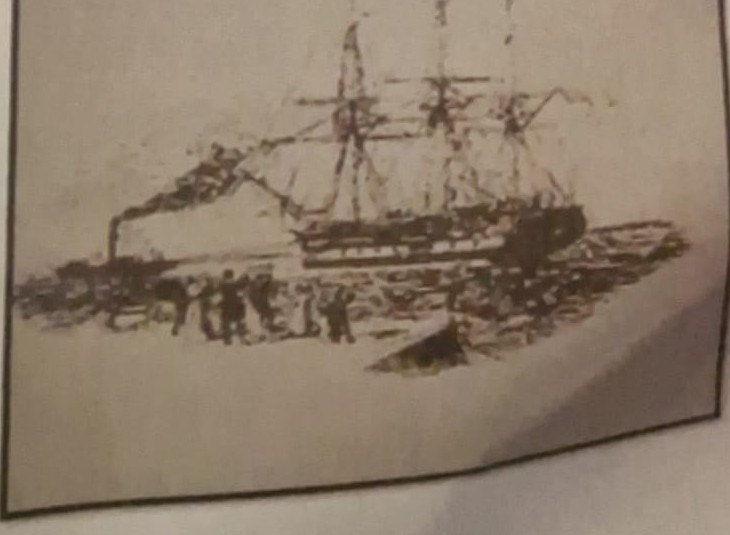
Sketch identified in the family archive as the Sebastopol leaving port
The Sebastopol leaves portThe drawing carried the ship’s image through the family story; its artist and first publication are unrecorded.

1861–63 · the passenger story

The Popes did not travel together.

John Pope, a blacksmith from Lanarkshire, sailed first on 5 September 1861. The Sebastopol reached Lyttelton after 99 days from the Downs. Mary and four children followed with Patrick on the Echunga in 1862. Ellen and three sons came on the David G Fleming in 1863.

This was not one brave departure but a chain of separation and trust. A wage-earning family sent people ahead, waited for letters and money to cross oceans, and eventually remade the household on the far side of the world.

Three departures. Two years apart. One family reunited.The passenger lists, 1861–63
99 days
Sebastopol

5 Sep–14 Dec 1861 · John sails first

102 days
Echunga

Sep–22 Dec 1862 · Patrick, Mary and four children

107 days
David G Fleming

23 Aug–8/9 Dec 1863 · Ellen and three sons

36 days
Rotorua

6 Dec 1923–11 Jan 1924 · Sylvia’s household

Below the line on the passenger list

What a hundred days
between decks meant.

The passenger lists show that the Popes travelled through Canterbury’s assisted-migration scheme, which helped working families pay their fares. Life aboard still depended heavily on class: it determined how much space, food, privacy and service a passenger received.

ABOVE / CABINPrivate cabins · served meals · fresh meat when available
MAIN DECKWork, washing, exercise, weather and the only broad horizon
BELOW / STEERAGEOpen compartments · tiered bunks · mess groups · little privacy
Typical cabin and steerage arrangements on mid-century emigrant ships
SPACE

A bunk became home.

Steerage commonly meant long open compartments rather than private cabins. Canvas might provide the married couple’s only screen. Bedding, boxes and bodies shared the same low between-decks world.

FOOD

Rations, messes and hard biscuit.

Salt or preserved meat, flour, oatmeal, dried potatoes and ship’s biscuit dominated the diet. Stores were issued to small mess groups; after 1855 meals were generally cooked in a central galley, but monotony remained.

WATER

Measured by the day.

Steerage allowance was about 3.4 litres of fresh water per person each day. Barrels could spoil, washing was difficult and rainwater mattered. By 1863 the David G Fleming carried a plant reported to distil 300 gallons daily.

TIME

Heat, cold and repetition.

The tropics brought humidity; the Southern Ocean brought cold and gales. Cleaning, ration collection, children’s lessons, worship and small entertainments organised weeks in which the horizon barely changed.

Te Ara: cabin, steerage and life on board ↗

SEBASTOPOL · 1861

John goes ahead.

The passenger list groups John, a 36-year-old blacksmith from Lanarkshire, with blacksmith Henry Kerr and Kerr’s two teenage sons. They paid £34 of the £54 fare themselves, while the Canterbury provincial government contributed £20. They were skilled working migrants receiving help with the fare, not wealthy cabin passengers.

The ship carried about 186 government-assisted immigrants as well as other passengers. Its cargo included anvils, bellows, forge parts, iron bars and agricultural tools—along with beer and stout. John arrived in Canterbury on a ship carrying the tools of his trade.

Open the passenger list ↗

ECHUNGA · 1862

A gale—and a landing refused.

The ship took 102 days from Gravesend. Seven babies were born. Four passengers died—three infants and John Barr, aged sixty-nine—and cook’s mate Edward Butters was washed overboard. Near New Zealand, the crew shortened sail and held the ship steady during a heavy gale.

At Timaru, about 130 immigrants went ashore and found that proper accommodation had not been prepared. Others refused to land and demanded to continue to Lyttelton. Even at the supposed end of the voyage, assisted passengers had little control over what happened to them.

Read the contemporary account ↗

DAVID G FLEMING · 1863

Ellen crosses with three boys.

Ellen, John, Patrick and Francis travelled with James Madden. Friends already in New Zealand paid £39 13s 4d of the £40 11s fare; the province paid the remaining 17s 8d. Two years after the Popes lodged with the Maddens in Glasgow, that migrant network appears to have paid almost the entire cost of the next journey.

The vessel carried 357 government-assisted immigrants. Three children and a crewman died; three babies were born. The shared passenger deck was praised for its light and ventilation, and the ship carried equipment that could turn seawater into 300 gallons of fresh water a day. Good management reduced the danger but could not remove it.

Open the passenger list ↗

Sixty years later · Sylvia’s crossing

The same ocean had become a different world.

RMS Rotorua, formerly Shropshire, in service between 1923 and 1941
RMS Rotorua in 1923.The former Shropshire was refitted and renamed in the year Sylvia travelled. Alexander Turnbull Library PAColl-5471-028.

On 6 December 1923 William, Charlotte, Dorothy, Kenneth and ten-year-old Sylvia appear together on ticket 213, giving 338 London Road, Isleworth. Isleworth was then in Middlesex and is now part of west London, England. The family booked third class from Southampton on England’s south coast to Wellington. The Rotorua arrived on 11 January: 36 days, little more than a third of the Popes’ sailing-ship crossings.

Open the White family’s passenger record

The oil-fired liner sailed via the Panama Canal with 67 first-class and 335 third-class passengers. Its 1923 refit placed mass-passenger accommodation on the upper deck, immediately above the main deck, with cabins mainly for two or four and a few for six. First-class rooms and lounges occupied the shelter and promenade decks above. There were stewards, electric light, steam heat and fresher food—but social rank was still built into the ship.

SHIP12,112 tonsTwin-screw · oil-burning
WHITE TICKETThird classPassenger contract no. 213
ROUTEVia PanamaSouthampton, England → Wellington

Class reading: third class was the only alternative to first on this two-class liner; it is not evidence of poverty. For the household of a stationer and sub-postmaster it fits a respectable, cost-conscious small-trading family choosing permanent migration over luxury.

Episode three

What work tells us
about a life.

Occupations are often the most vivid words in a census. Read across several records, they reveal skill, status, risk and a family’s capacity to adapt.

Iron, rail and land

Patrick Pope, blacksmith

Patrick’s obituary places him in the iron industry in Derry in north-west Ireland and Glasgow in western Scotland, then at the Lyttelton tunnel and Addington Railway Workshops in Canterbury. An 1872 report shows him speaking for fellow workers. Later records follow him into hotel work and farming at Halswell.

Open Patrick’s obituary
Inside the workshop

Blacksmithing meant heat, noise, coal smoke, heavy stock and skilled judgement repeated over long shifts. Addington was a major industrial complex: trades worked beside one another to repair and build the railway’s moving parts. Patrick’s role as spokesman suggests standing among the men, though it does not tell us his politics or temperament.

Te Ara: railway workshop life ↗
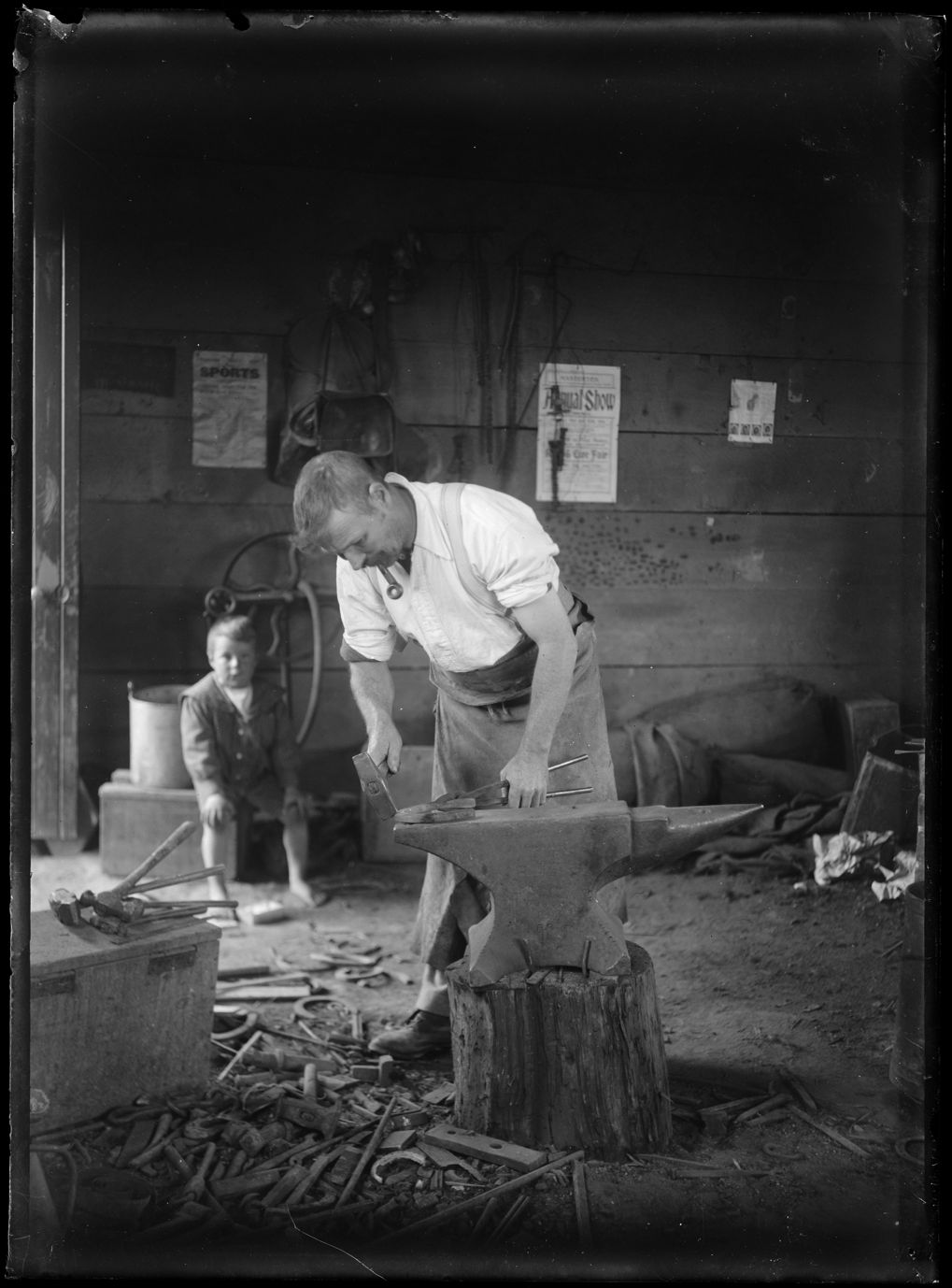
A New Zealand blacksmith working at an anvil in his forge around 1910
Hammer, anvil, judgement.A New Zealand forge photographed c.1910 gives the bodily scale of the trade Patrick carried from Britain into railway work.Fred Brockett · Te Papa B.027899 · no known copyright restrictions

From tunnel mouth to workshop floor

Blacksmithing made rail possible.

A smith did more than shoe horses. Railway work demanded the heating, shaping and repair of iron components: repeated blows, close control of temperature and an eye trained to read colour in hot metal. The forge photograph shows the bodily scale of that work; the 1898 Addington image shows the industrial system around it.

Workers at the Lyttelton tunnel entrance
Tunnel workforce
An Addington railway worker's cottage
Railway worker’s cottage

Together they evoke the industrial works and modest housing that framed Patrick’s railway years.

The family’s confirmed hotel · Lyttelton, 1888–90

Patrick leaves the forge
and takes the bar.

After his years at Addington, Patrick Pope became the owner-operator of the Cambridge Hotel at the corner of Dublin and Winchester Streets. He moved from answering to managers in a railway workshop to running a large licensed house with travellers, boarders, family quarters and eighteen guest rooms.

CAMBRIDGE HOTELDUBLIN × WINCHESTER · LYTTELTON
010203040506070809101112131415161718

18 rooms, exclusive of those required for the family

Eighteen guest rooms · family quarters beyond

P. POPE · PROPRIETOR

“Late Foreman of the Addington Workshops”

Patrick used his position at the railway workshops to build trust in the hotel, promising moderate prices and “liquors of the best quality.” The advertisement shows the former foreman presenting himself as a hotel keeper.

Advertisement naming Patrick

PRIMARY NEWSPAPER · 14 MAY 1888

A house built around hospitality.

A licence notice for the premises describes eighteen rooms beyond those required by the family. That wording gives us bedrooms, family quarters and a substantial licensed house—not merely a bar room.

Read the original notice ↗
01

What could be poured?

Beer and “liquors” were the language of Patrick’s advertisement. Canterbury customs returns in 1888 list bottled and cask ale and beer, still and sparkling wines, Australian wine and spirits—the commercial world from which a Lyttelton publican stocked his bar.

See the 1888 customs categories ↗
02

Who came through the door?

The publican’s licence and room count point to travellers and boarders as well as local trade. Lyttelton was a port town: sailors, rail workers, tradesmen and people moving between harbour and Christchurch formed the surrounding world. A guest list or ledger has not survived in the material found so far.

03

What might be eaten?

The family account says the hotel provided dining service, but no menu has been located. Tea, coffee, cocoa and chocolate appear in contemporary import returns. Any claim about a particular breakfast, stew or roast would go beyond the evidence.

04

Why did Sunday matter?

The law generally allowed Sunday sales only to hotel guests and people who were genuinely travelling. One reported case concerned a pint of stale beer said to be “horse medicine”—the kind of colourful argument hotel keepers used when testing the limits of Sunday trading.

Read about the licensing law ↗

The next White generation · Isleworth, west London · 1911–21

The counter becomes the centre of the White story.

In 1911 William Anthony White described himself as a newsagent and confectioner. Ten years later, at the same address—18 Pembroke Terrace—he was a stationer and sub-postmaster, working at home for the Postmaster General.

Open the 1911 census Open the 1921 census
1911Newsagent & confectioner

Newspapers and inexpensive treats meant regular deliveries, small cash sales and repeat local customers.

1921Stationer & sub-postmaster

The stock broadened; the counter now carried a public-service responsibility as well as private trade.

Same addressBusiness and home overlapped

The census says he worked at home. It does not prove whether the shop occupied a front room, an attached unit or another arrangement.

A new fourteen-page discovery · Isleworth, 1916–17

One shopkeeper.
One appeal.
Three brothers at war.

The tribunal papers do more than settle a military decision. They let William speak for himself: about two businesses, a post office serving soldiers, the people who depended on him and the two teenage brothers who had already left his counters for military service.

MIDDLESEX APPEAL TRIBUNALV2895Local case 778 · MH 47/90/46
William’s own statement survives

The “one-man business” was really two shops and two dependent households.

In December 1916 William said he was sole proprietor and manager of premises at 538 London Road, Isleworth, and the Post Office in Thornbury Road, Osterley. His trades ranged across news, books, stationery, tobacco, household outfitting and soldiers’ requisites.

He employed one young woman and several lads, but said no trained adult could take responsibility for the businesses. Their income supported Charlotte and three small children, while his widowed mother and three younger siblings depended almost entirely on him.

Open the official tribunal record Download the transcript and page guide
  1. Temporary protection

    The local tribunal exempted William until 2 April 1917.

  2. The military objects

    Its representative challenged the need for continued exemption.

  3. Appeal allowed

    The Middlesex tribunal withdrew William’s certificate.

  4. Not exempted

    The formal decision left him liable for service.

The clue hidden inside William’s appeal

His hardship case names two younger brothers already serving.

“Previous to the war, two brothers assisted me in the business; neither of them hesitated to join the forces although considerably under military age.” The 1911 household points to Frederick James and Maurice Frank White.

J41370
Identity confirmed

Maurice Frank White

From an Isleworth shop to wireless work at sea—and then Canada.

William described his seventeen-year-old brother as a wireless operator aboard a North Sea battleship. The Royal Navy register identifies Maurice Frank White, official number J41370, born at Egham on 29 November 1899. The name, age, birthplace and service fit together.

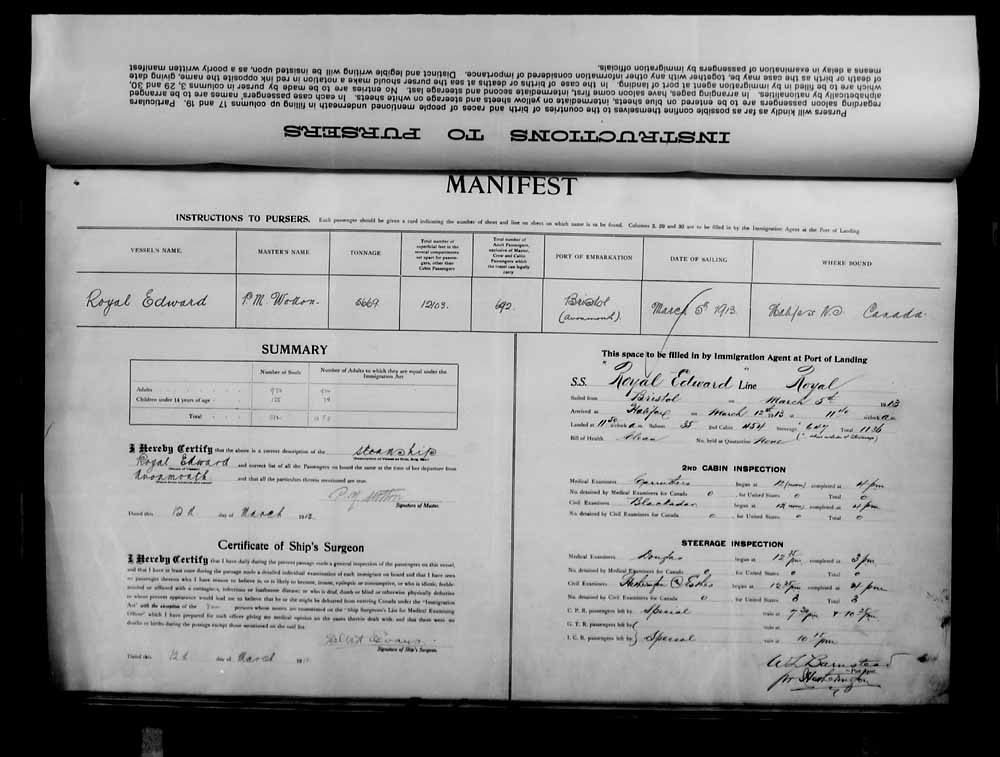
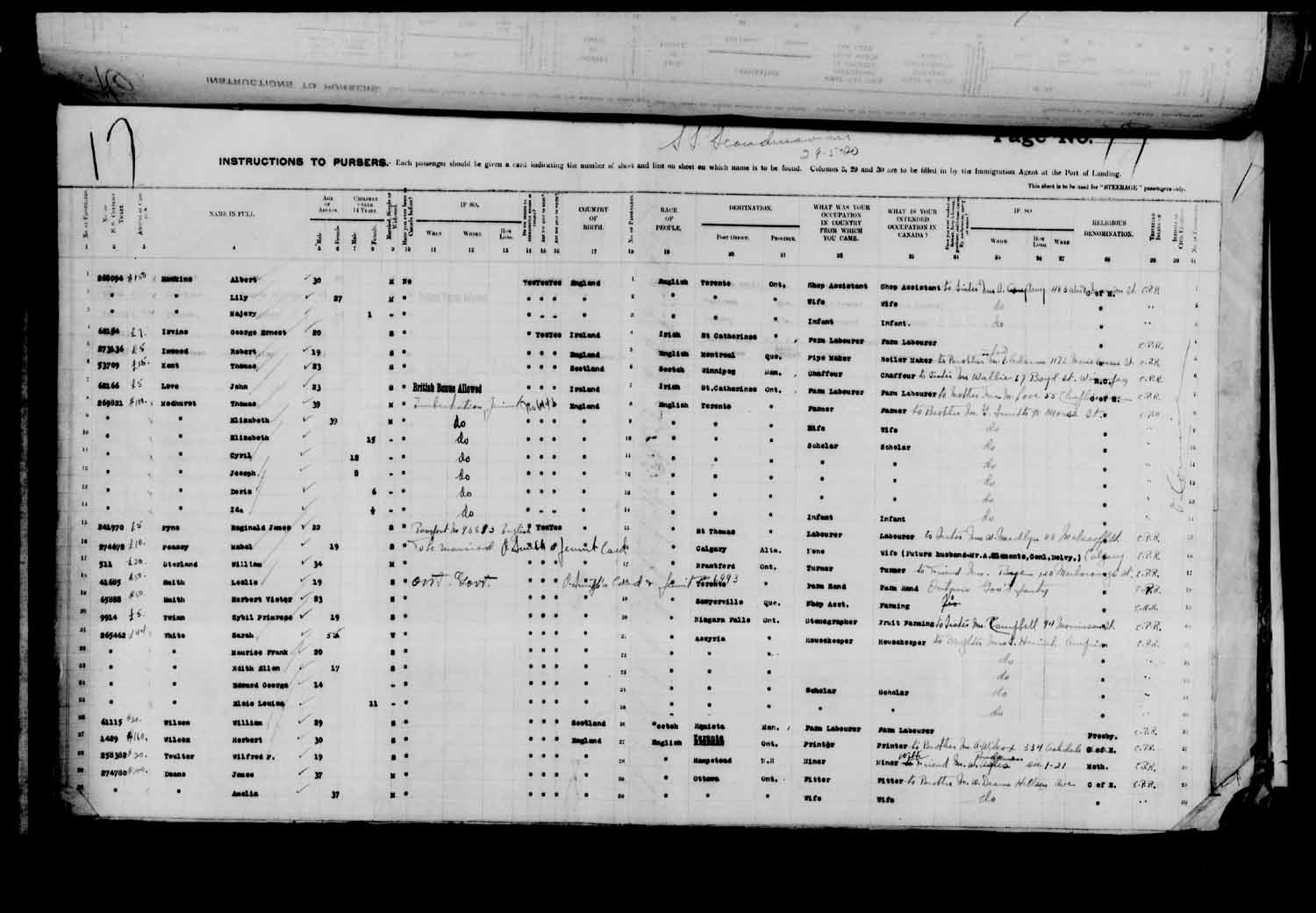
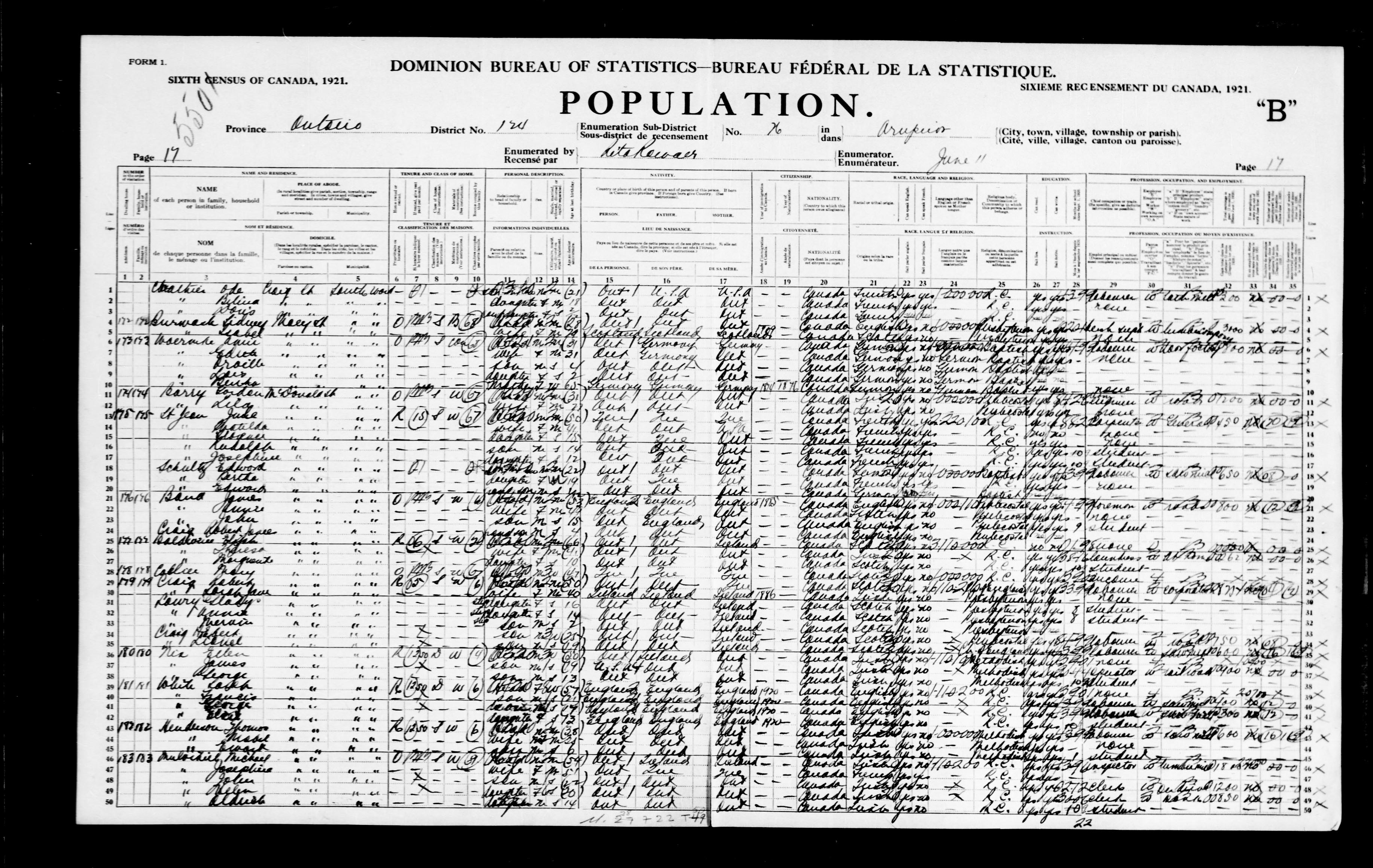
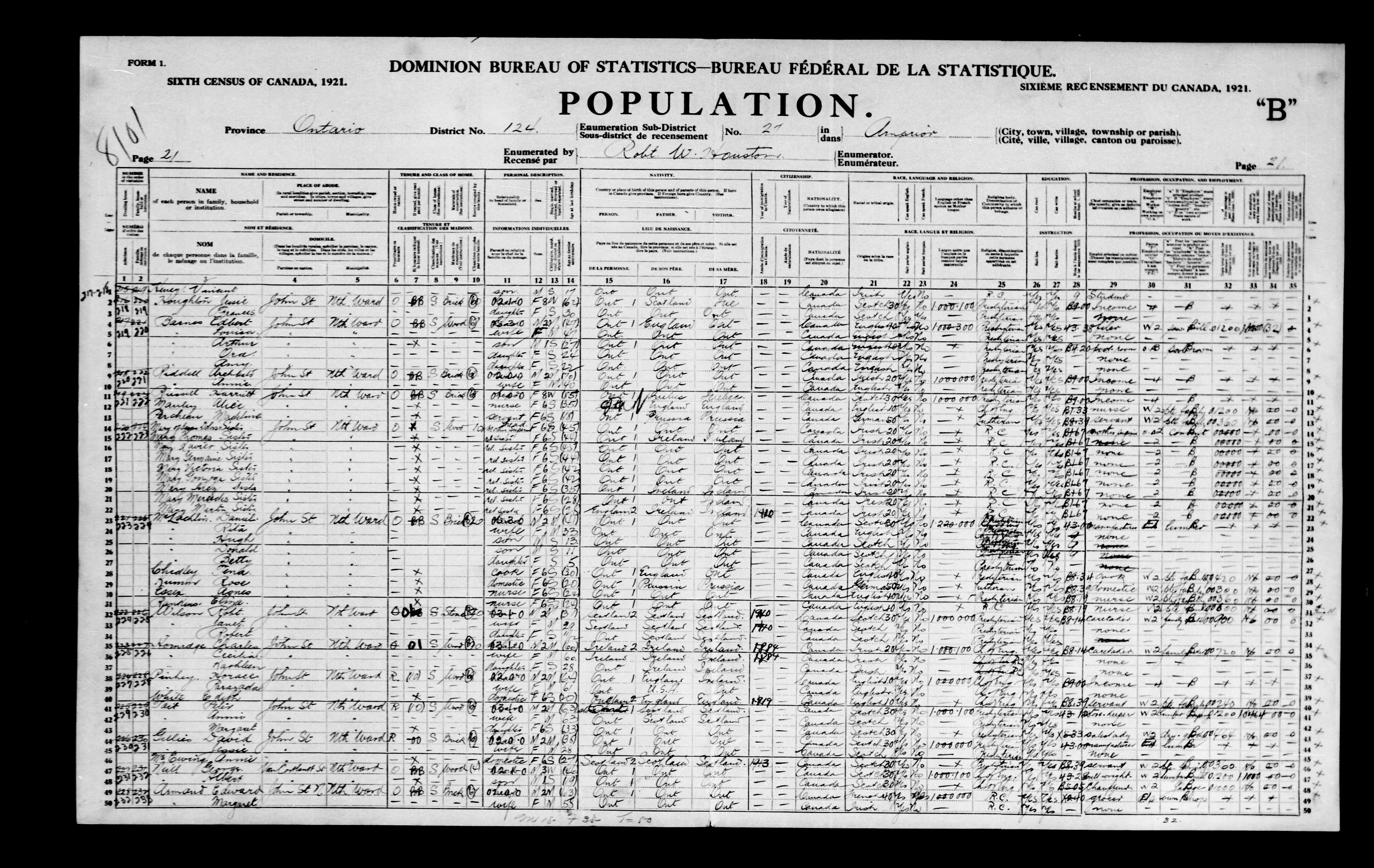
War was not the end of his movement. In May 1920 Maurice, his widowed mother Sarah and siblings Edith, Edward George and Elsie crossed the Atlantic on the Scandinavian. A year later official census pages place the family around Arnprior, Ontario.

Open Maurice’s naval record See the Canadian records below
2091
Strong match; final bridge still needed

Frederick James White

From private in the London Regiment to a commission and the Gurkha Rifles.

The elder brother in William’s statement was nineteen, had spent nearly two years in the ranks—mostly in France—and had become an officer. A matching medal card records Frederick James White as private 2091 in the London Regiment, then second lieutenant and acting captain in the Gurkha Rifles.

The London Gazette records a Frederick James White of the London Regiment as a second lieutenant from 28 December 1917, later confirms him in the Indian Army, and in 1939 names a man of the same full name—late captain, 2/10 Gurkha Rifles—on appointment as a major. The sequence is compelling, but an officer file giving his address or next of kin is still needed to prove that every entry belongs to William’s brother.

Open the medal-card catalogue Open the 1918 Gazette notice Open the 1939 major appointment

What the fourteen pages contain

A voice, an objection and a decision.

  1. 01–05Wrapper, warning and military appeal

    The administrative trail and the military representative’s reasons for objecting.

  2. 06–07William’s application

    Age, address, attestation, occupations and the local tribunal’s temporary exemption.

  3. 08–09William in his own hand

    Two businesses, dependants, staff, soldiers at Osterley Park, hospital work and his brothers.

  4. 10–14Arguments, hearing and decision

    The military case, Guildhall hearing notice and withdrawal of the exemption certificate.

After New Zealand

William’s working life kept changing.

Later records describe William Anthony White in four different ways: storekeeper, retired manufacturer, retired storekeeper and retired mixed farmer. He may genuinely have moved between these occupations, earned money from more than one of them, or simply answered the question differently on different documents.

  1. 1937Storekeeper

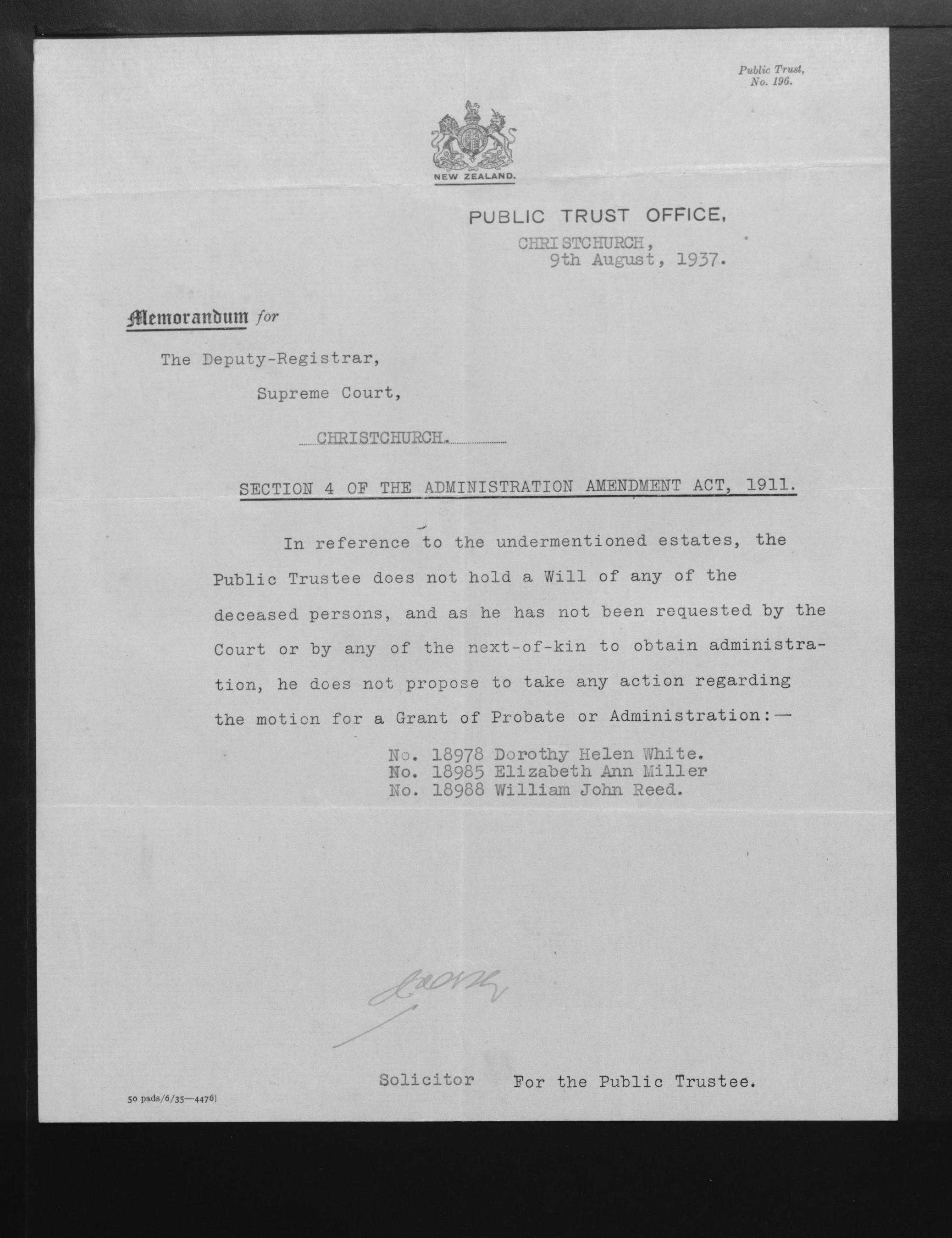
    Named as Dorothy’s father and as the person appointed to settle her estate.

    Open the estate papers ↓
  2. 1940Retired manufacturer

    A different description, suggesting business activity beyond the English shop.

    Open the newspaper record ↗
  3. 1953Retired storekeeper

    His will says that he had lived in Fendalton and later in Akaroa.

    Open his will below ↓
  4. 1965Retired mixed farmer

    The last description of his occupation completes a journey from shop counter to farmland.

    Open the cemetery record ↗

How the family’s position changed

Not rags to riches.
A move toward independence.

The British class system was complicated, and moving to New Zealand did not make it disappear. Occupation, property, control over one’s working day and even the part of a ship in which someone travelled all mattered. The family became more independent over time, but the records do not show inherited wealth or entry into the social elite.

01

Depending on daily wages

Patrick in Glasgow and William the carman earned their living through physical work. Their income depended on employers, available work and their health.

02

A recognised skill

Blacksmithing made Patrick a skilled tradesman and could bring more status and better pay than general labour. Railway reports still describe long hours, wage pressure and physically demanding work.

03

Running a business

A hotel, dairy farm or shop brought more control but also more financial risk. Patrick as hotel keeper and William Anthony as an independent newsagent dealt directly with customers and ran workplaces closely connected to their homes.

04

Public trust and modest property

Running a sub-post-office brought public responsibility. Later wills and property records show modest savings and assets: evidence of independence and respectability, but not a fortune.

Episode four

Lives interrupted.

Some of the clearest family records exist because something went wrong: a death, institutional care, war, an accident or a fire.

1876

Charlotte is born after her father’s death.

Charlotte Mountford was born after James Mountford died in October 1875. Later records show Charlotte and some of her siblings living with Sophia Sharpe. They are described at different times as boarded children or adopted daughters, while their mother, Charlotte Allam, was still alive and working in domestic service.

Financial hardship probably separated the family, but the records do not tell us whether there was a legal adoption or how those involved felt about the arrangement.

Open the 1881 census Open the 1891 census
1898

Fire takes Patrick’s Halswell home.

A newspaper reported that his six-room house was destroyed in March 1898 and that nothing was saved. The building was insured for £120 and the furniture for £70, although we do not know whether this covered the full loss.

Open the newspaper report
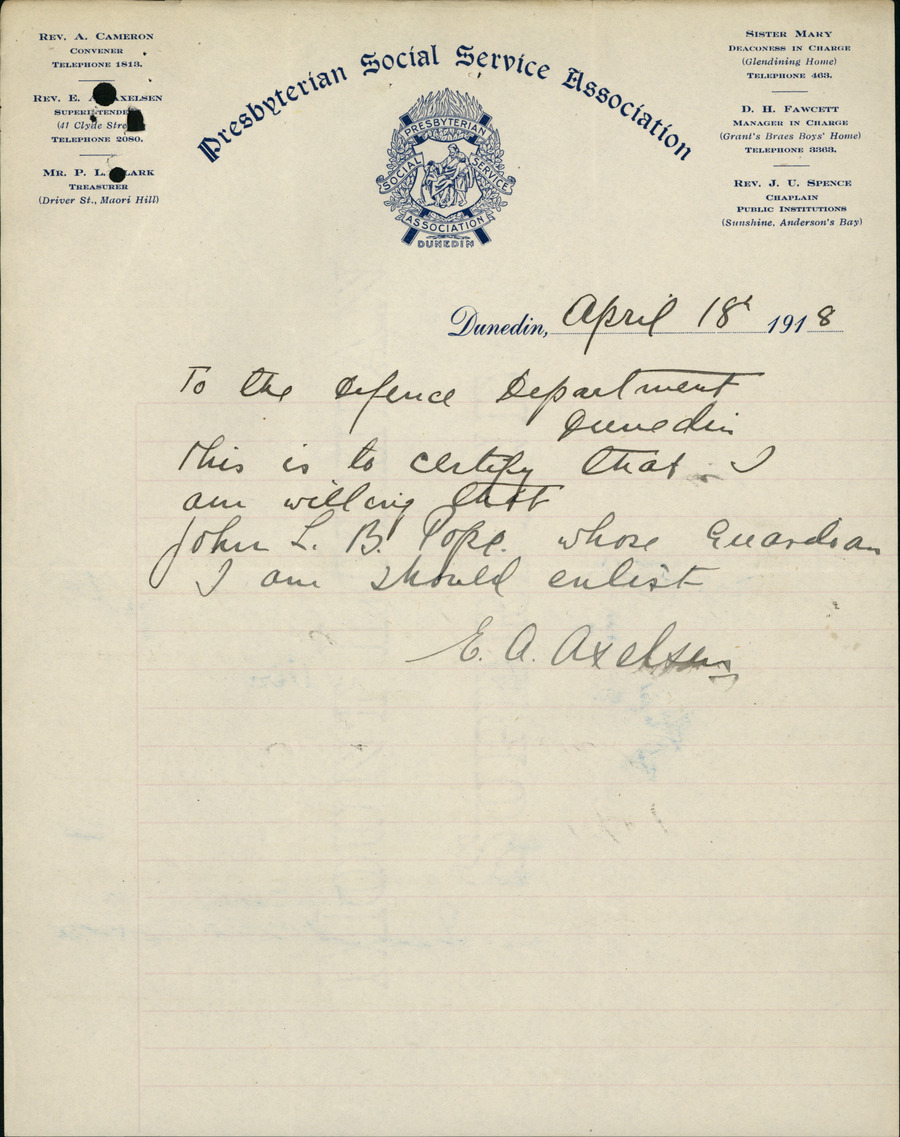
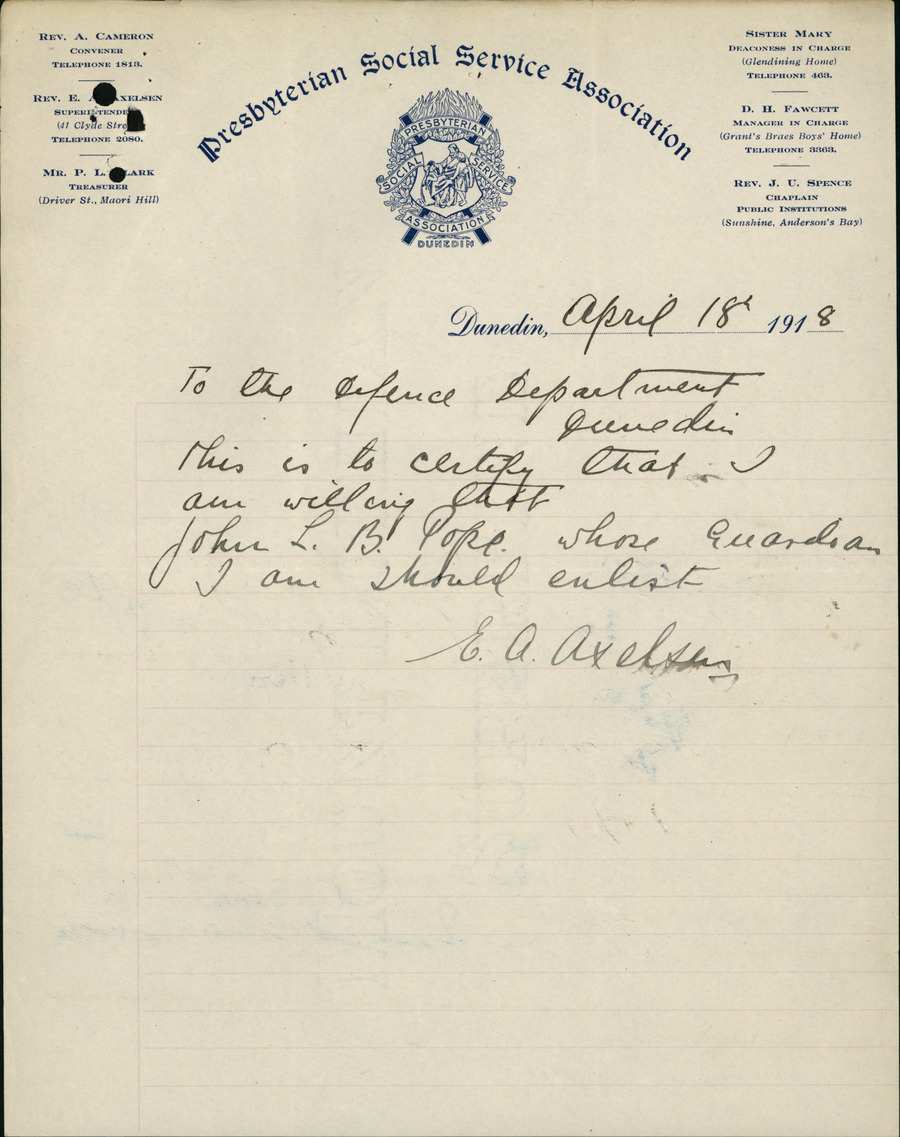
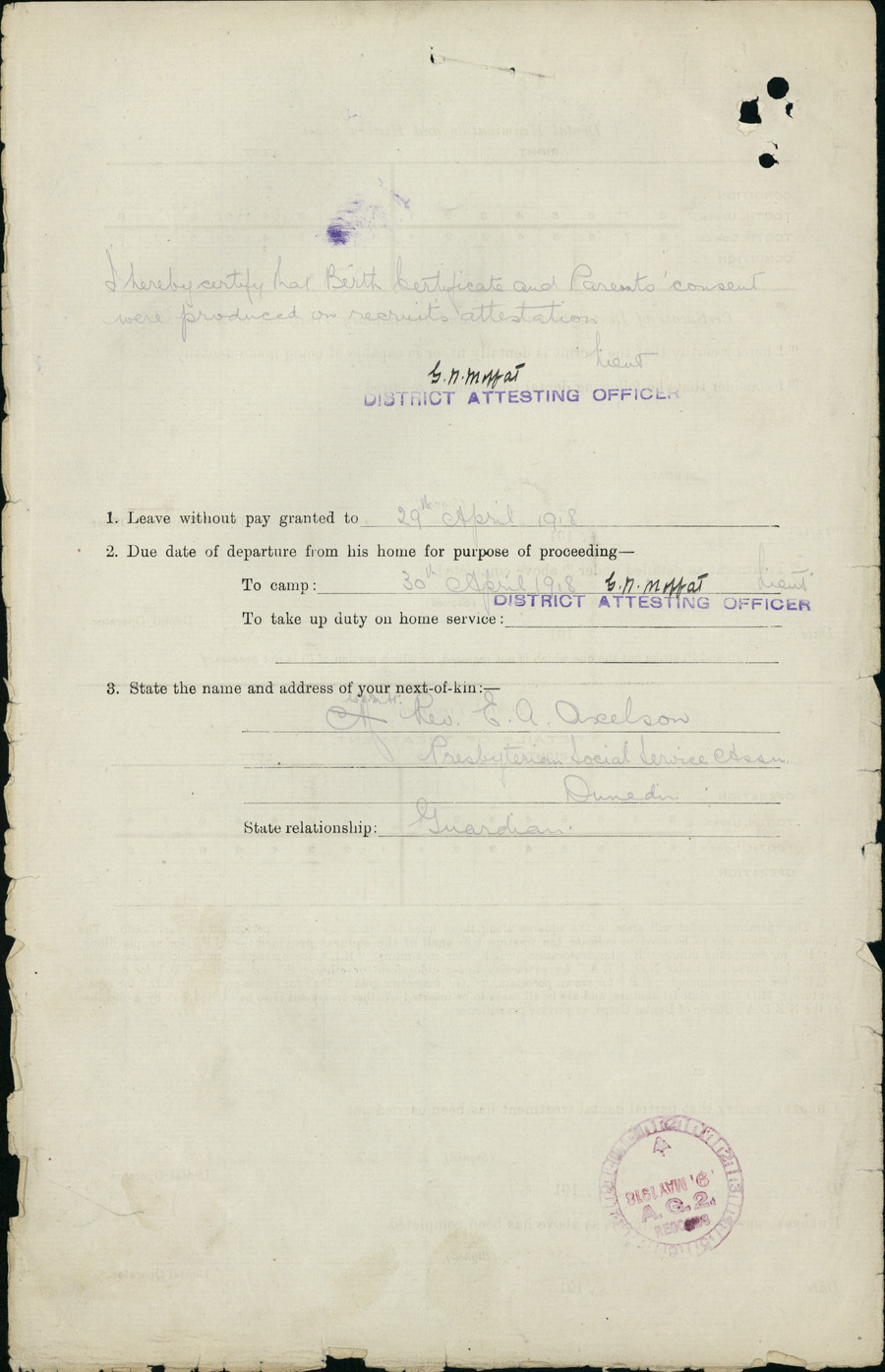
1918 guardian letter concerning John Lawrence Benson Pope
1918

A guardian writes for John.

Rev. E. C. Axelson of the Presbyterian Social Service Association supported John Lawrence Benson Pope’s enlistment and called himself John’s guardian. This one letter confirms that the welfare organisation had a formal role in John’s young life.

Open the letter below
1930

David’s final years, handled with care.

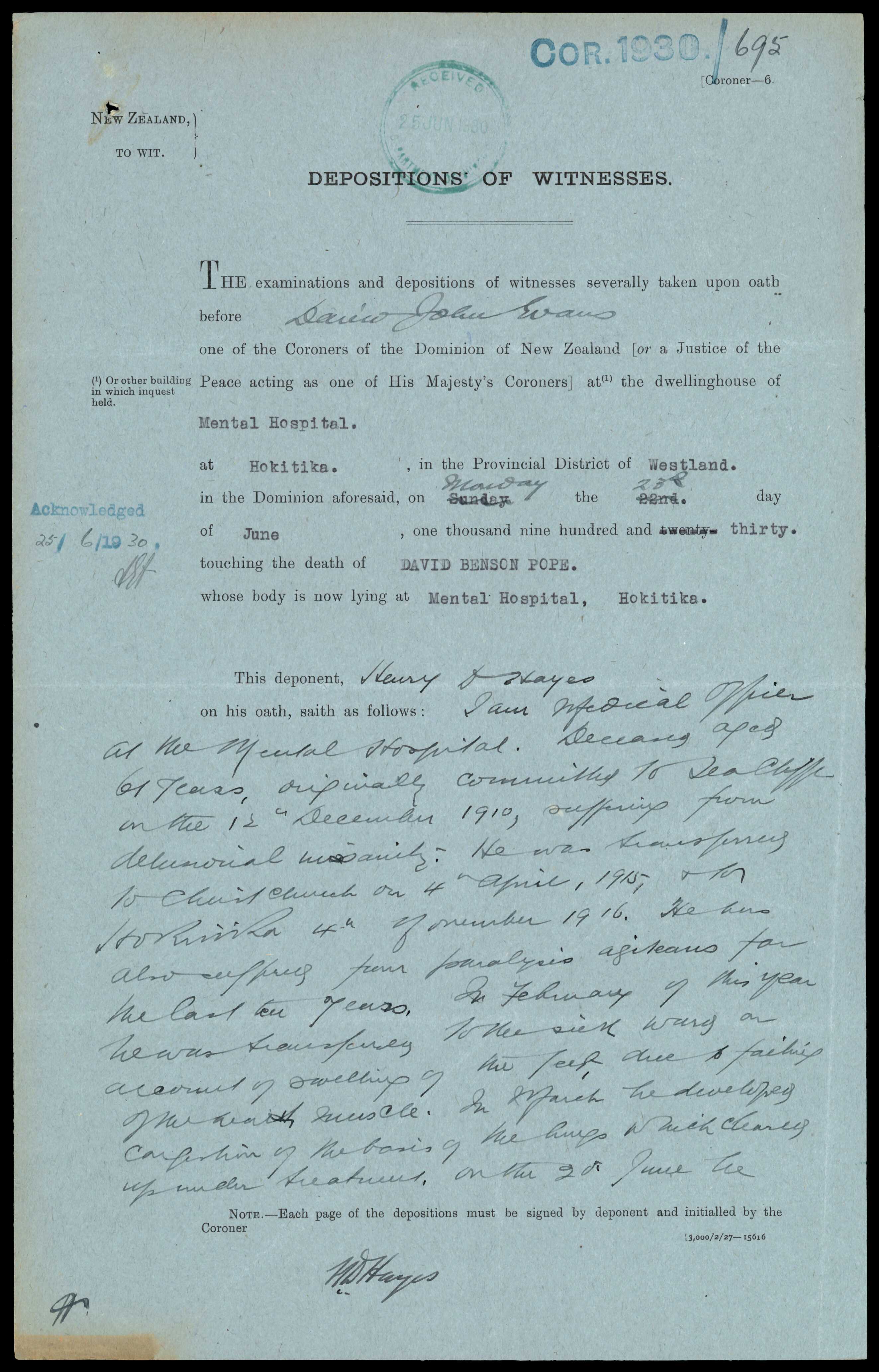
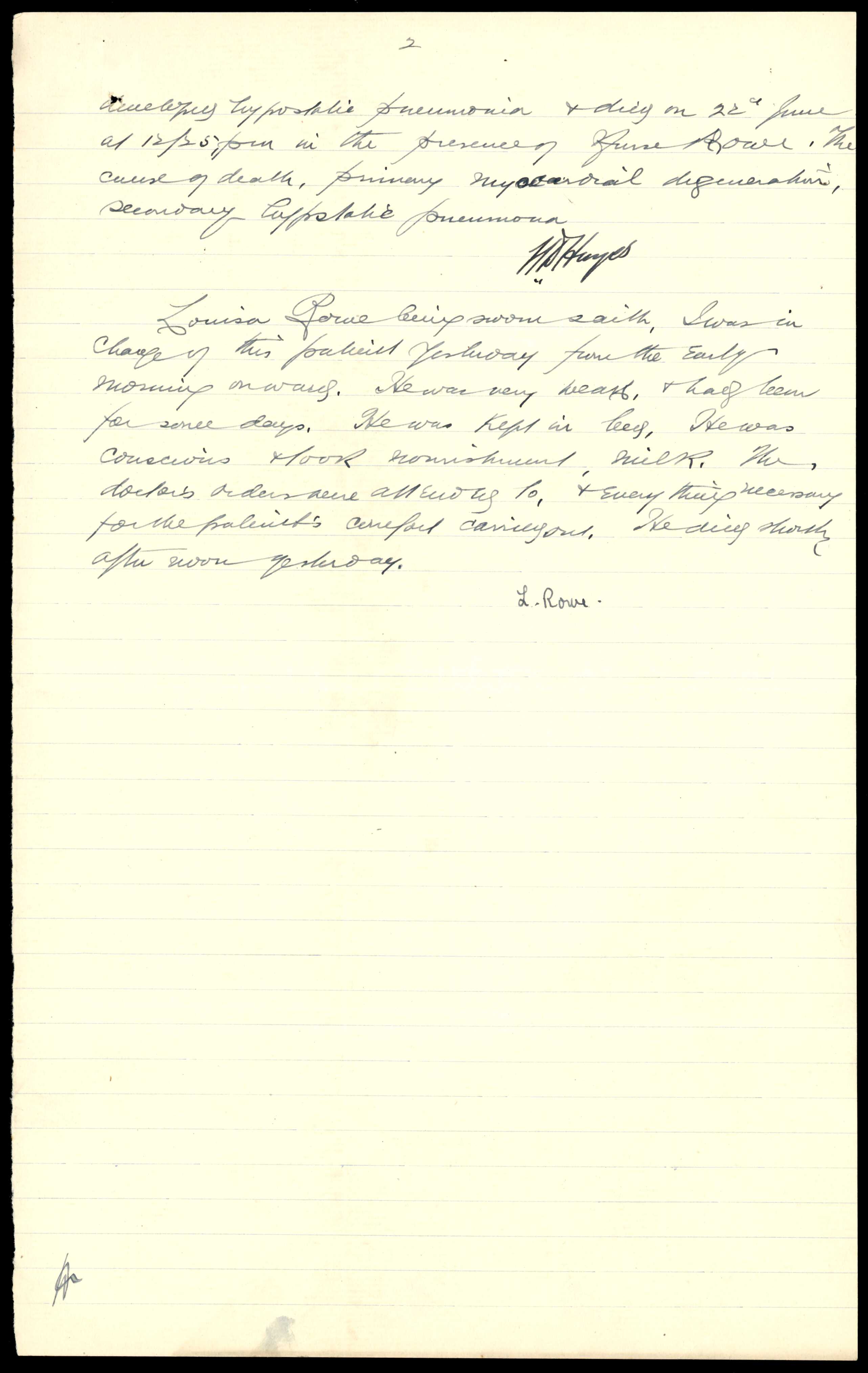
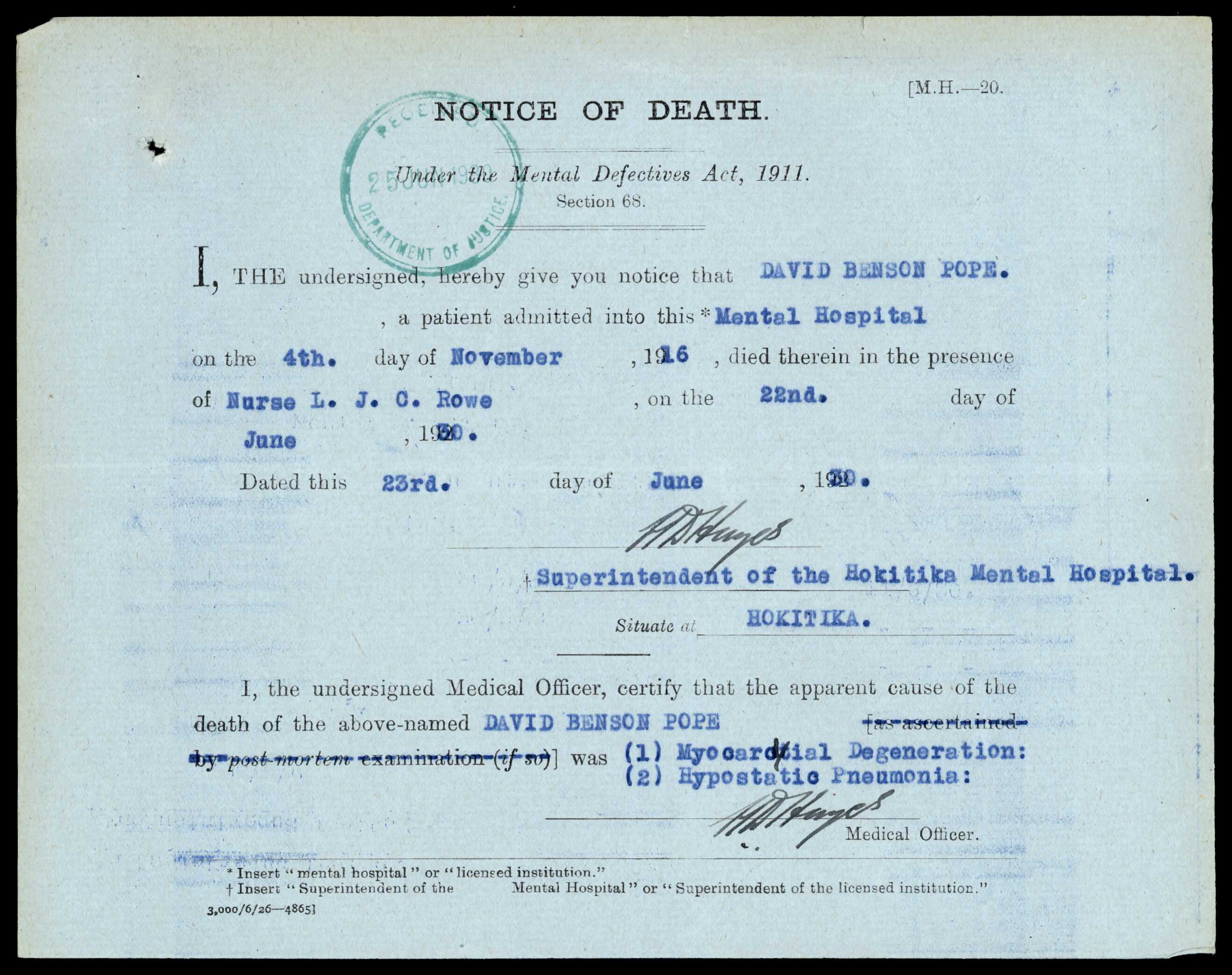
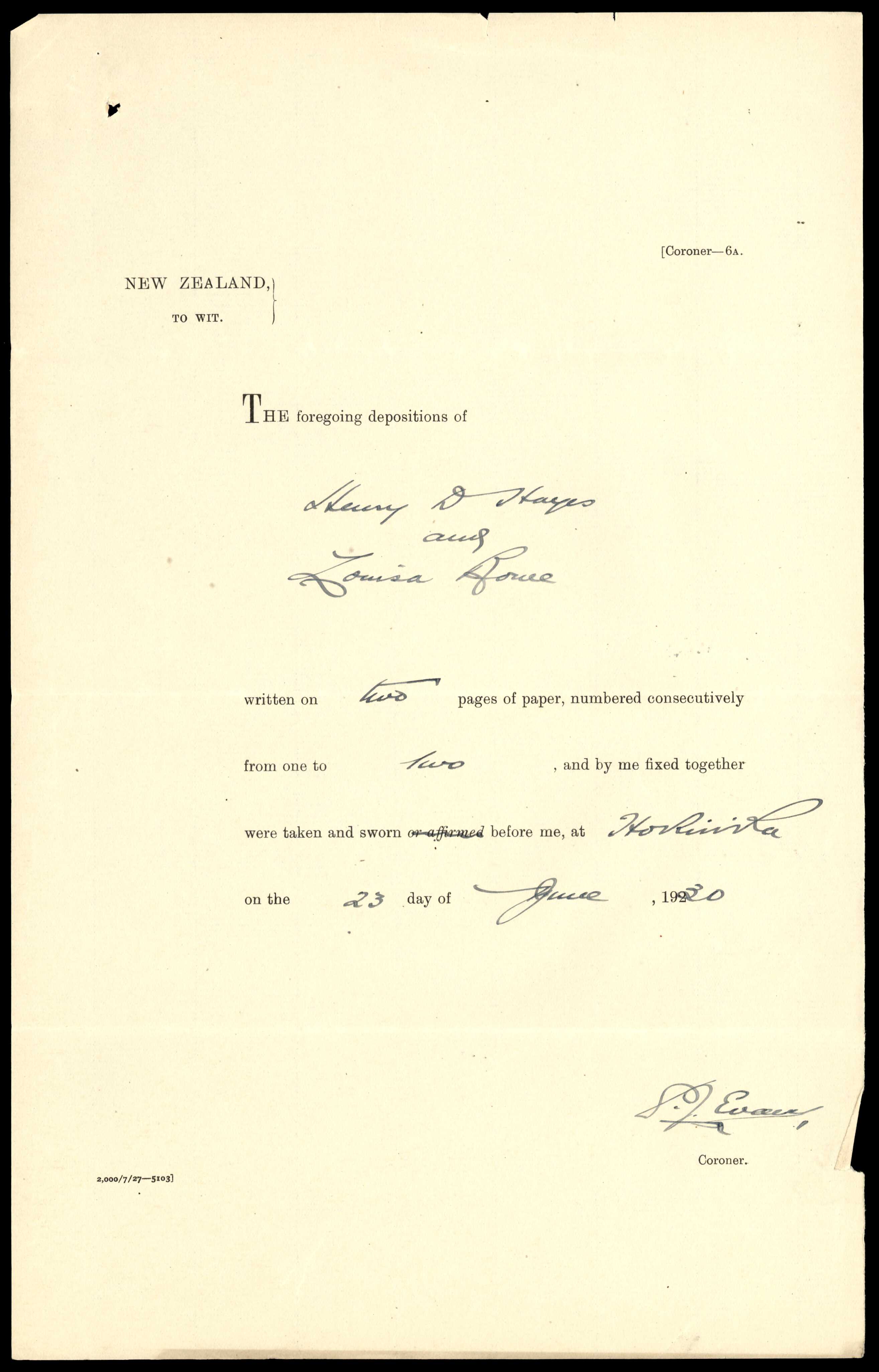
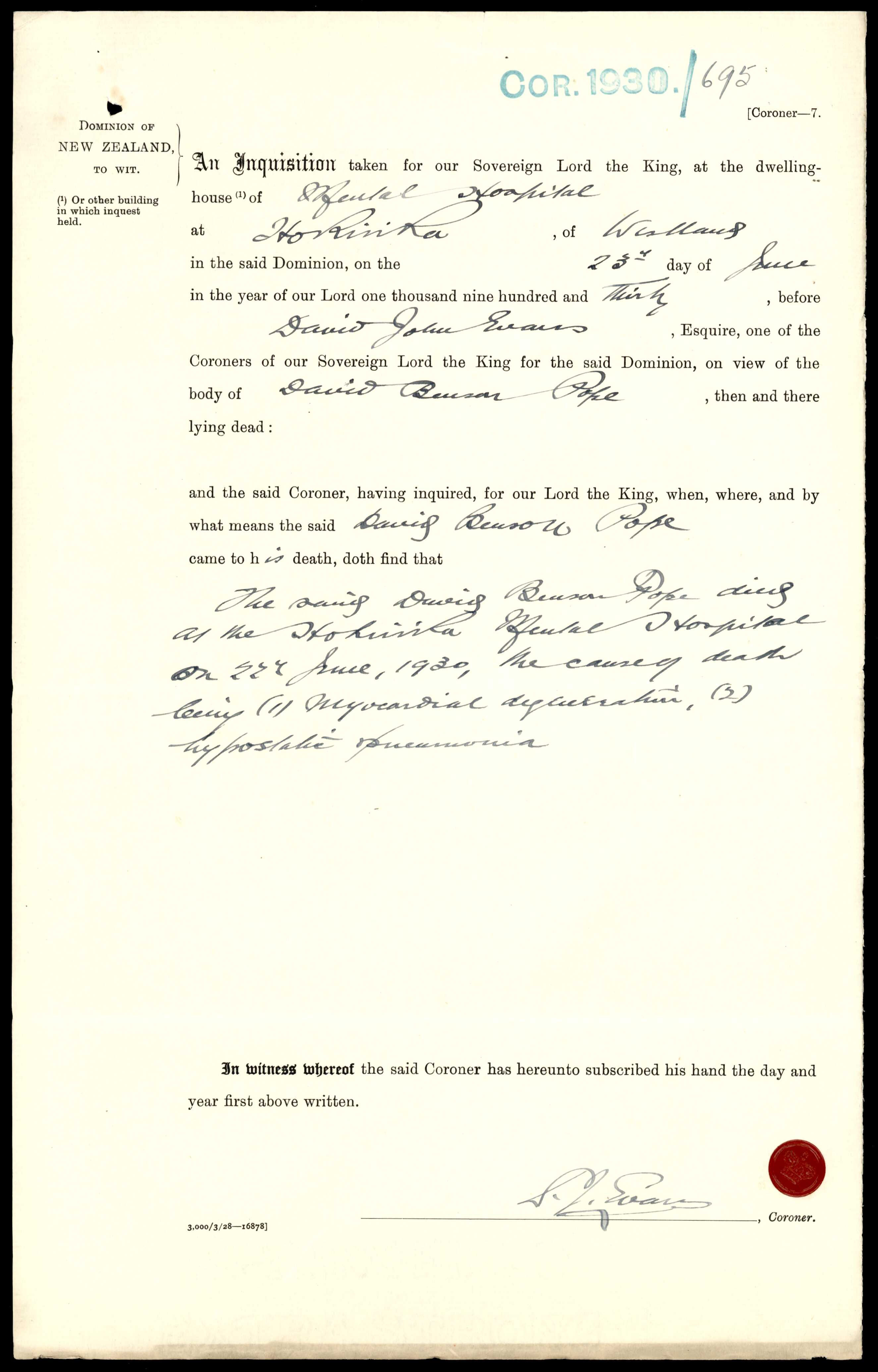
David Benson Pope’s coroner’s file says that he lived in institutional care from 1910 and died at Hokitika Mental Hospital on 22 June 1930. Its medical language reflects the period in which it was written. A family story says that David was deliberately harmed after questioning bridge foundations. Public records support the fact that he raised an engineering objection, but not the claim that anyone retaliated against him.

Open the coroner’s file

Episode five · a life rediscovered

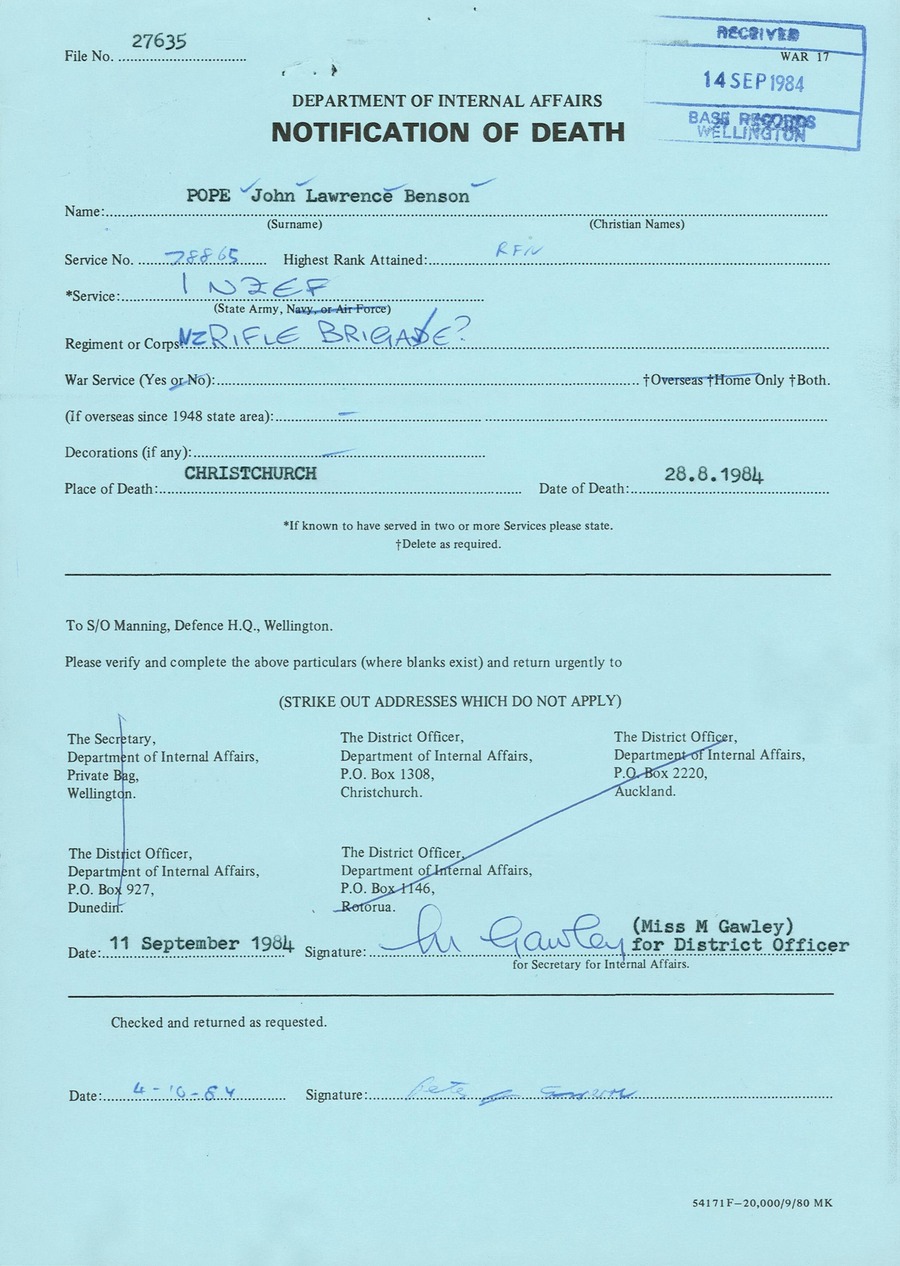
John Lawrence
Benson Pope

Soldier, amateur actor, radio narrator, Labour candidate, Theosophical lecturer and Liberal Catholic priest. No single document tells the whole story. It emerges only when hundreds of brief notices are brought together.

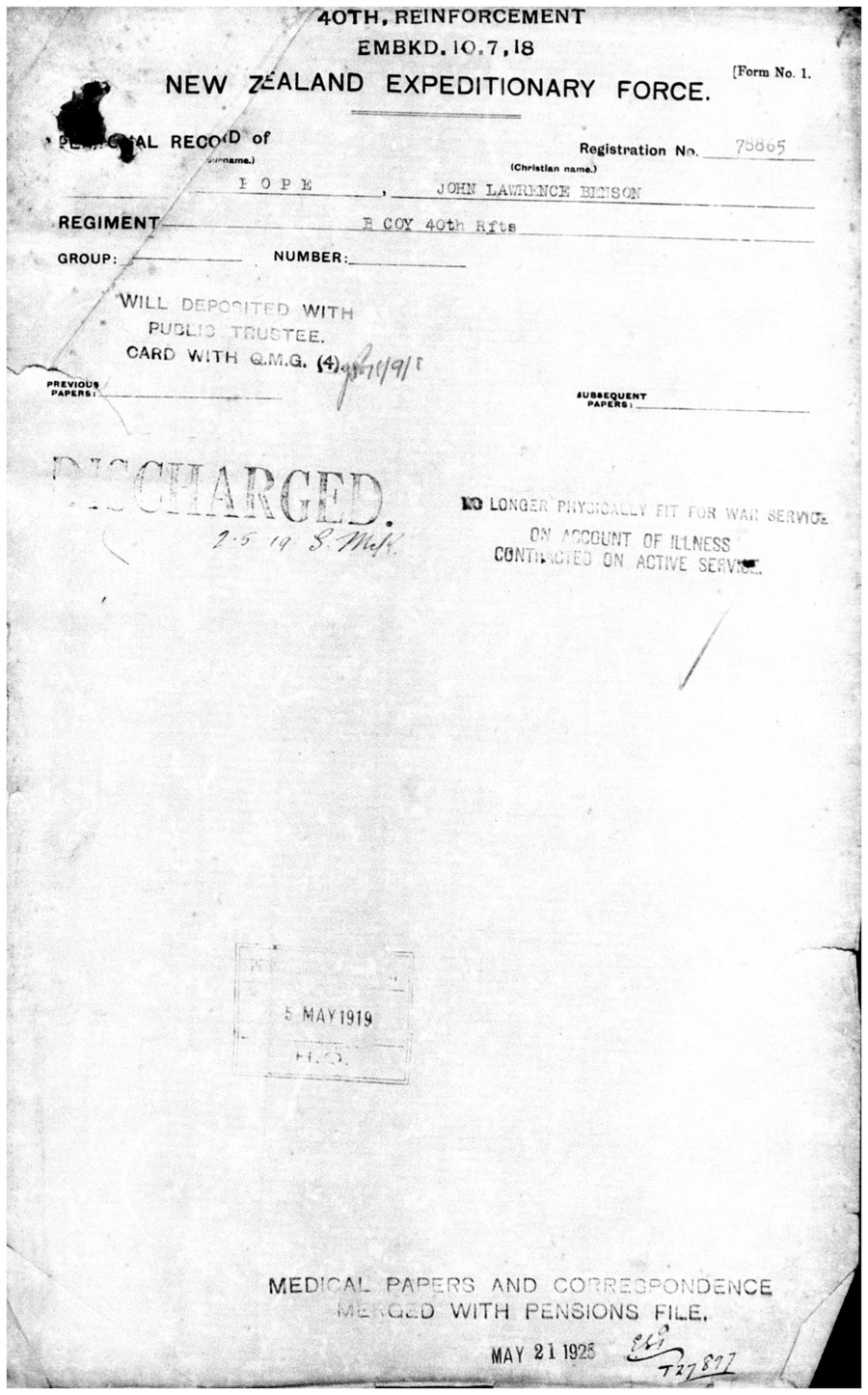
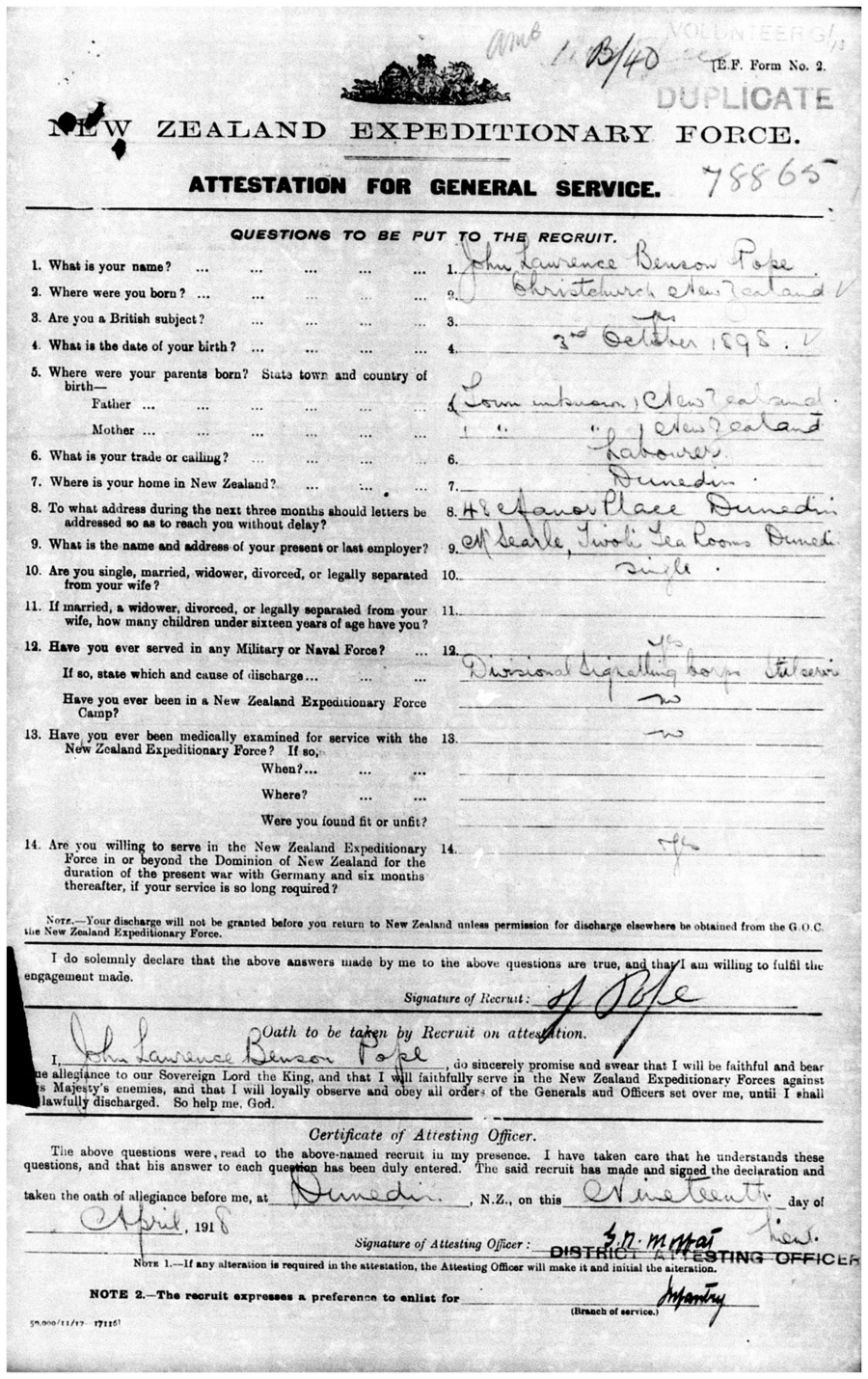
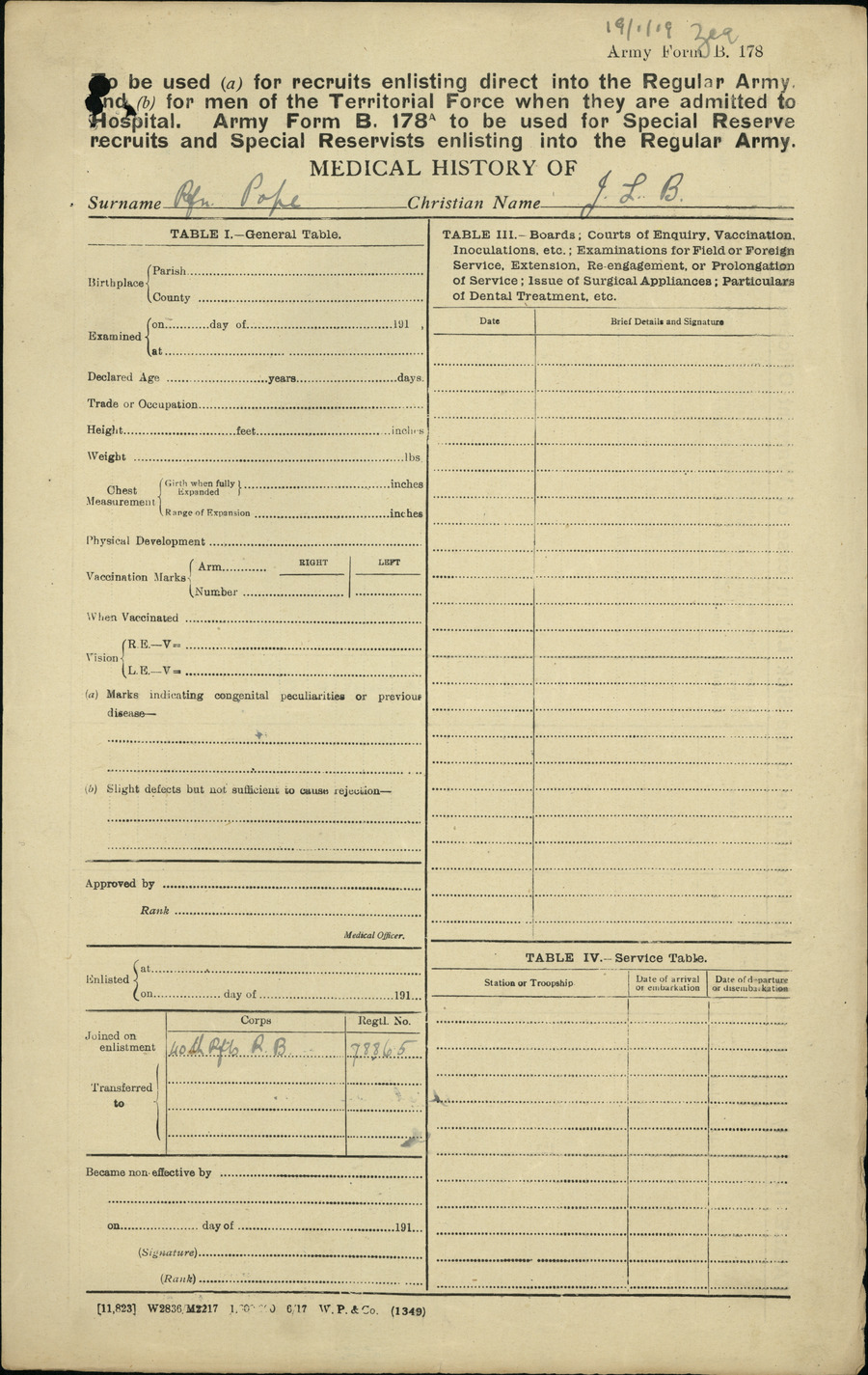
78865

First World War service number

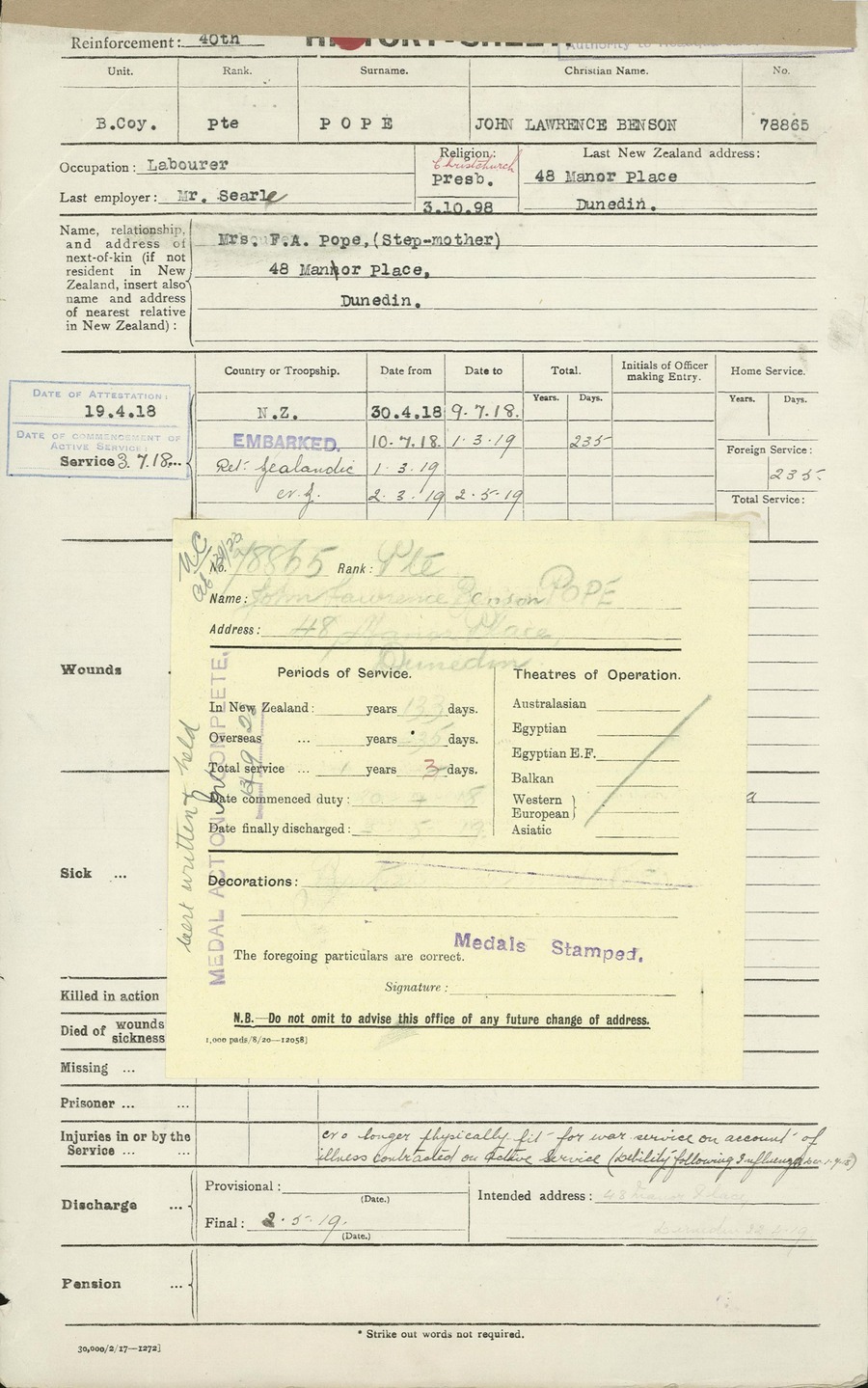
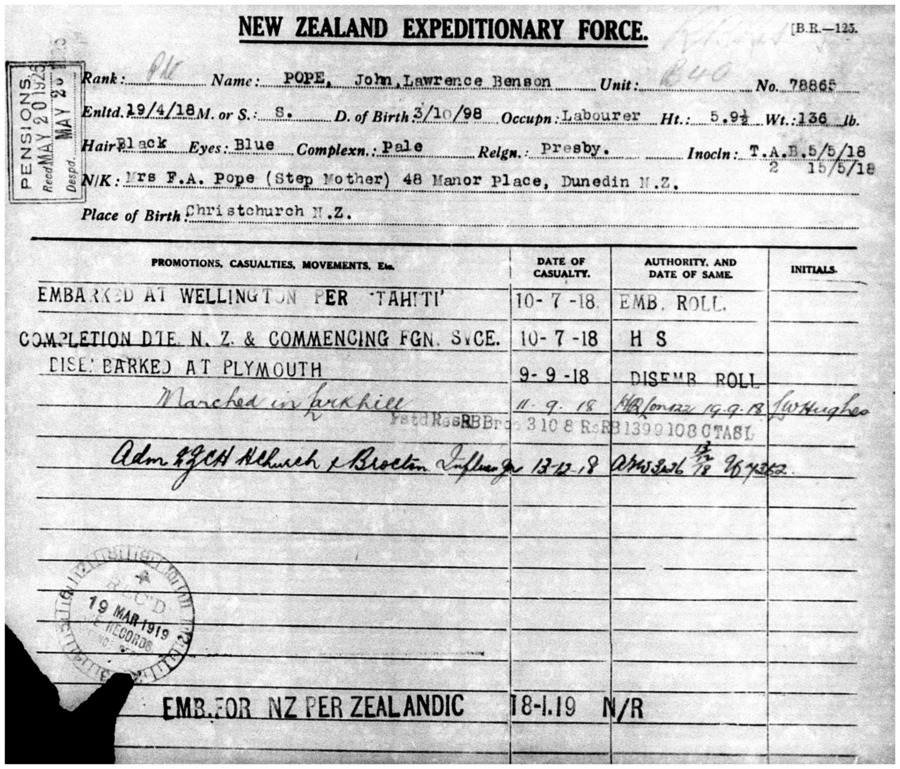
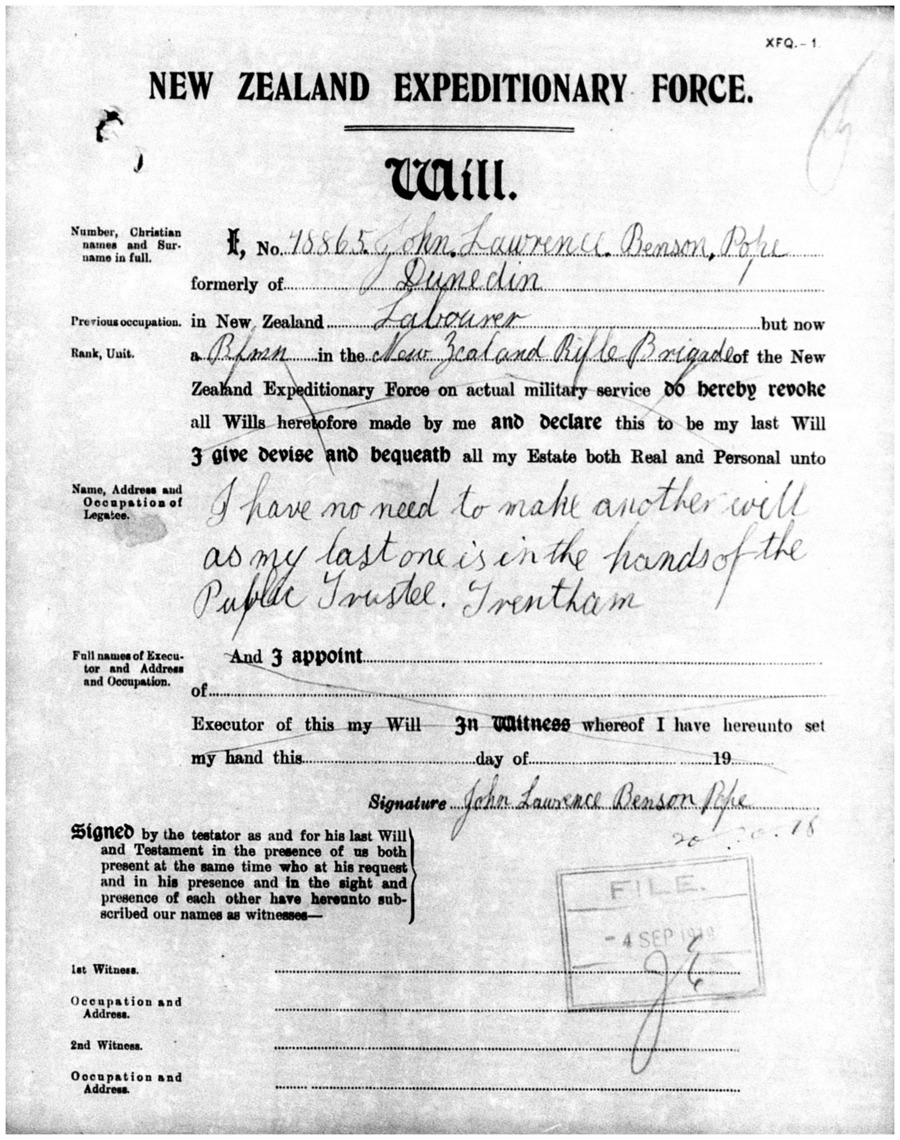
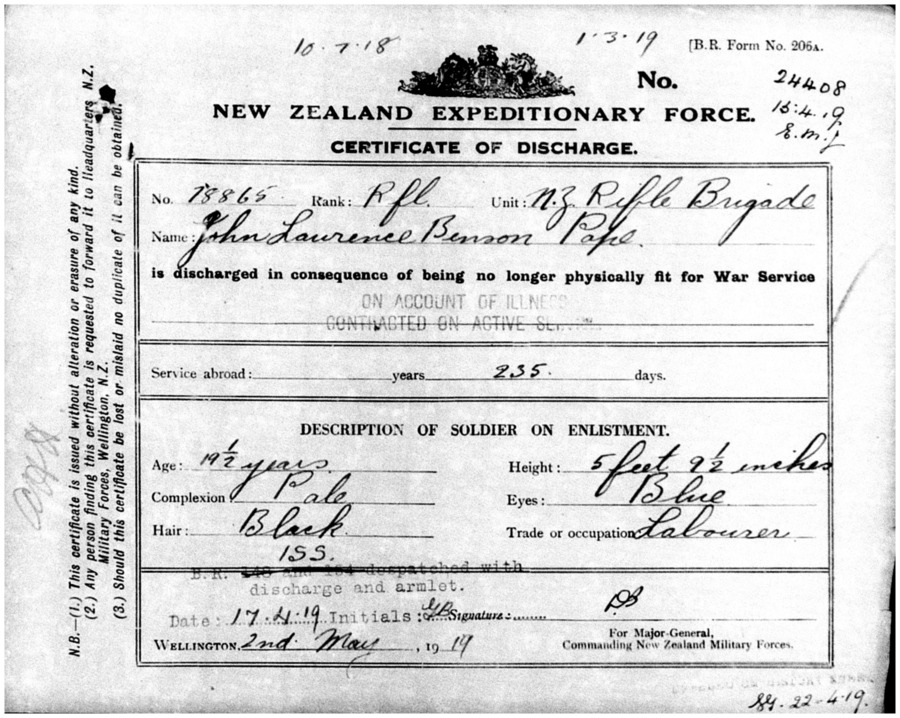
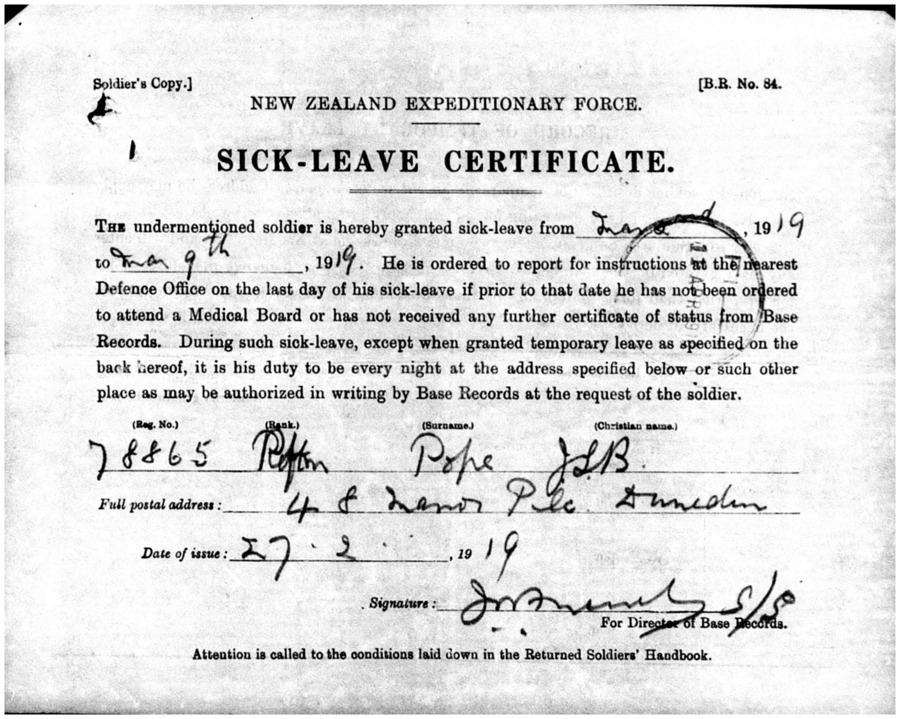
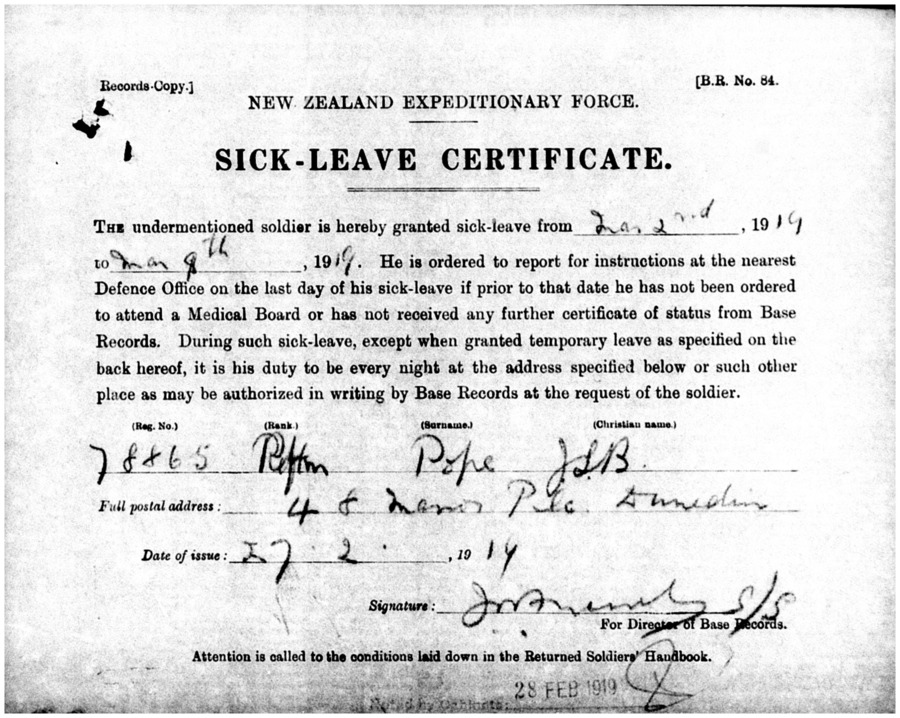
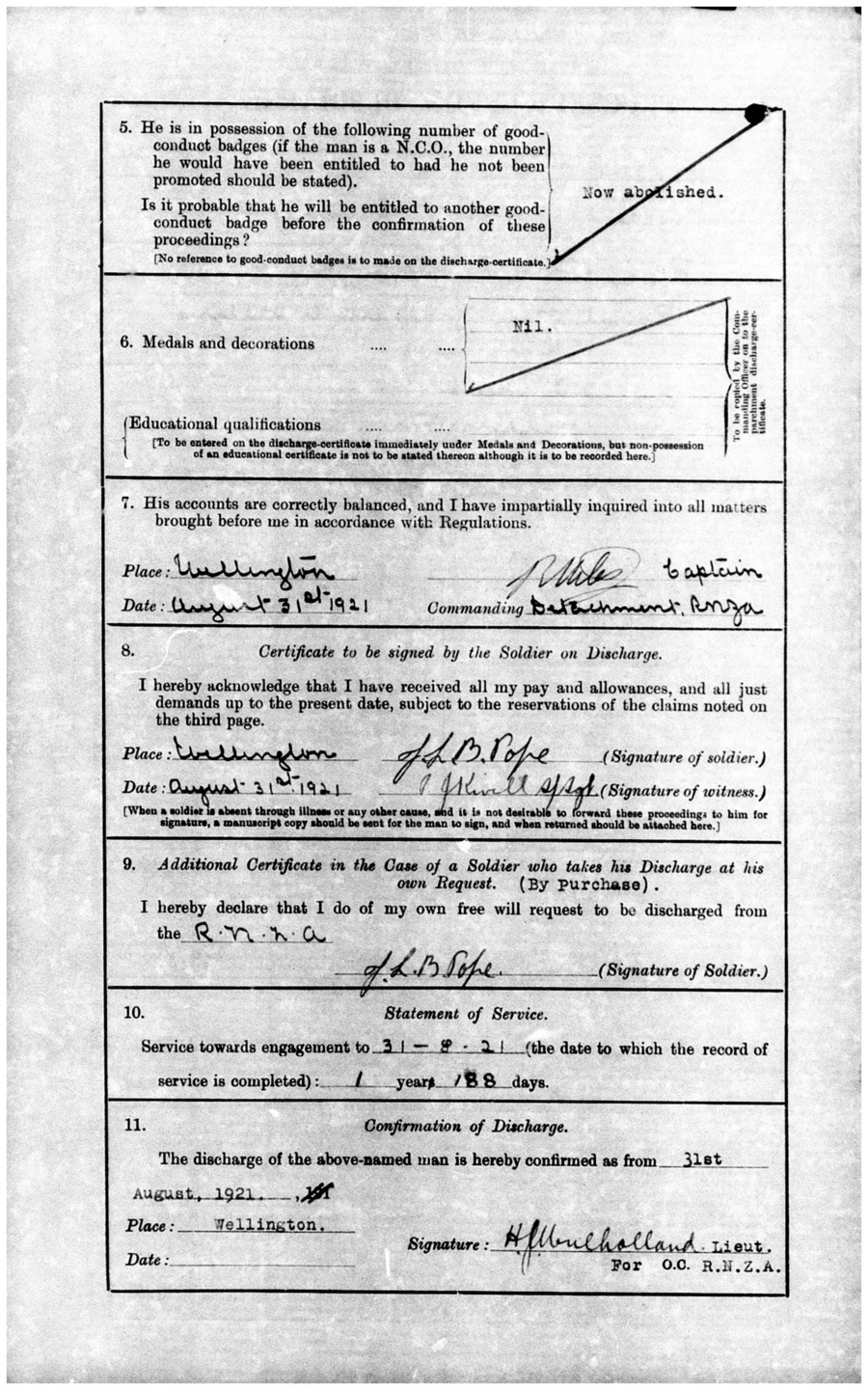
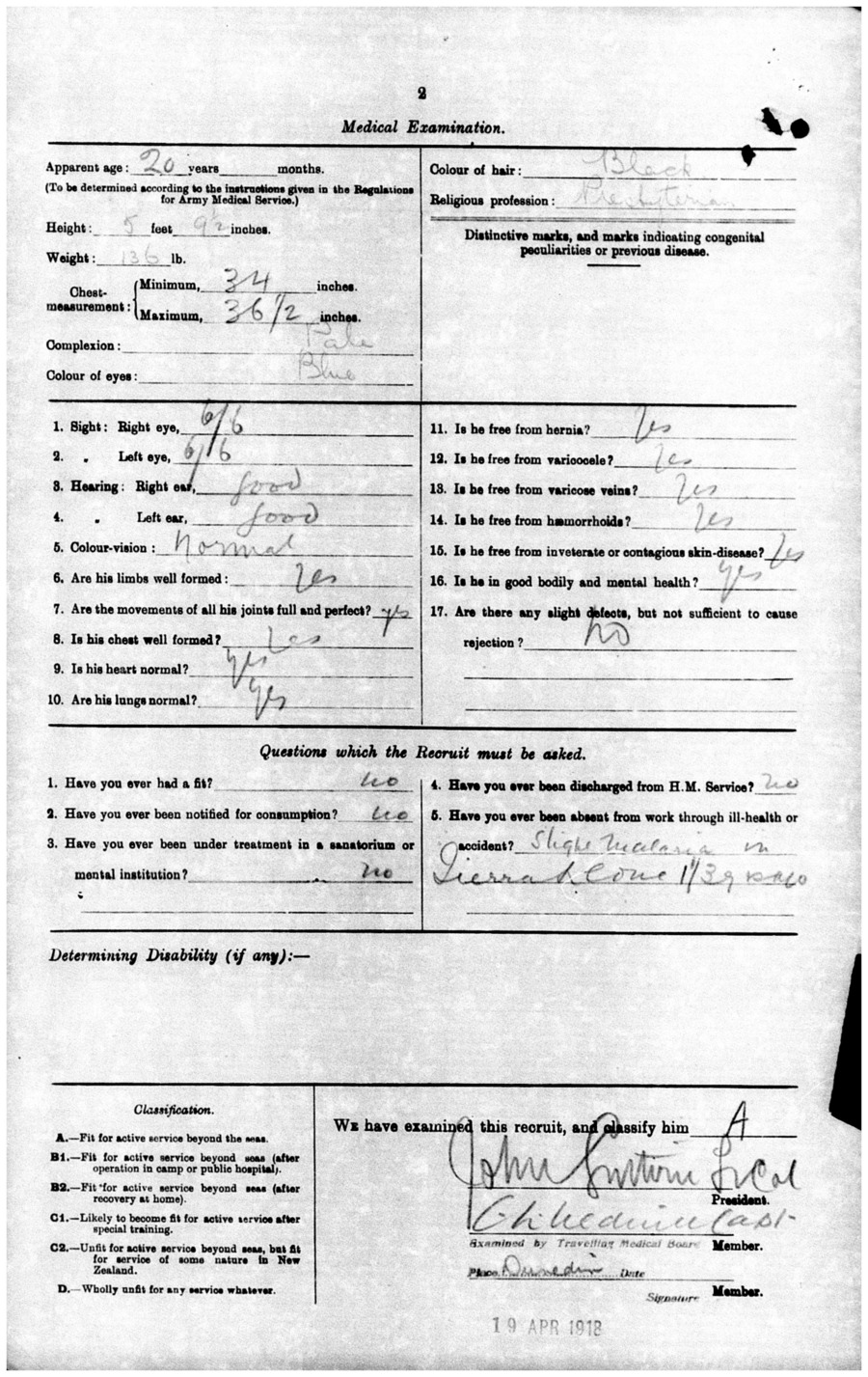
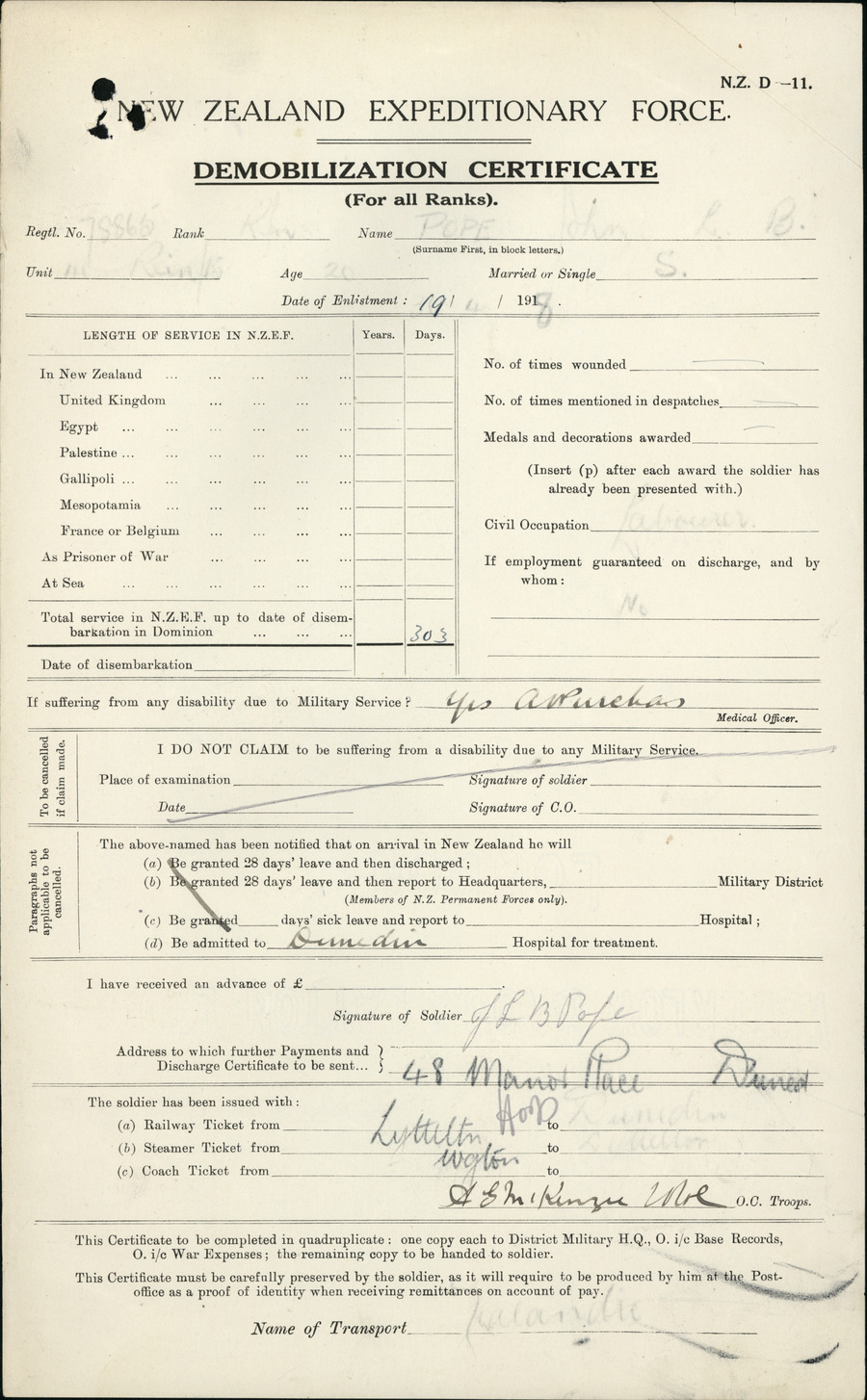
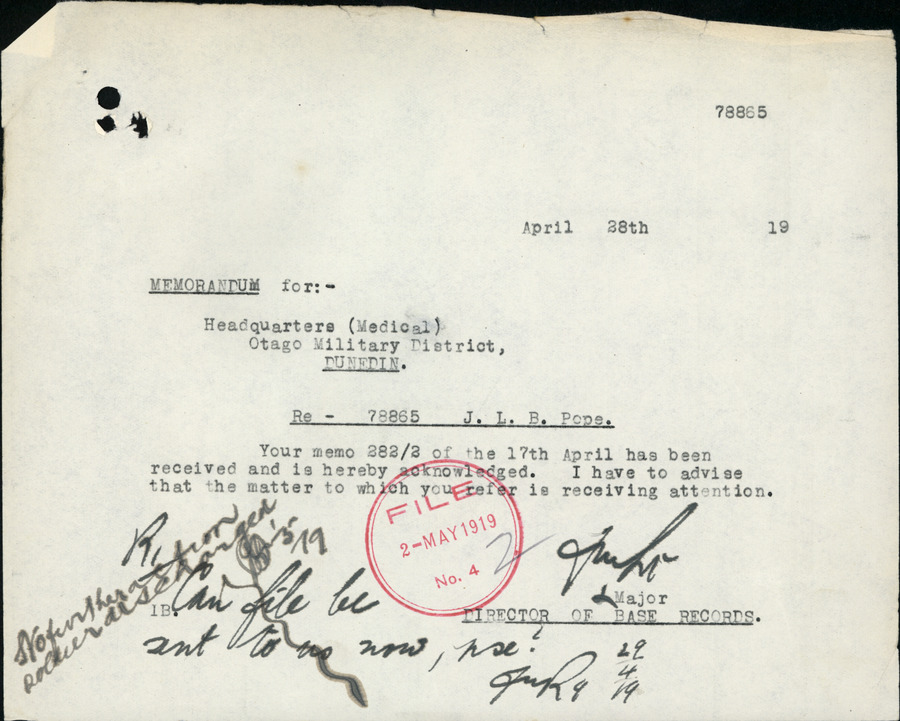
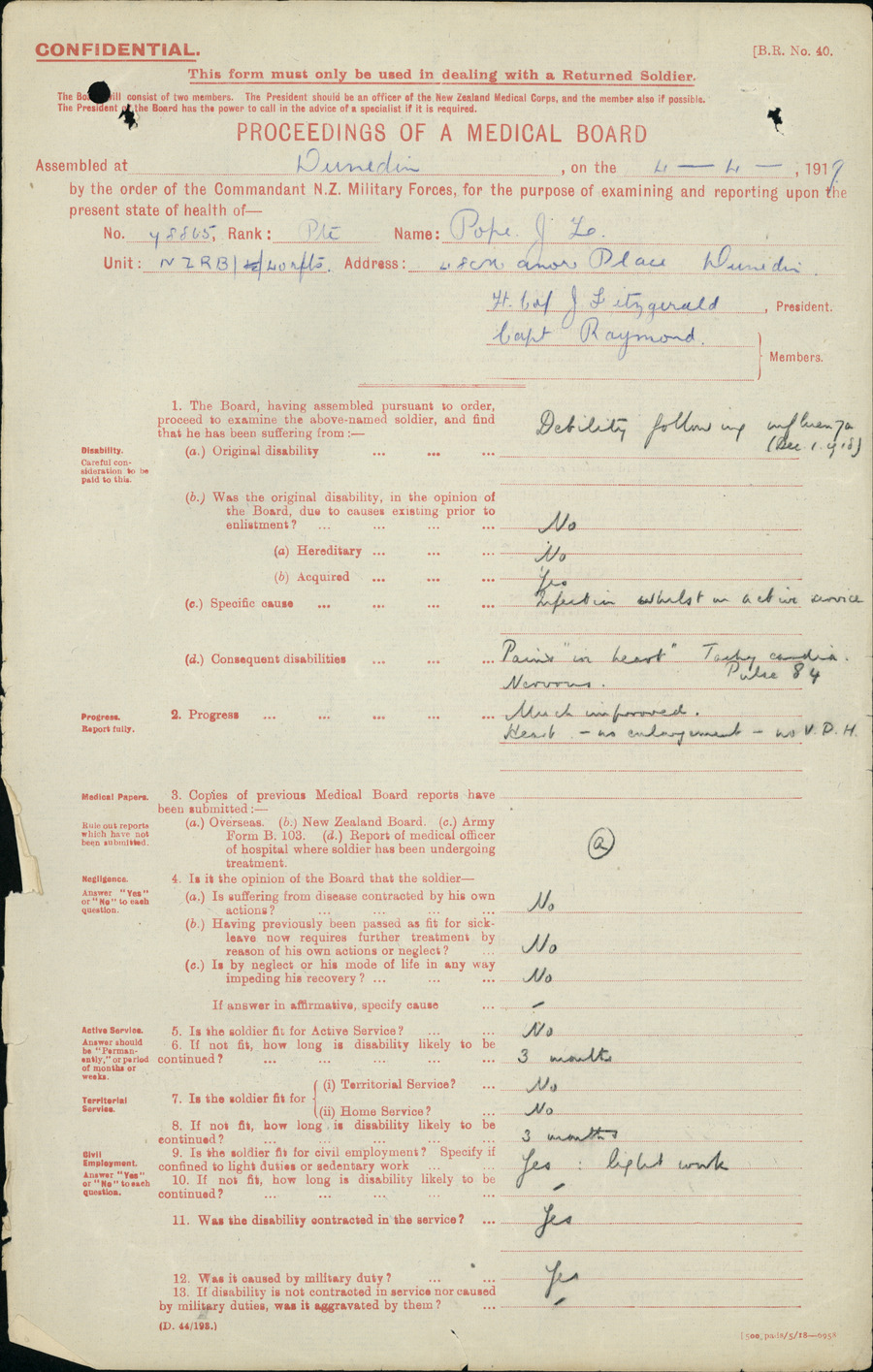
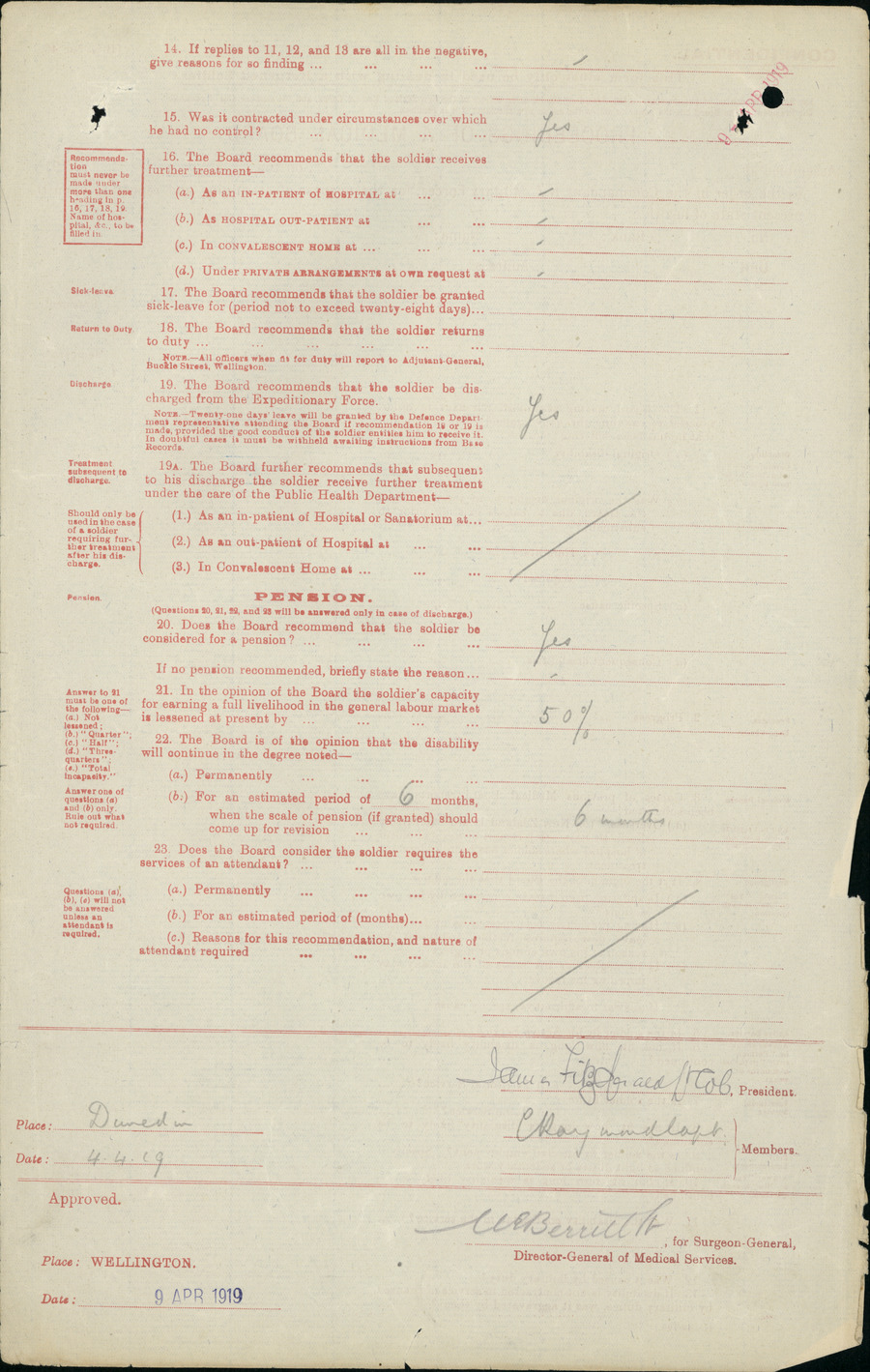
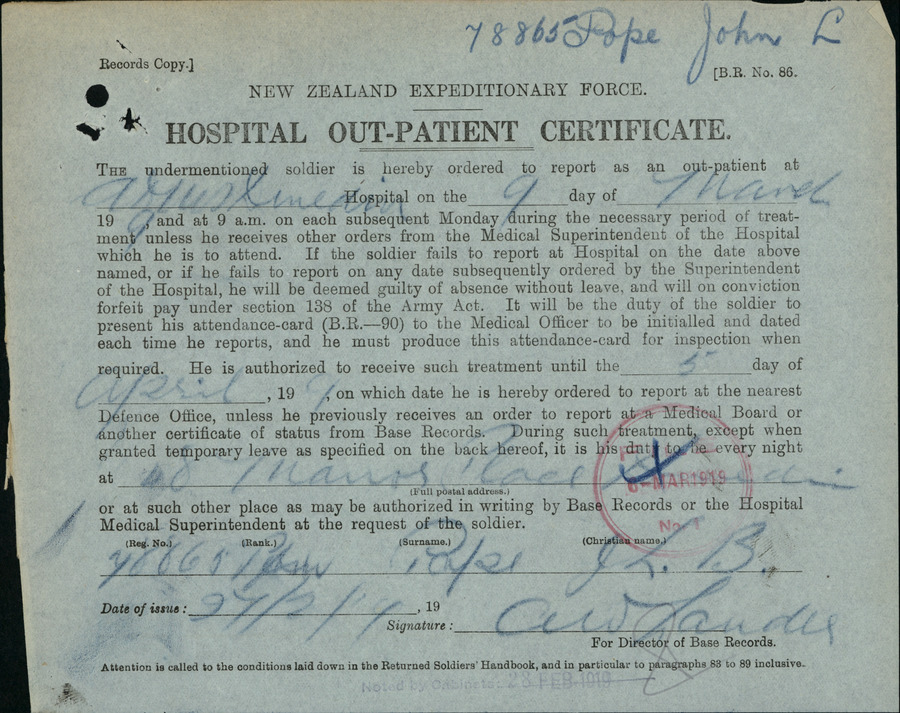
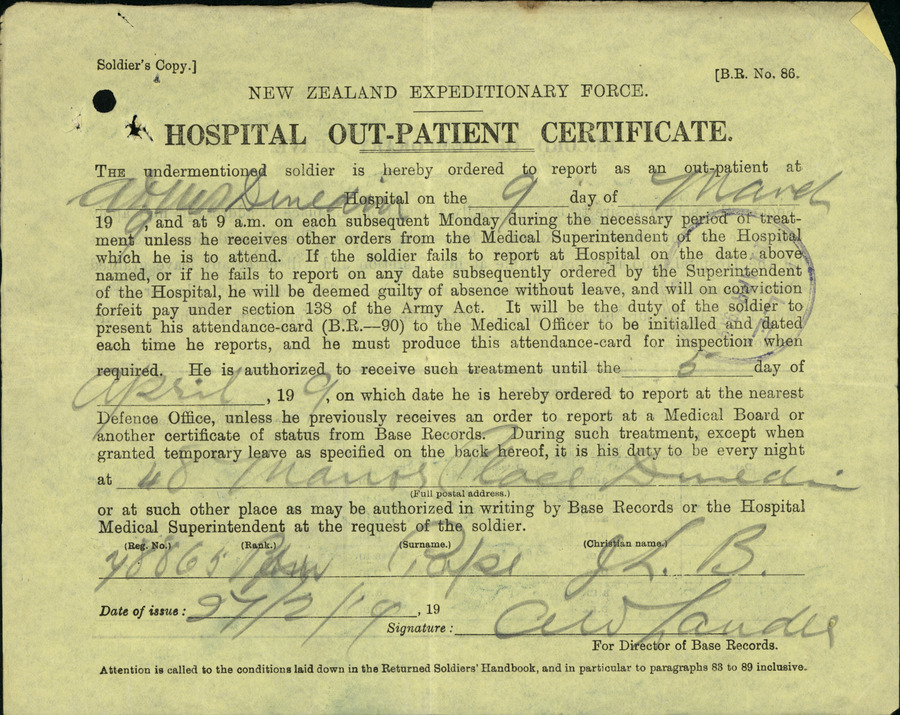
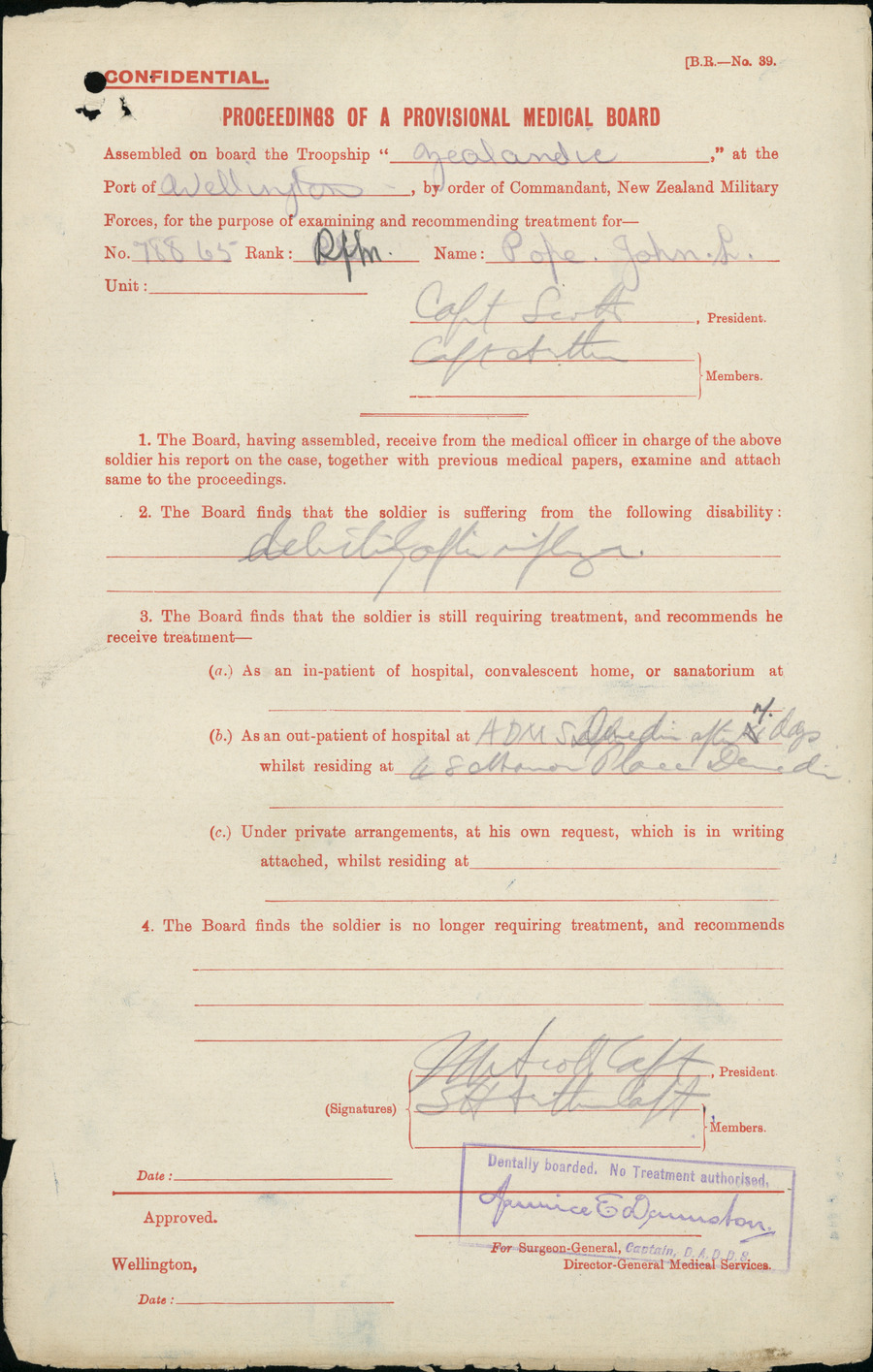
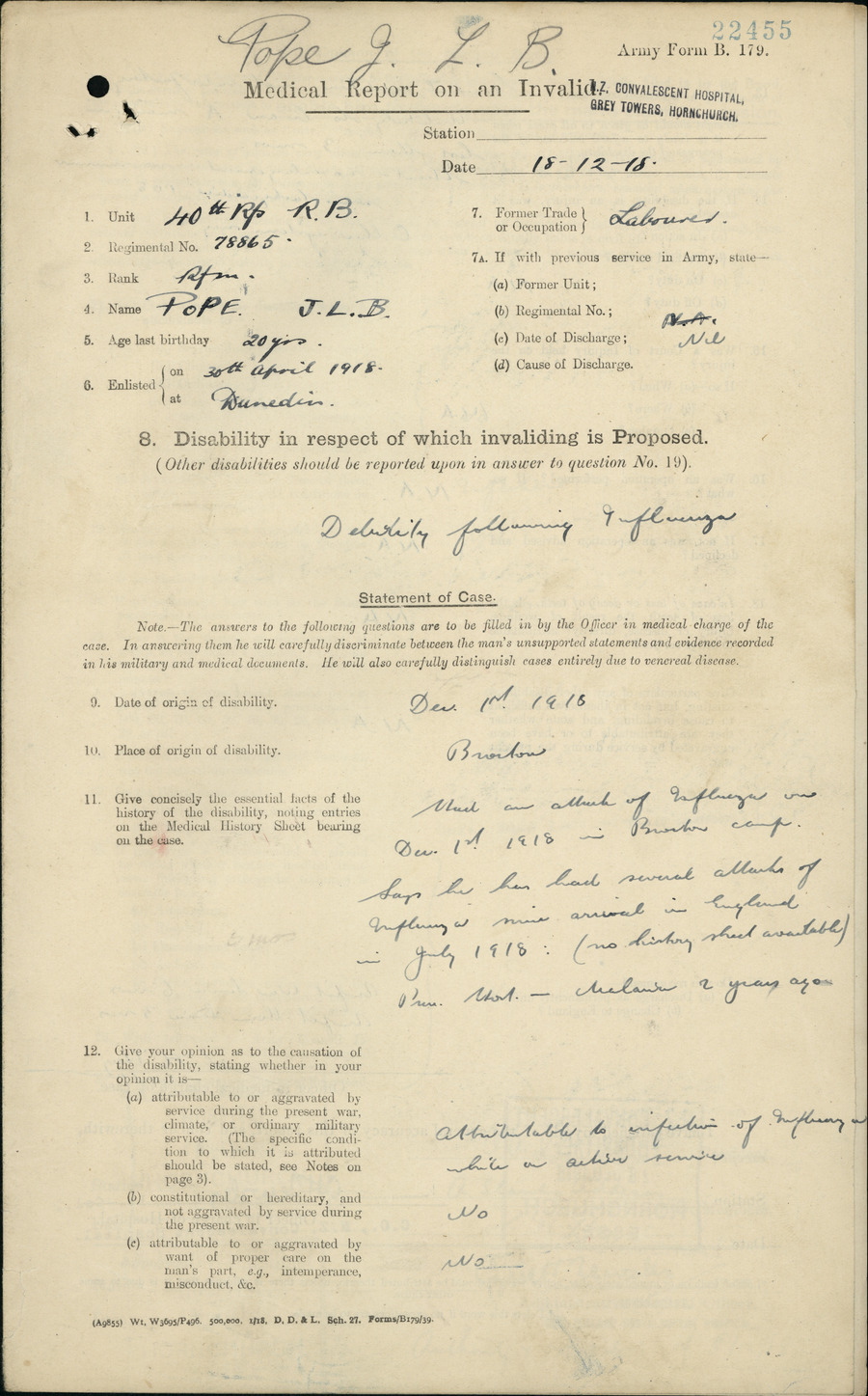
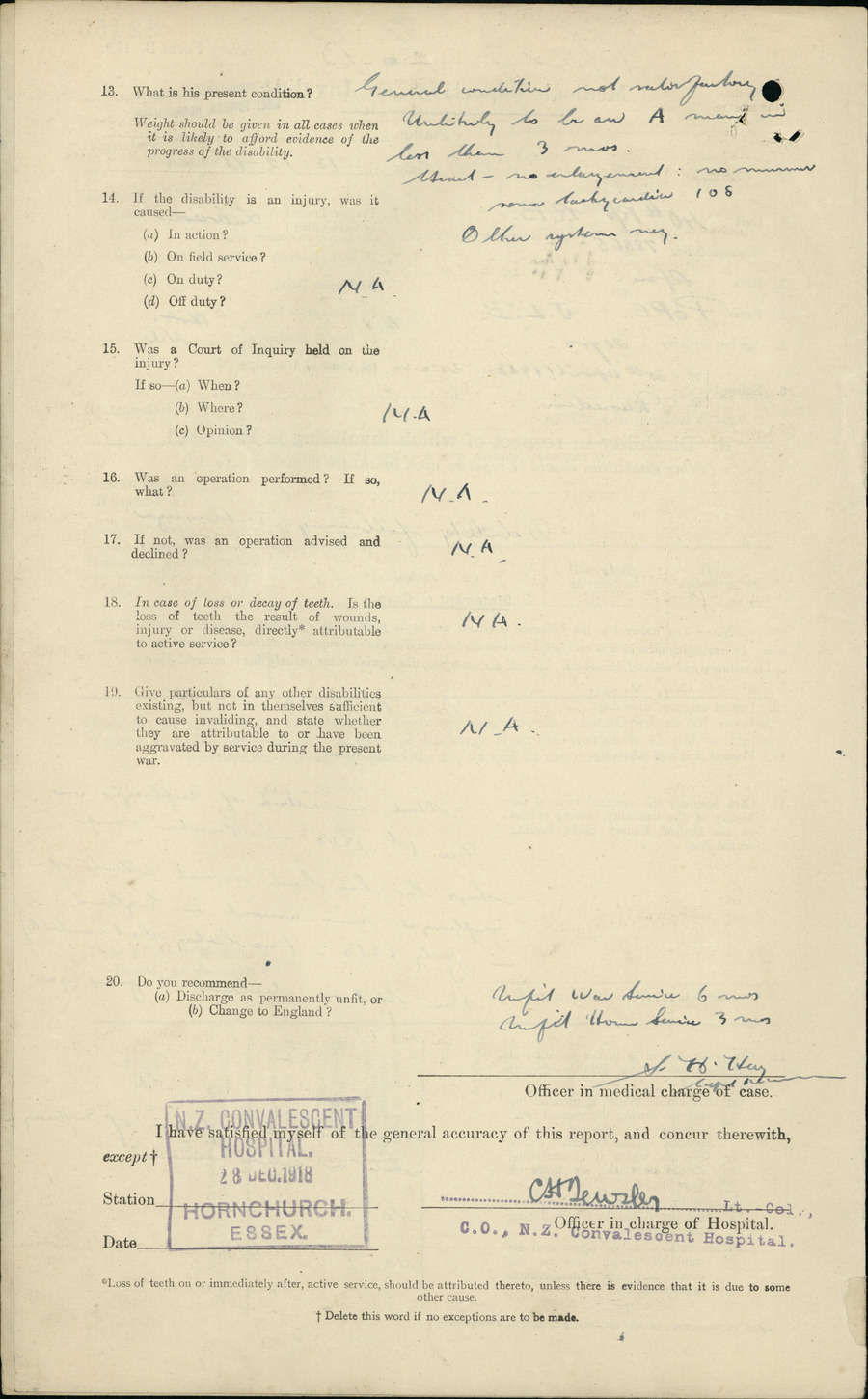
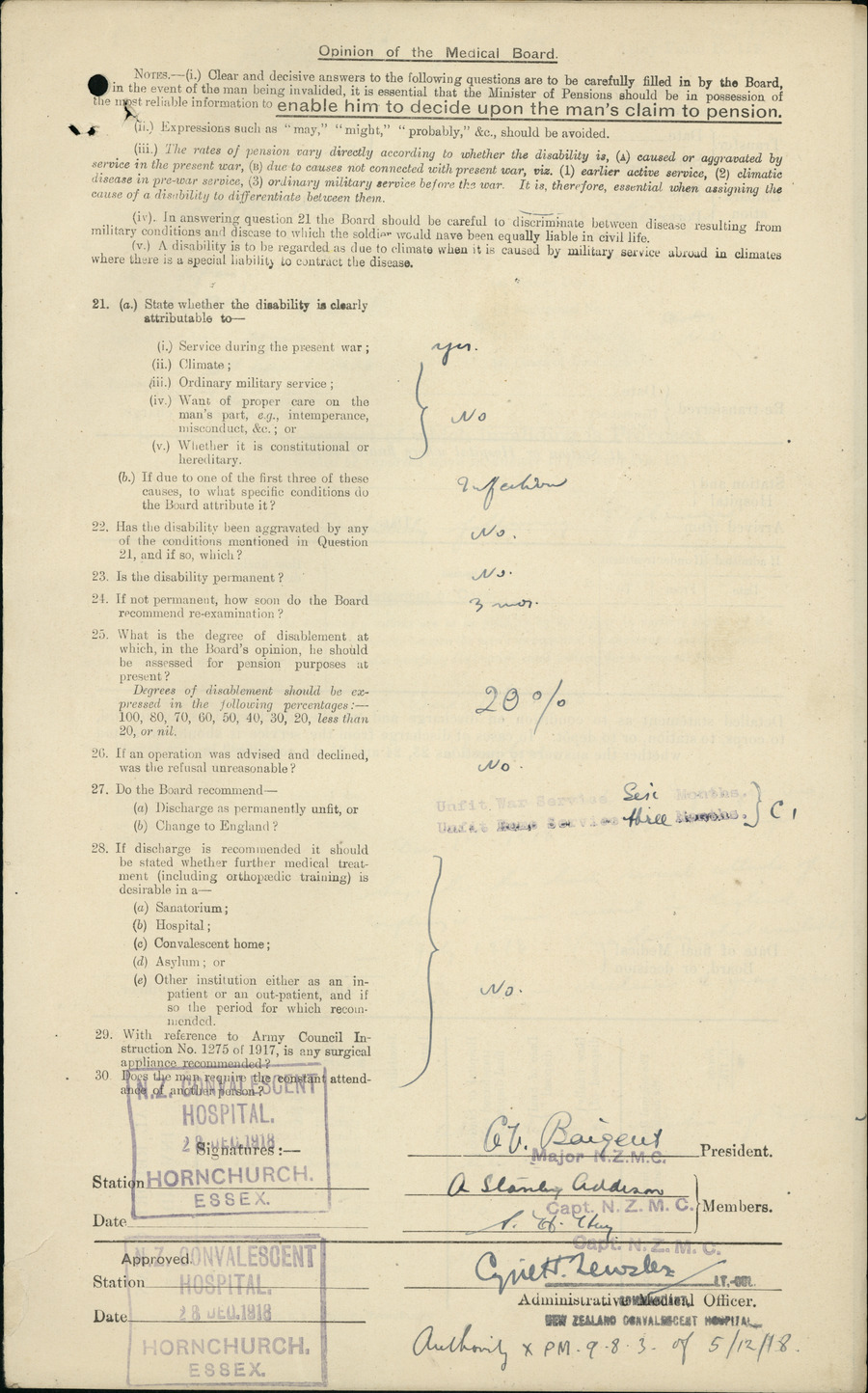
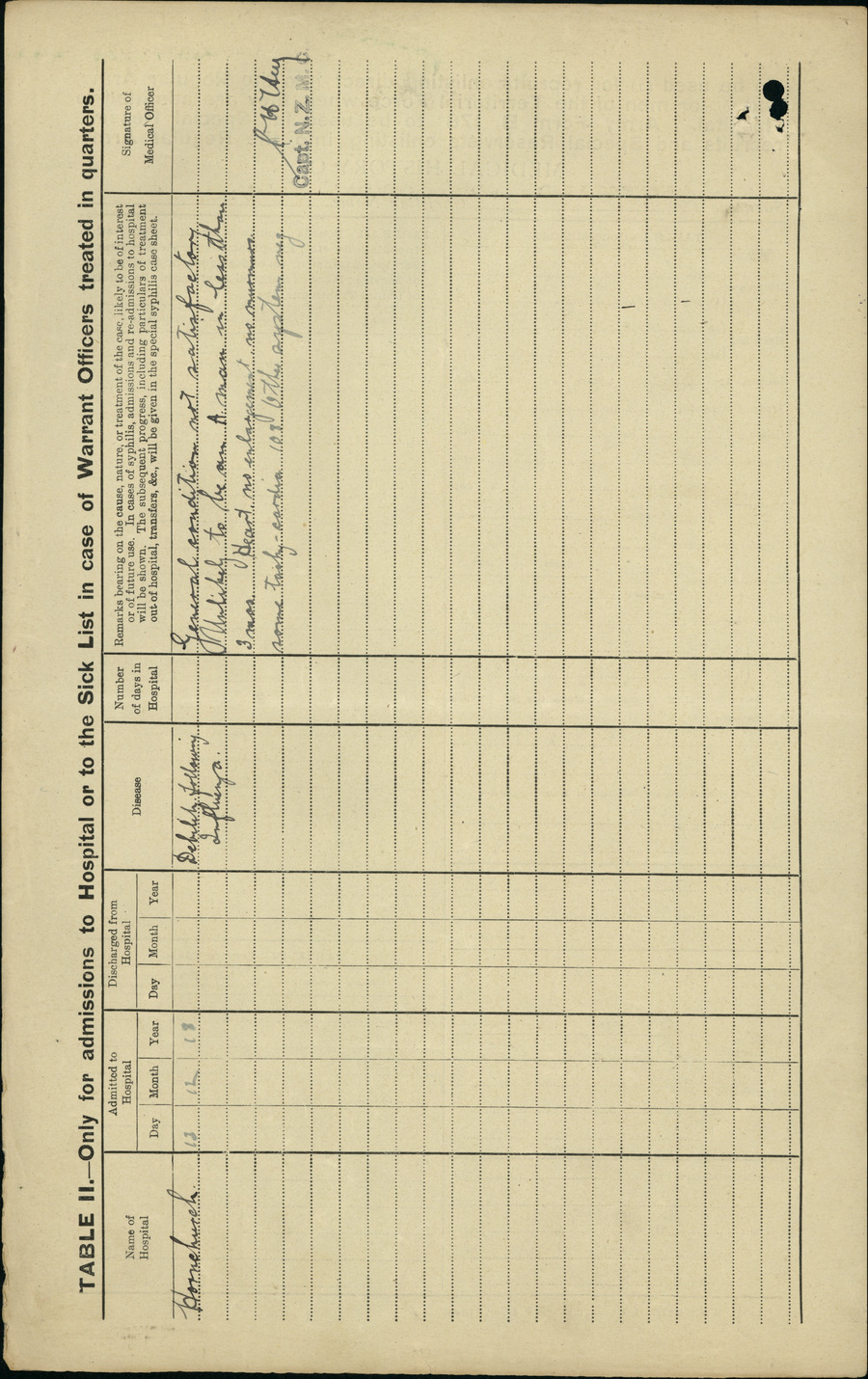
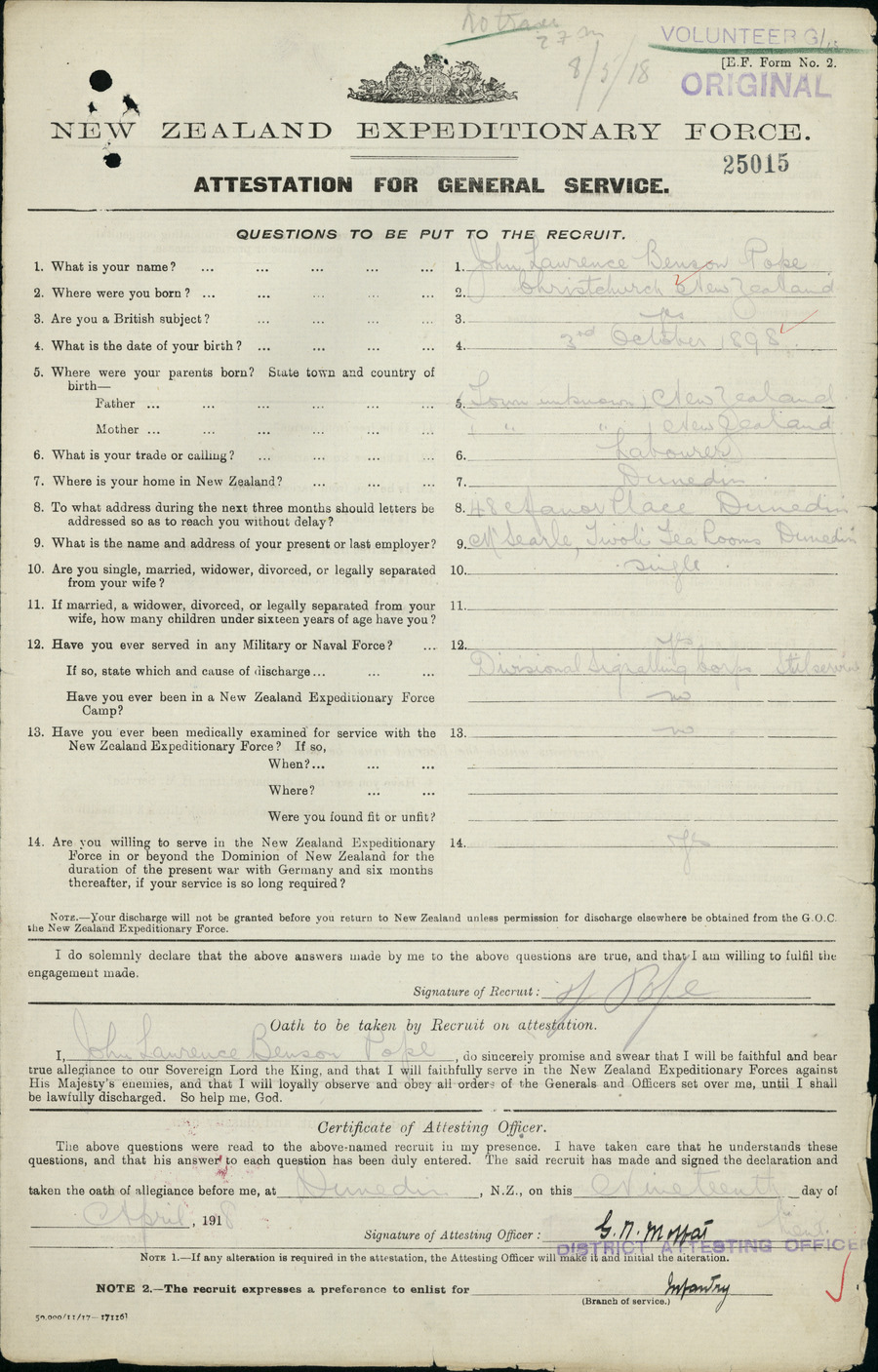
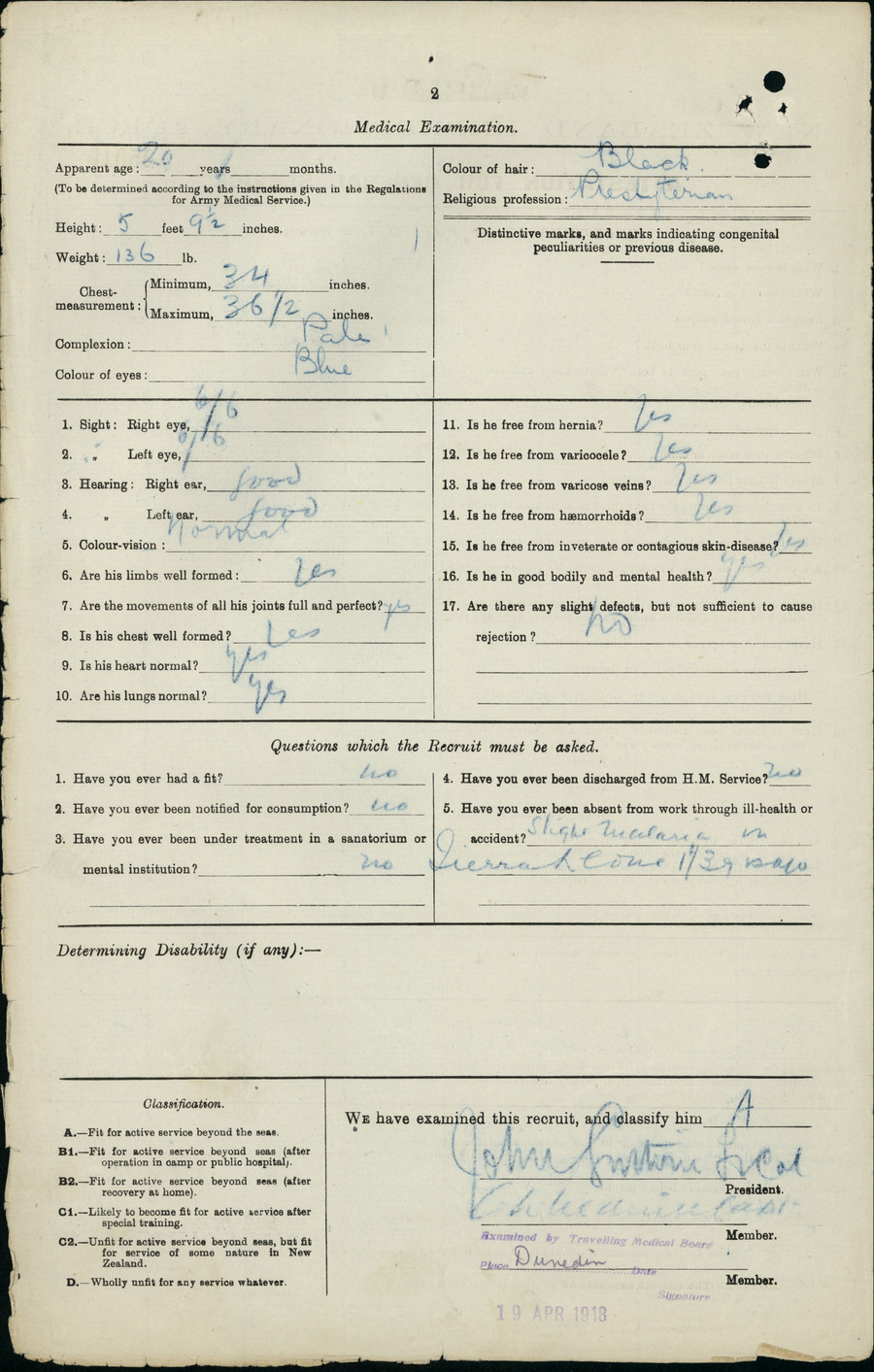
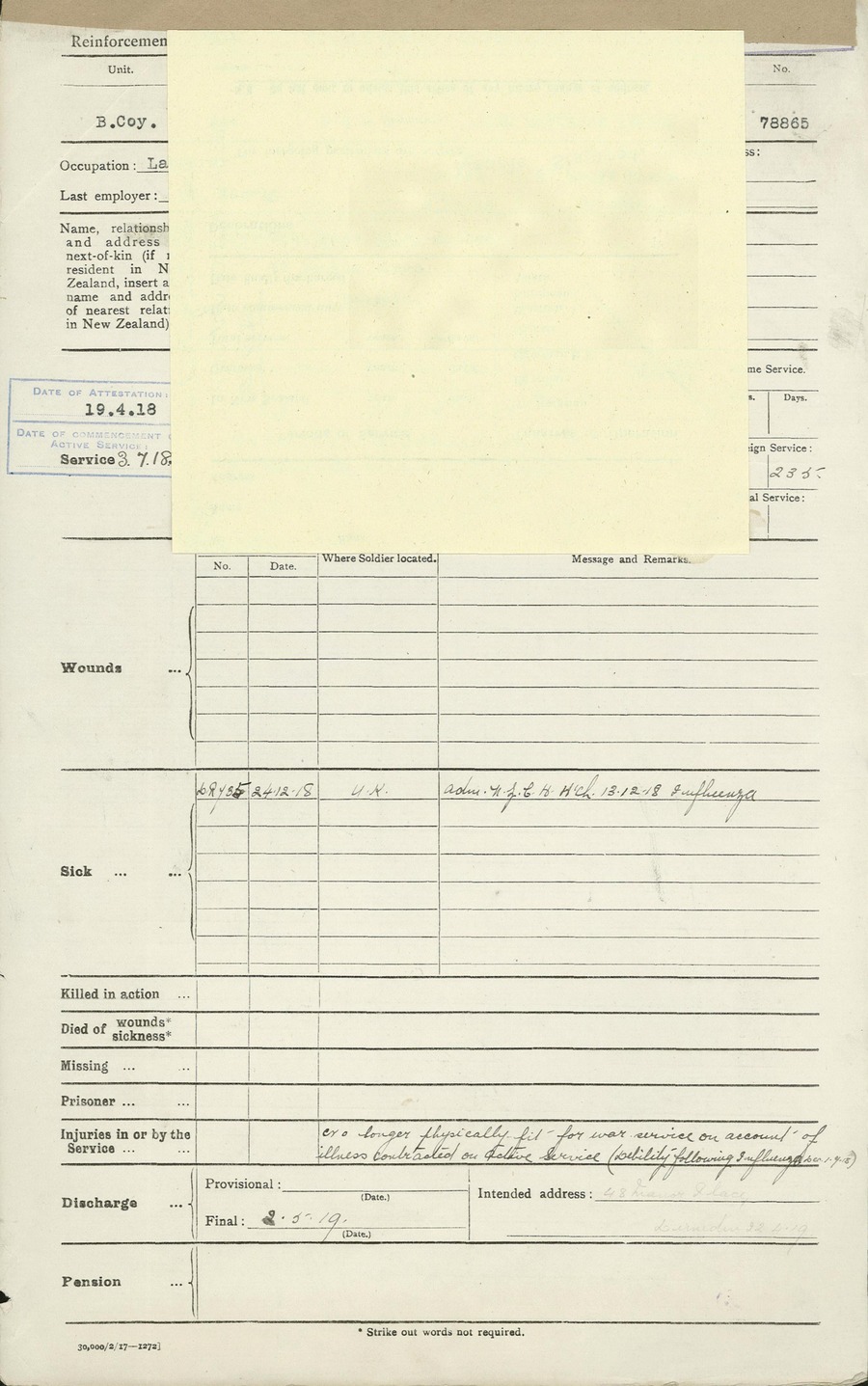
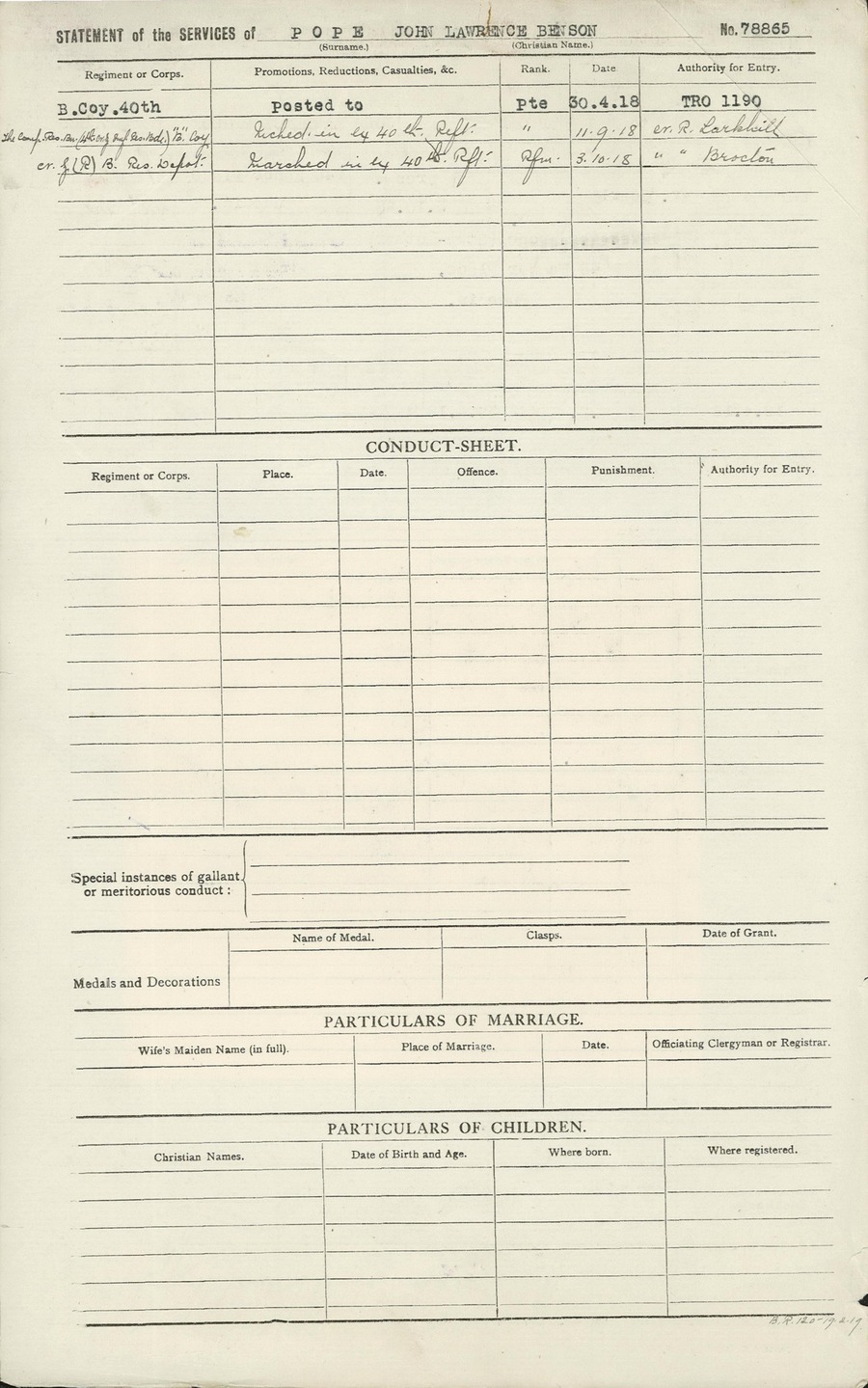
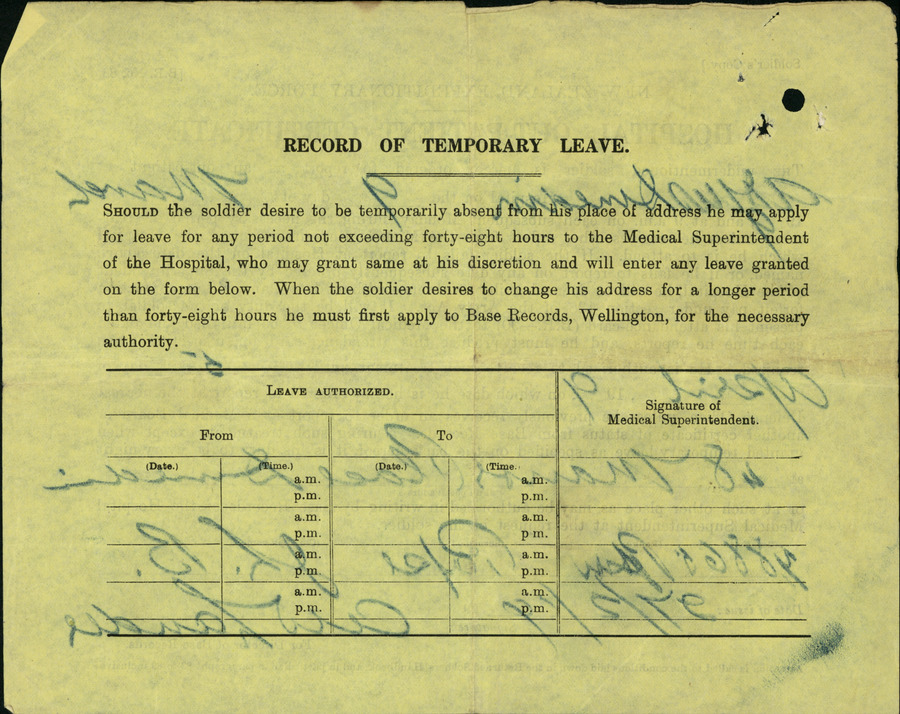
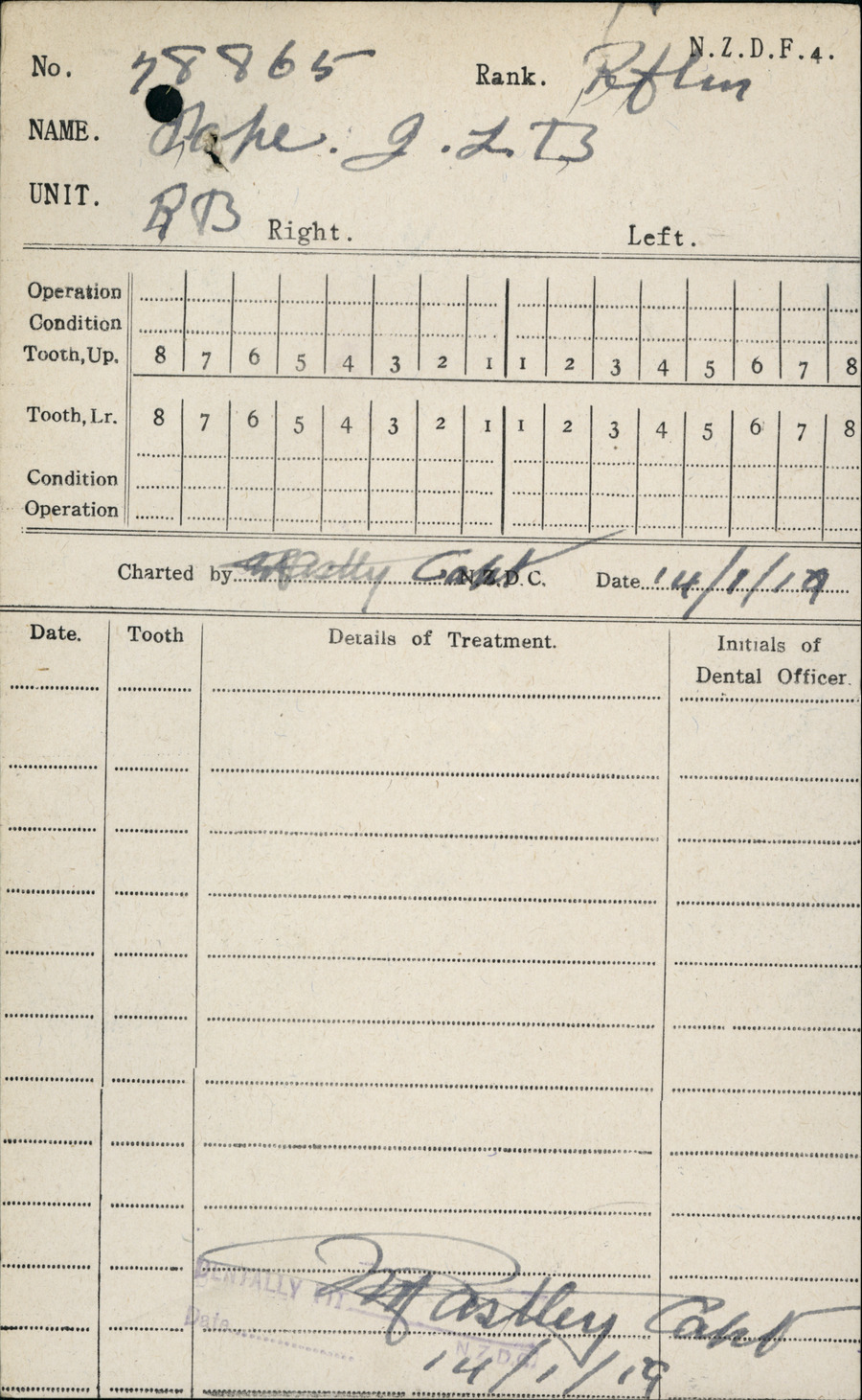
John signed his army papers in April 1918 and sailed on the Tahiti. At Brocton military camp in Staffordshire, central England, he became ill with influenza and what the records called “debility”—severe weakness after illness. He returned to New Zealand on the Zealandic and left the army in May 1919 because the illness had been contracted during his service.

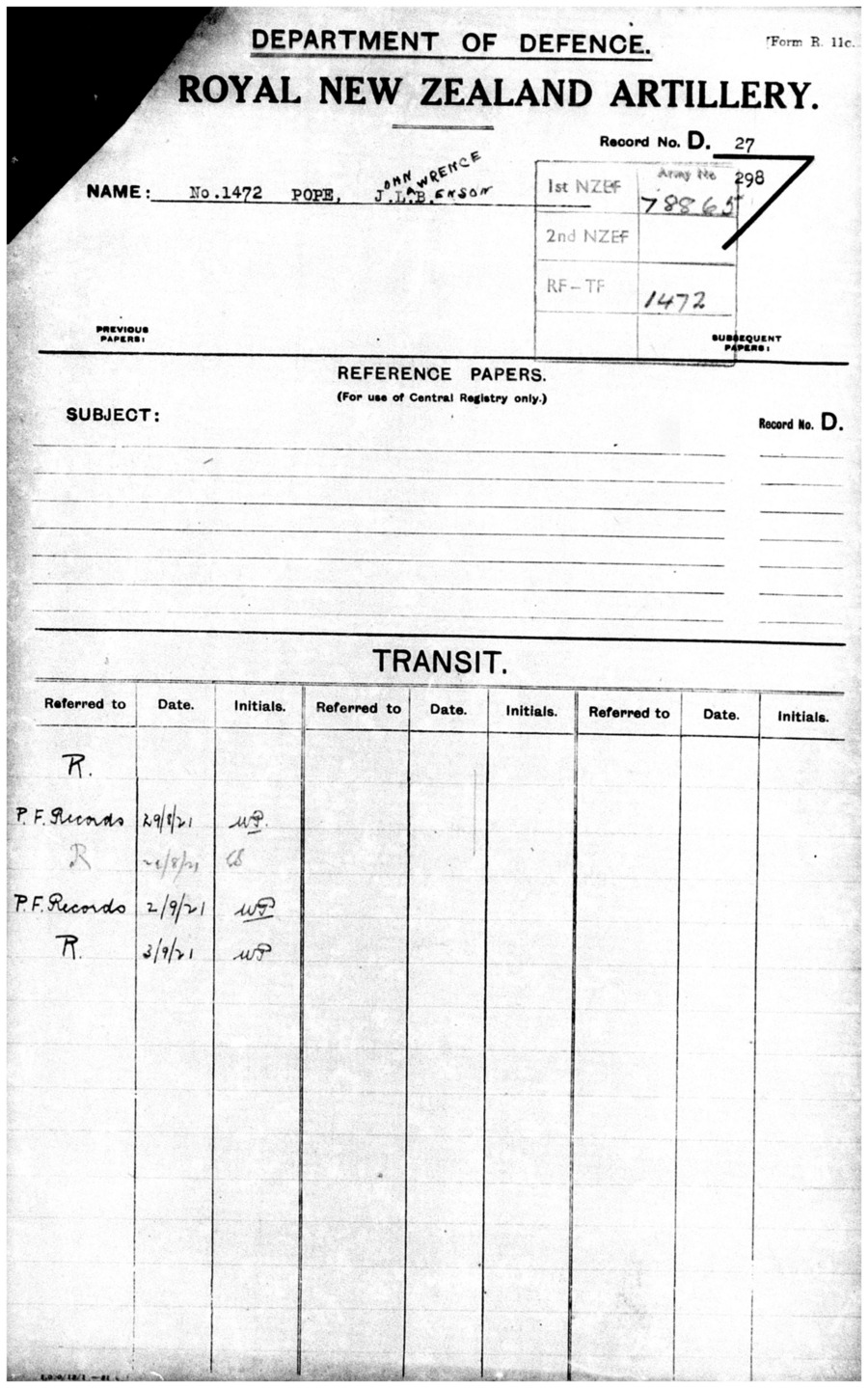
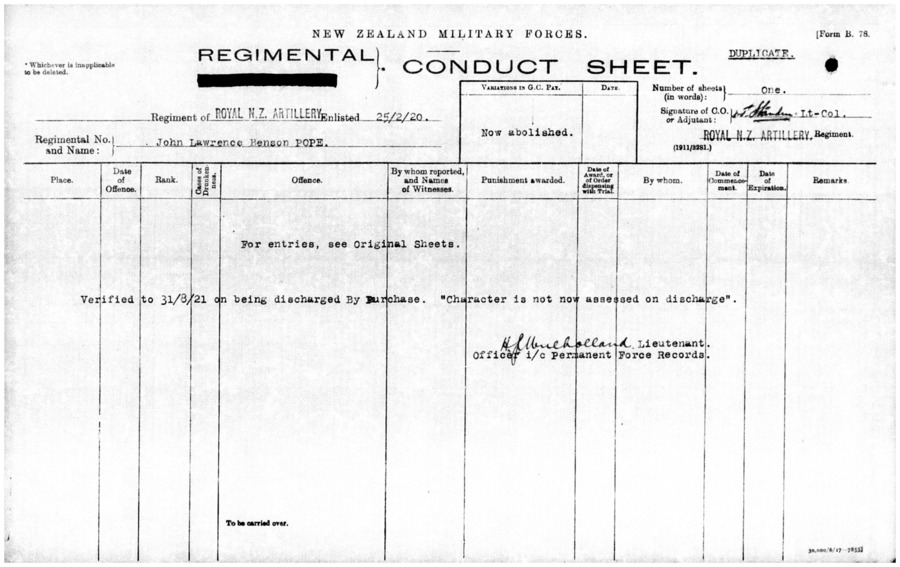
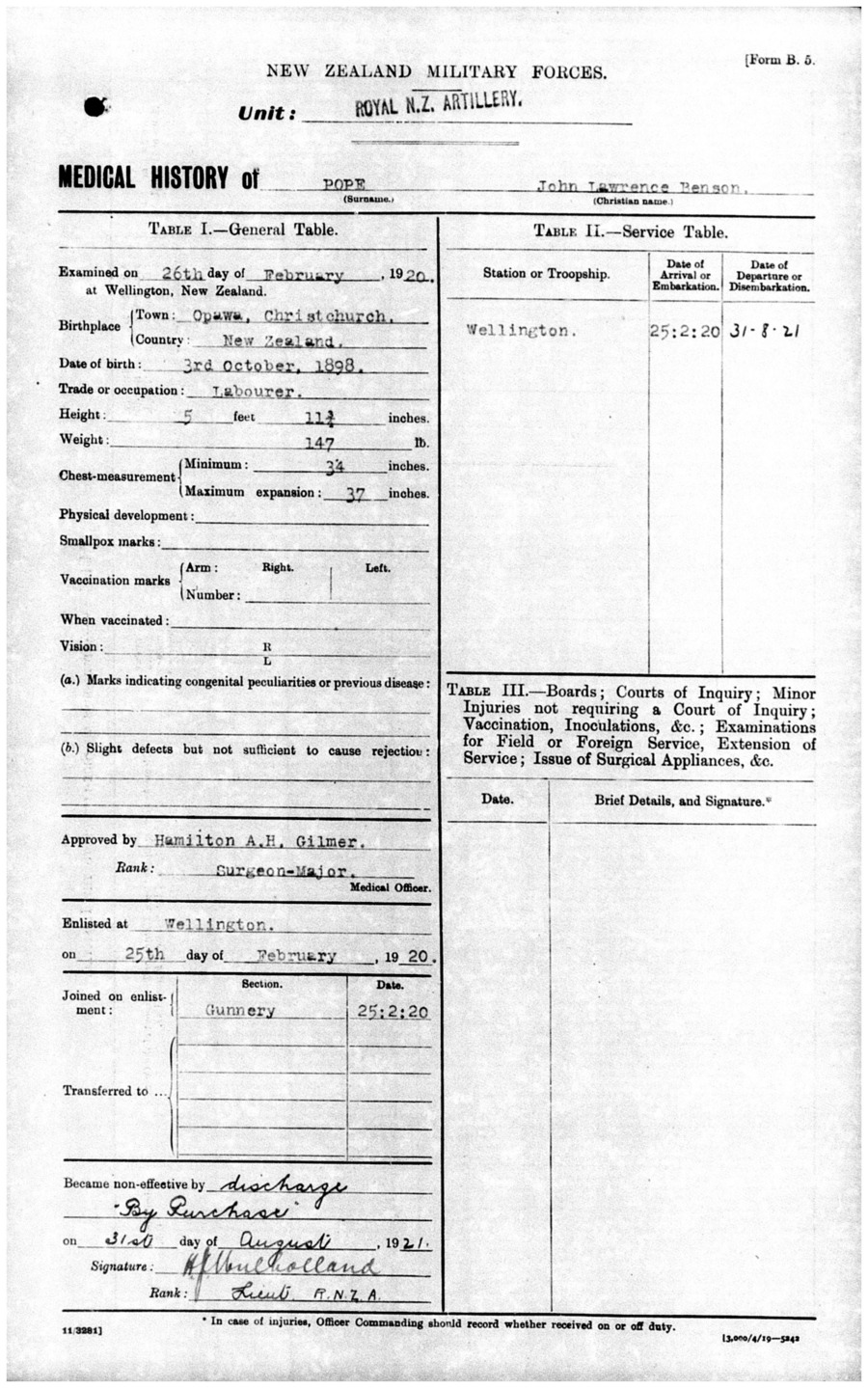
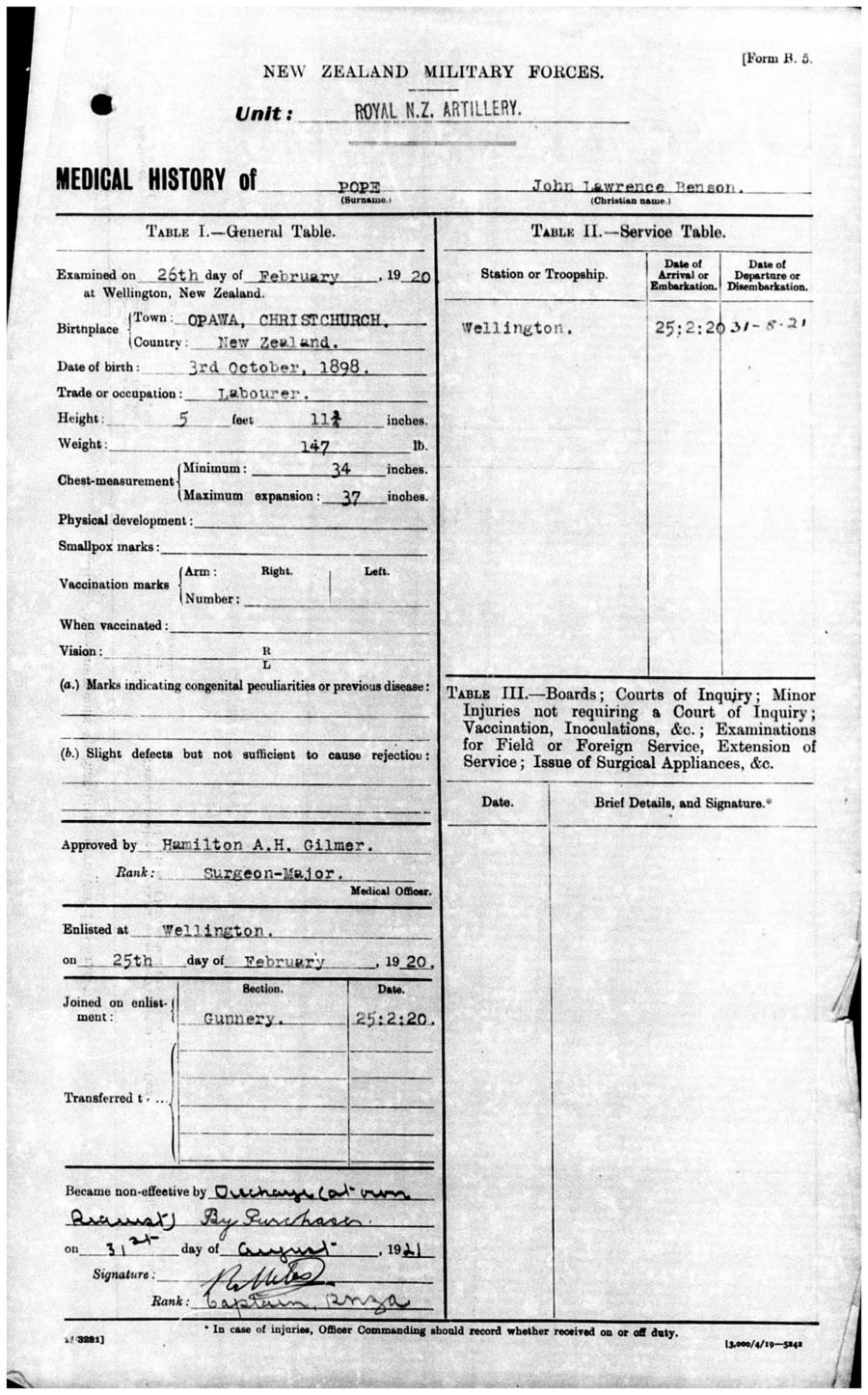
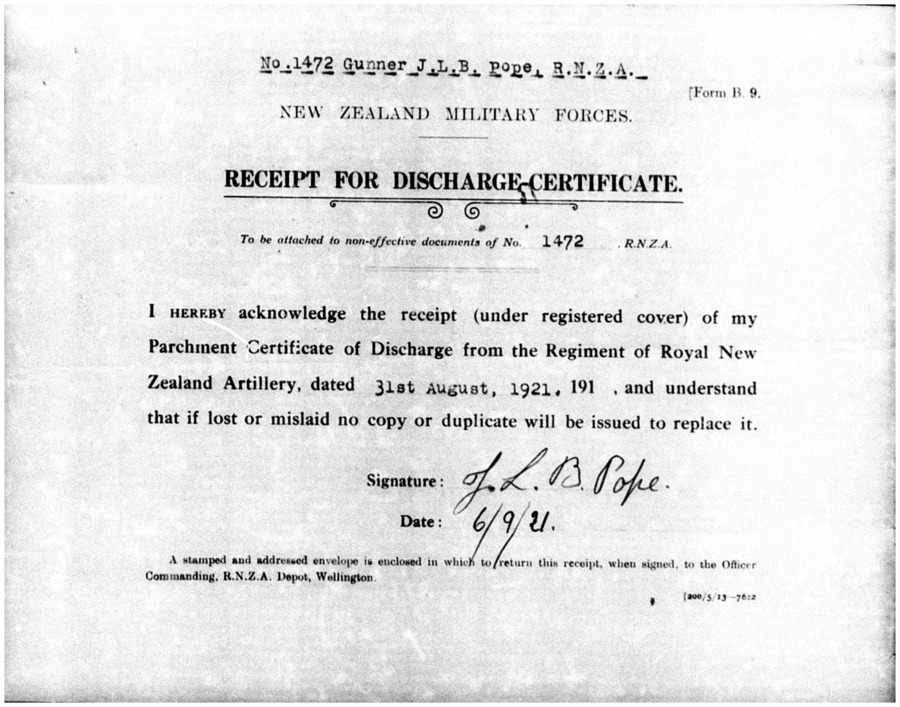
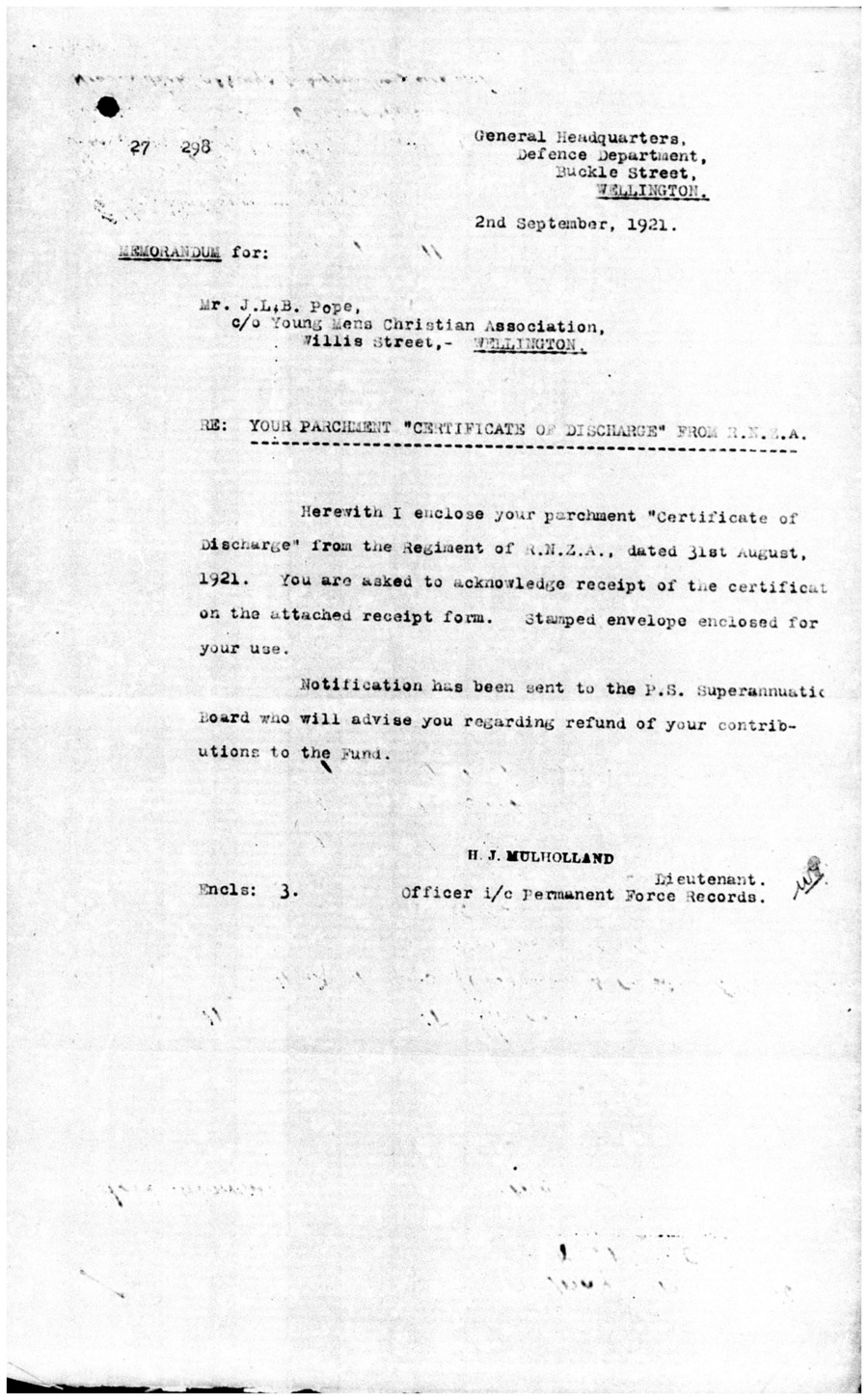
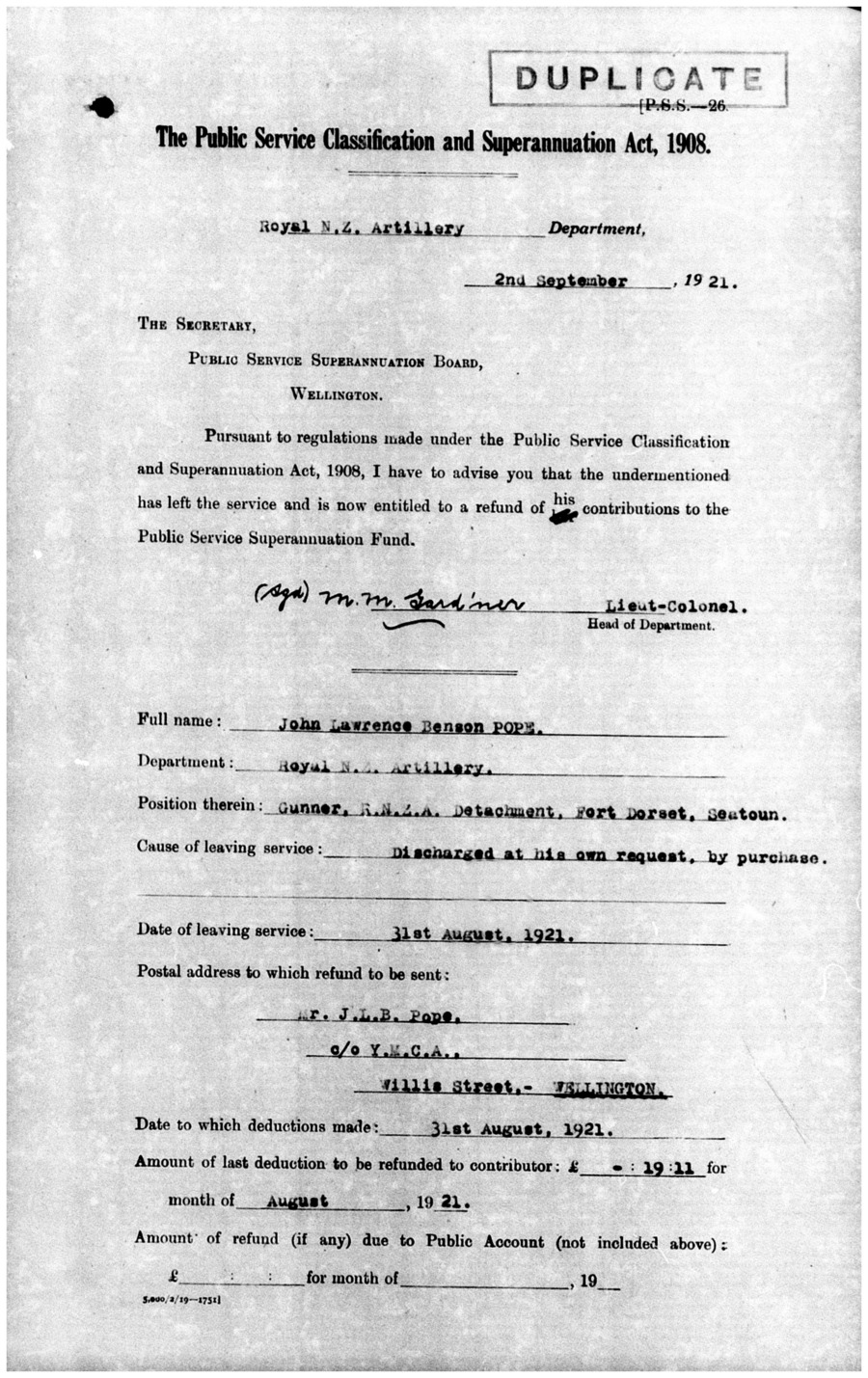
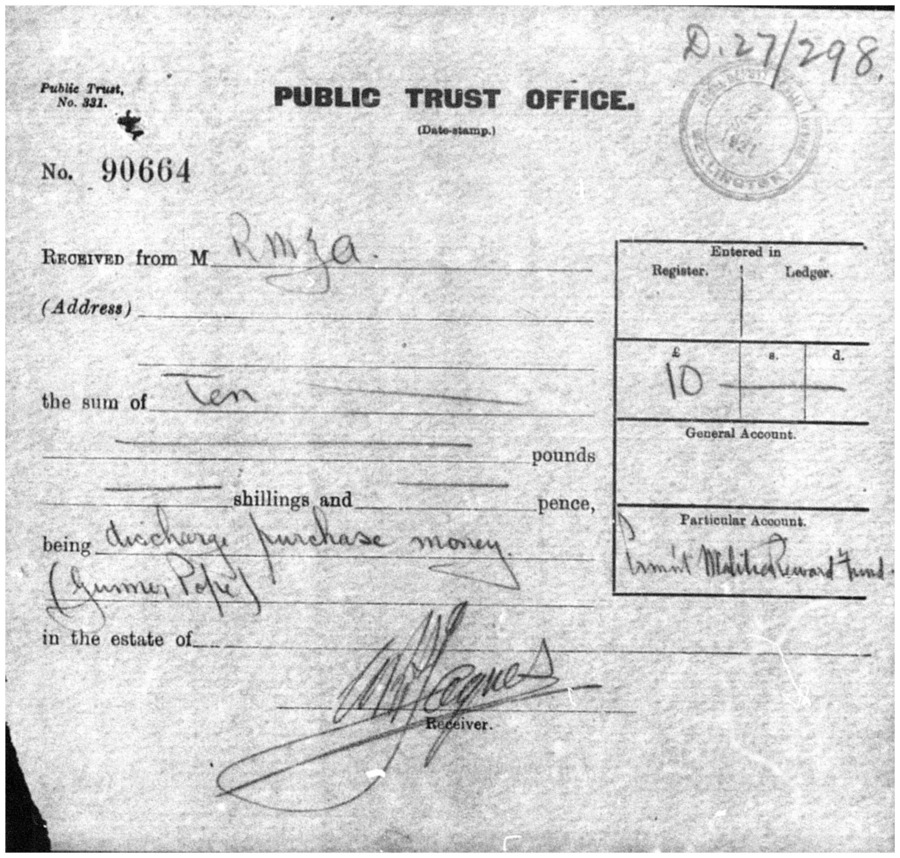
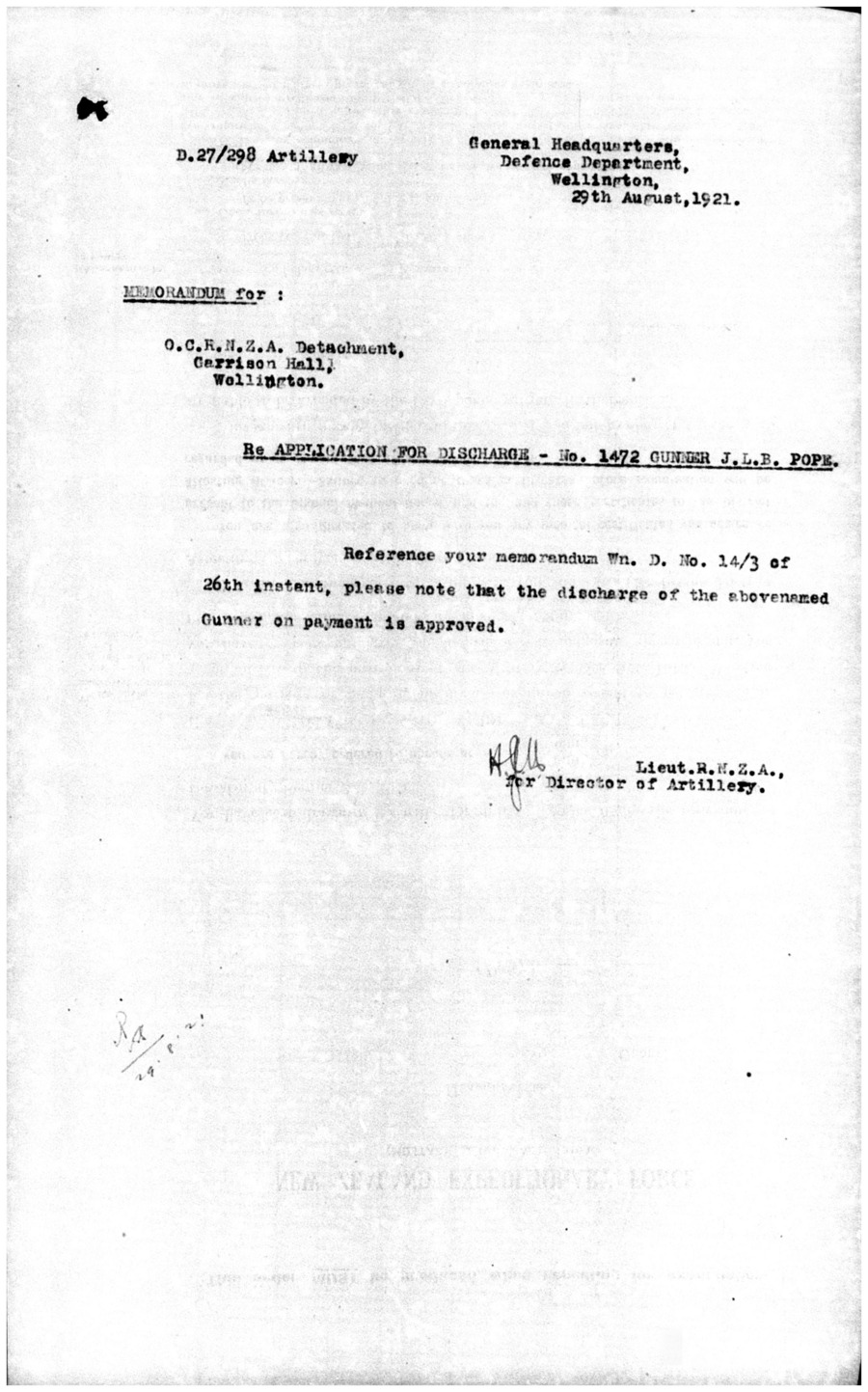
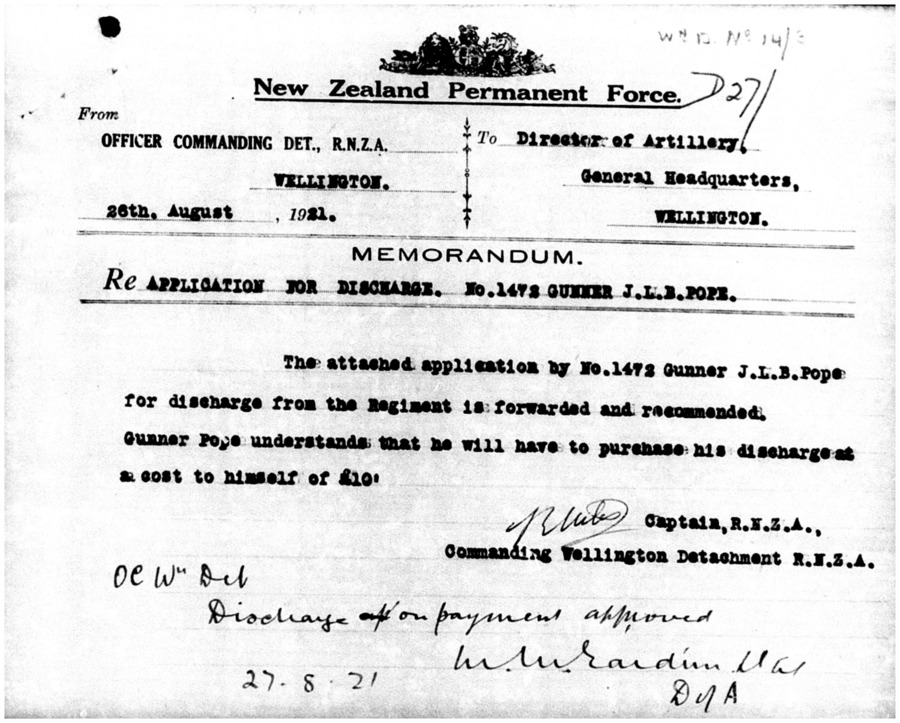
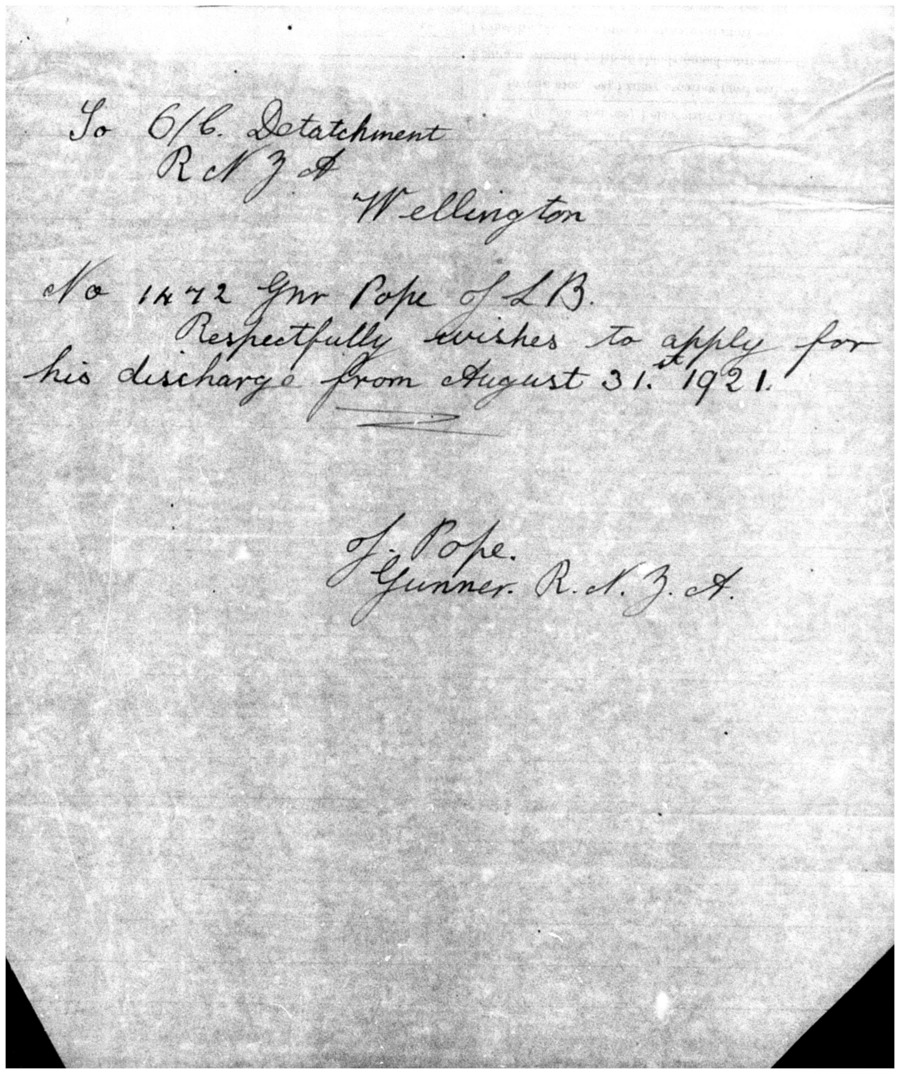
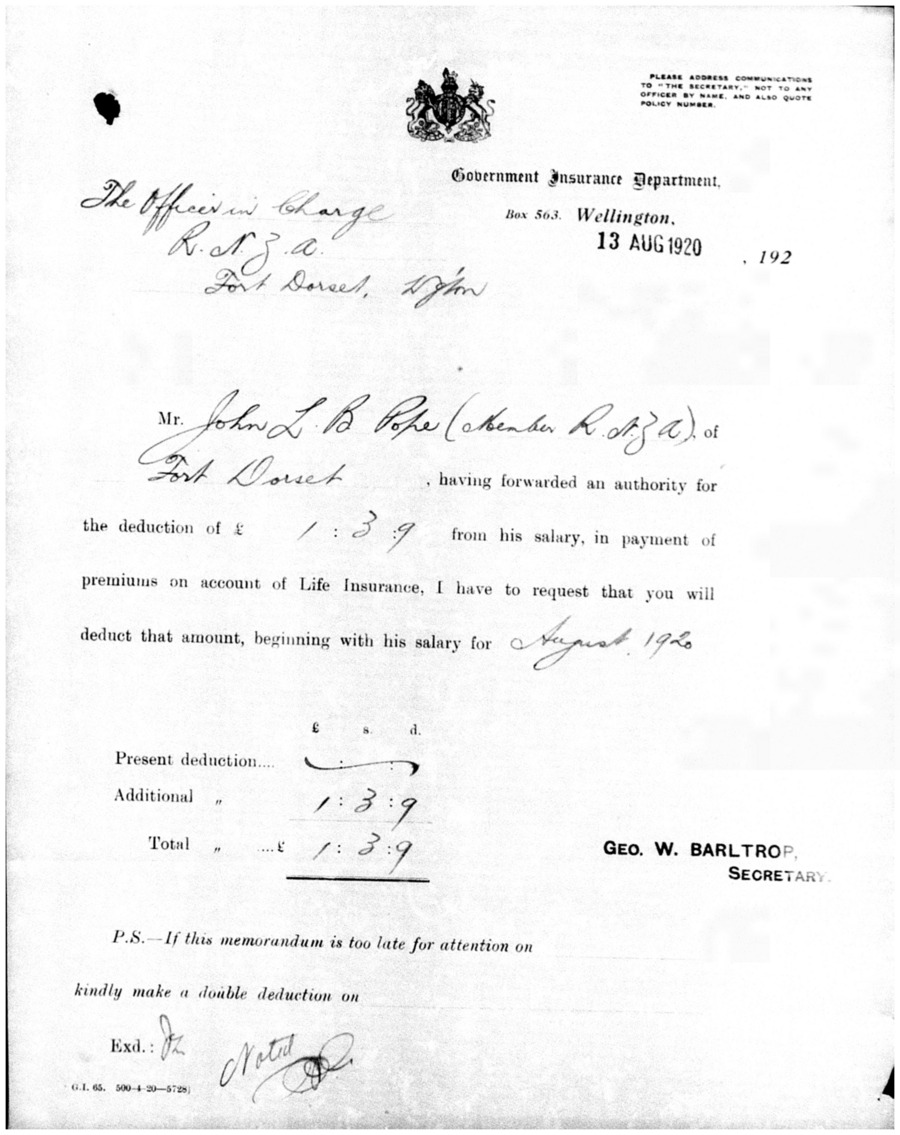
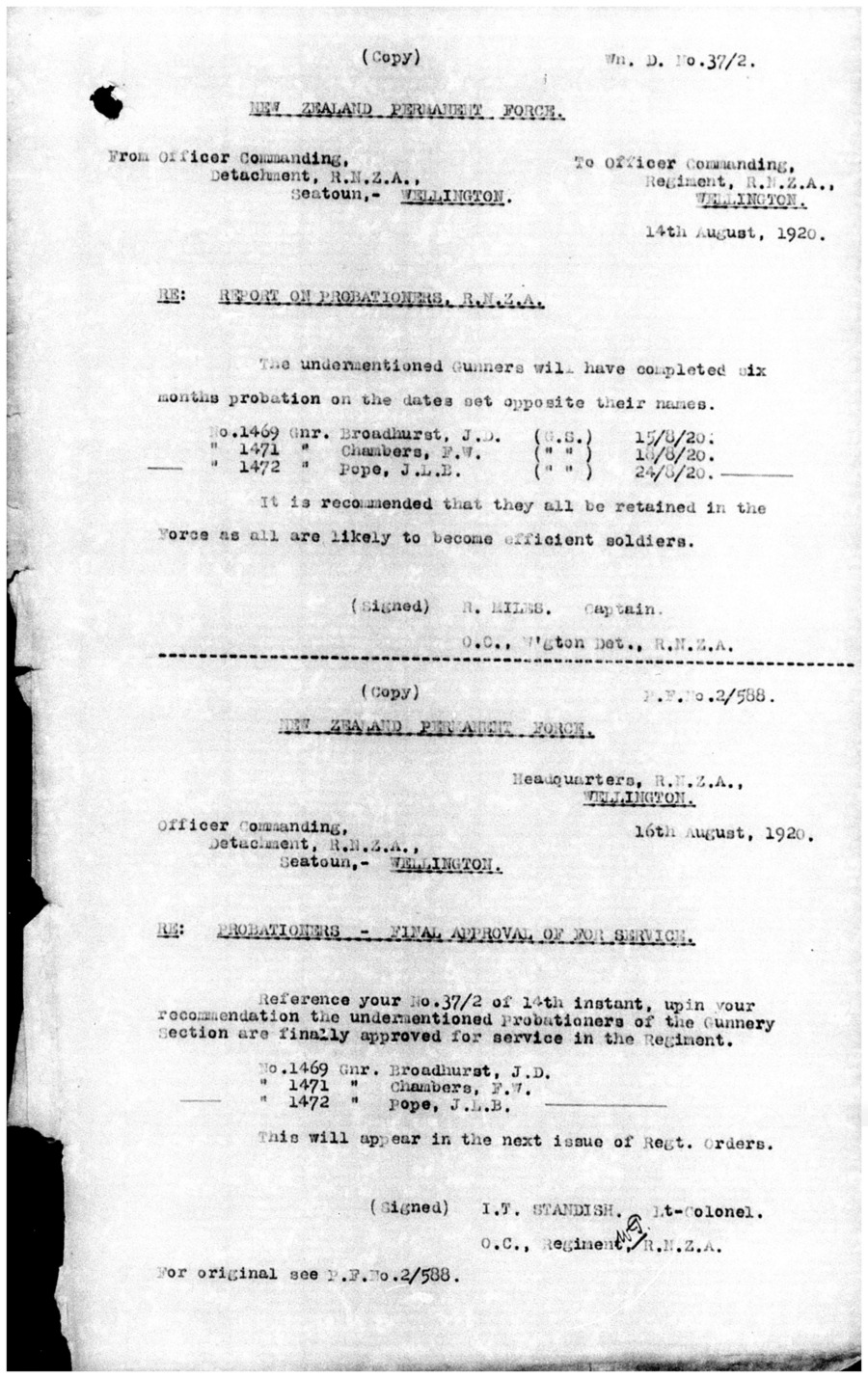
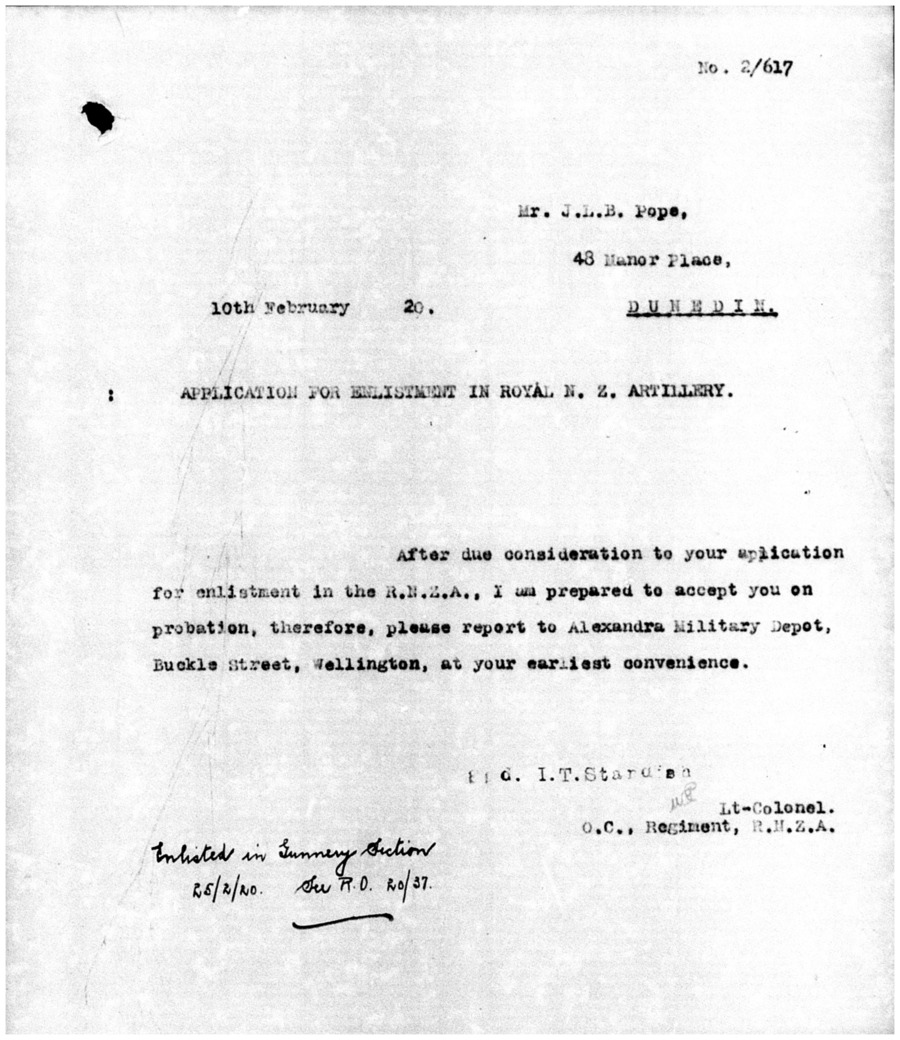
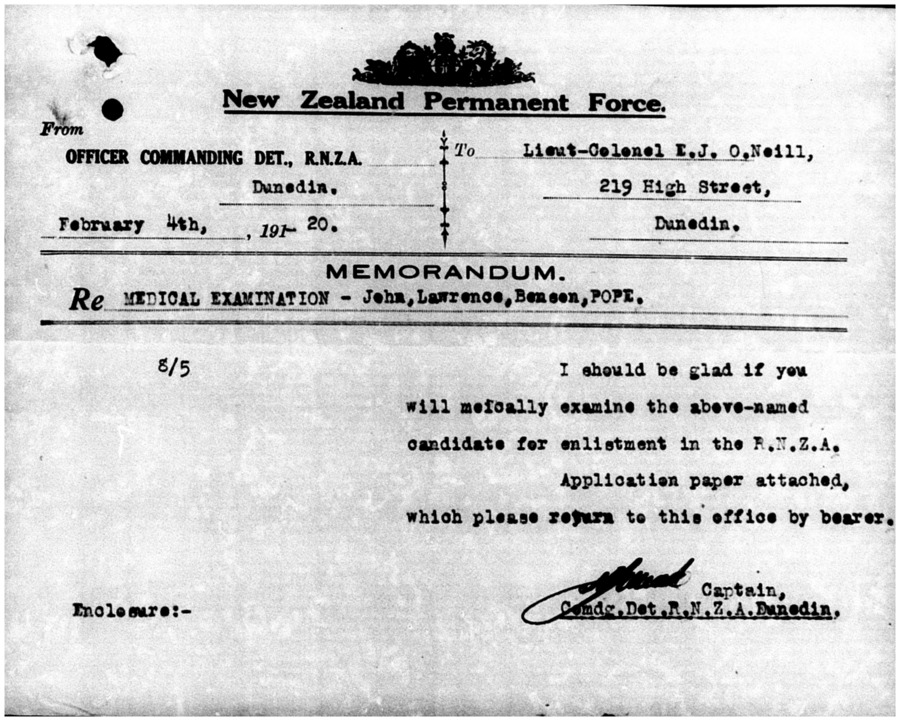
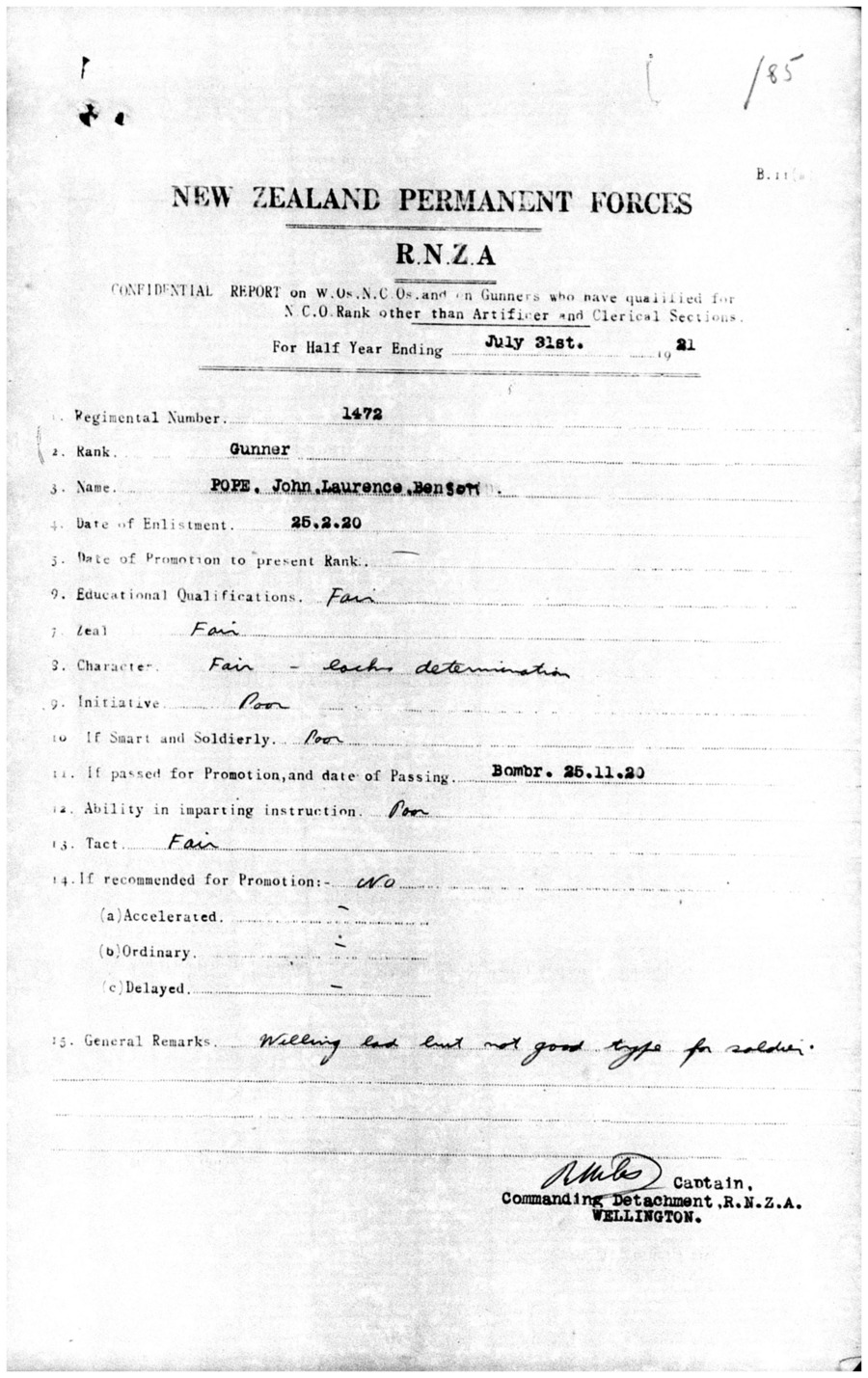
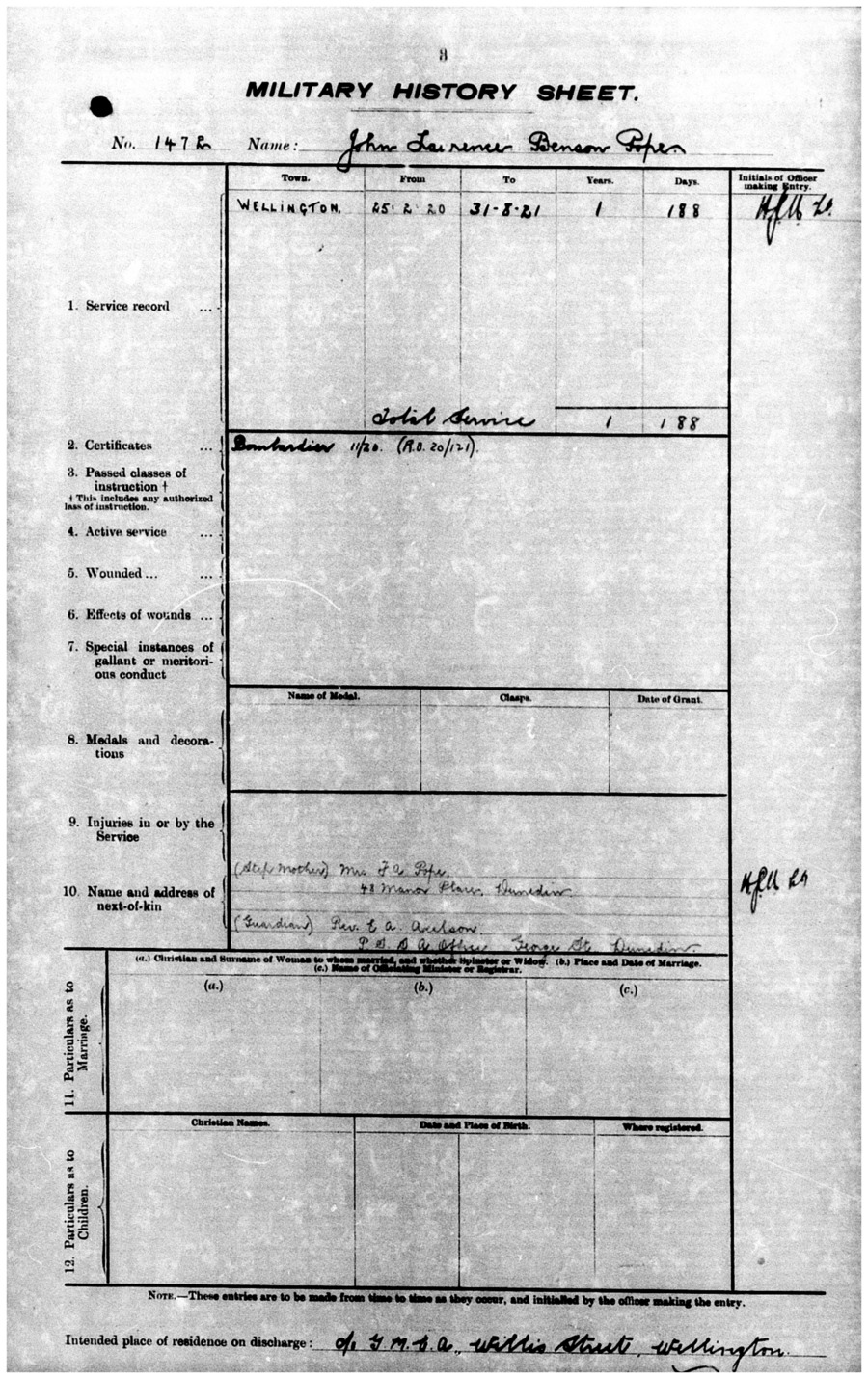
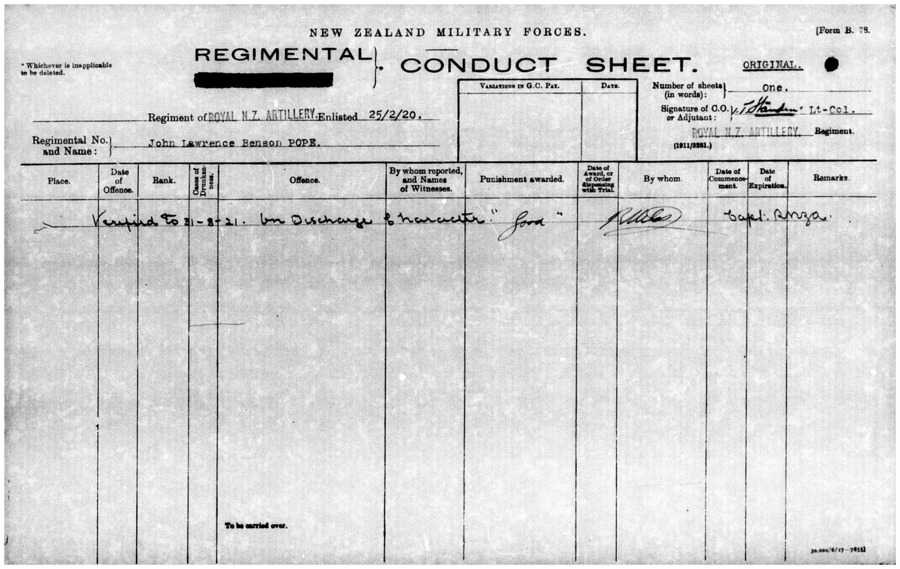
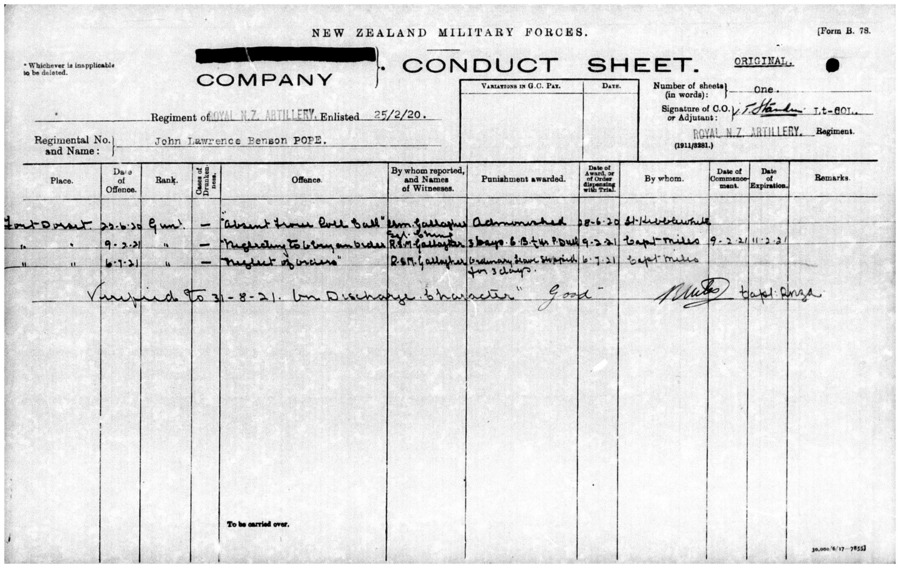
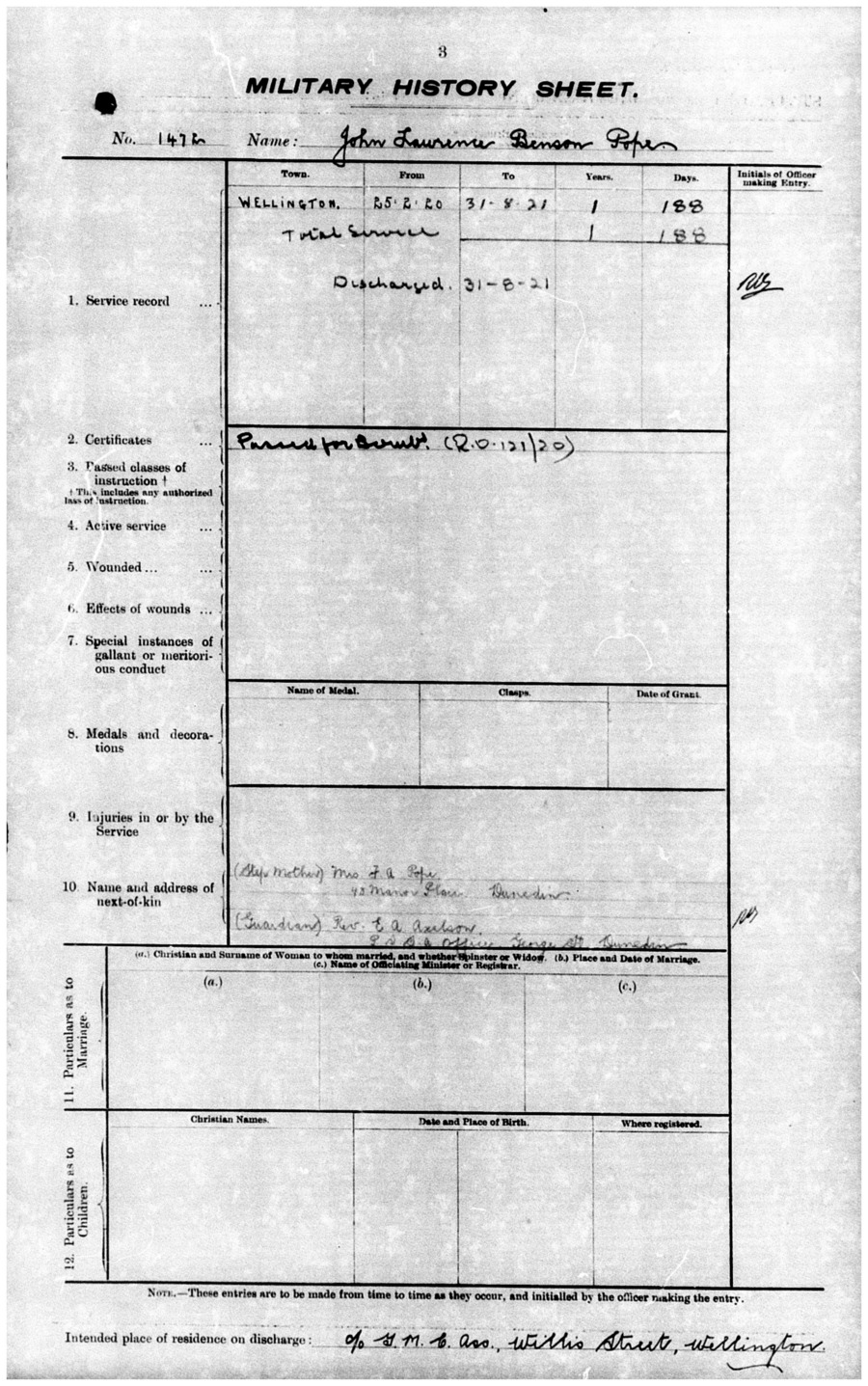
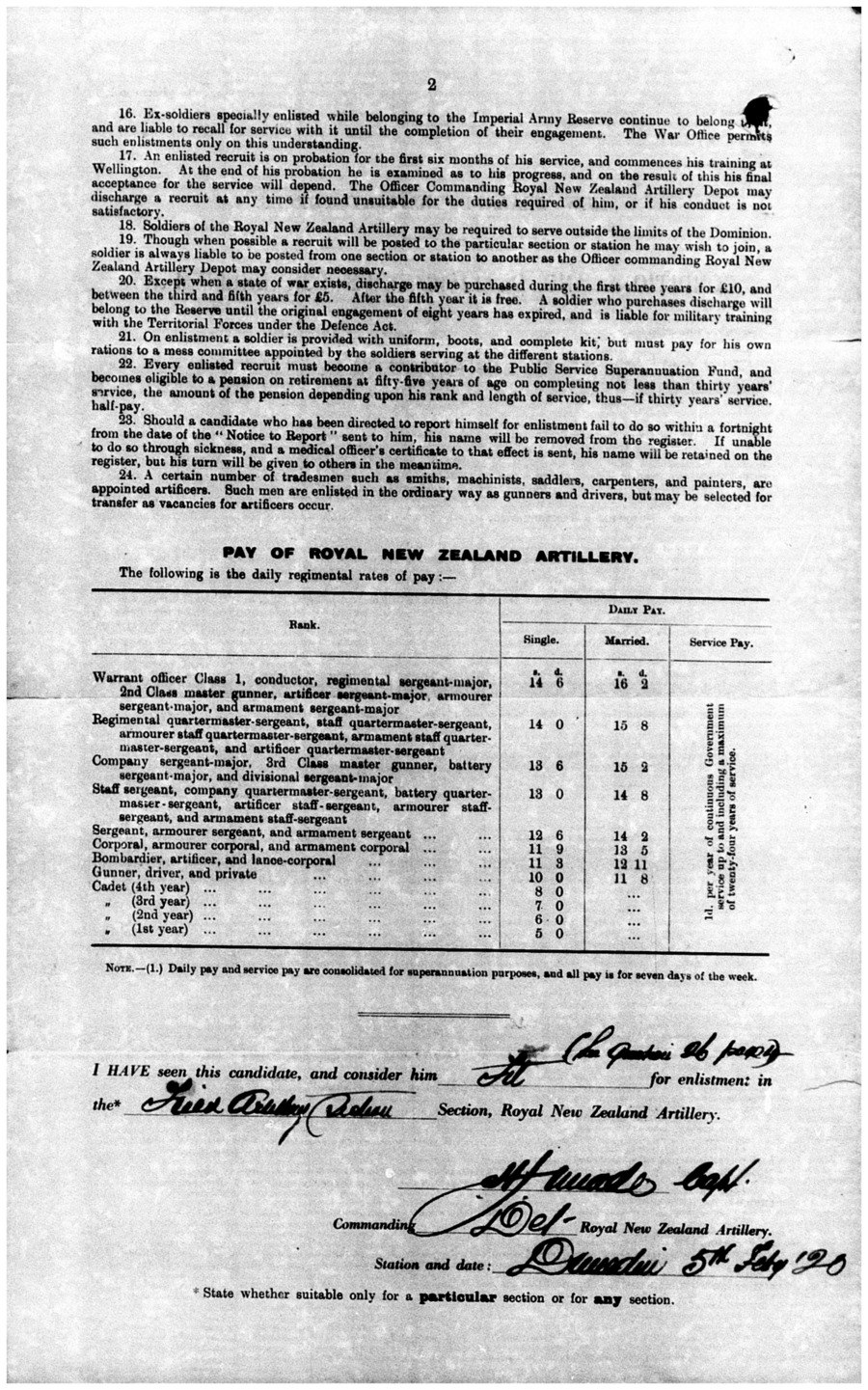
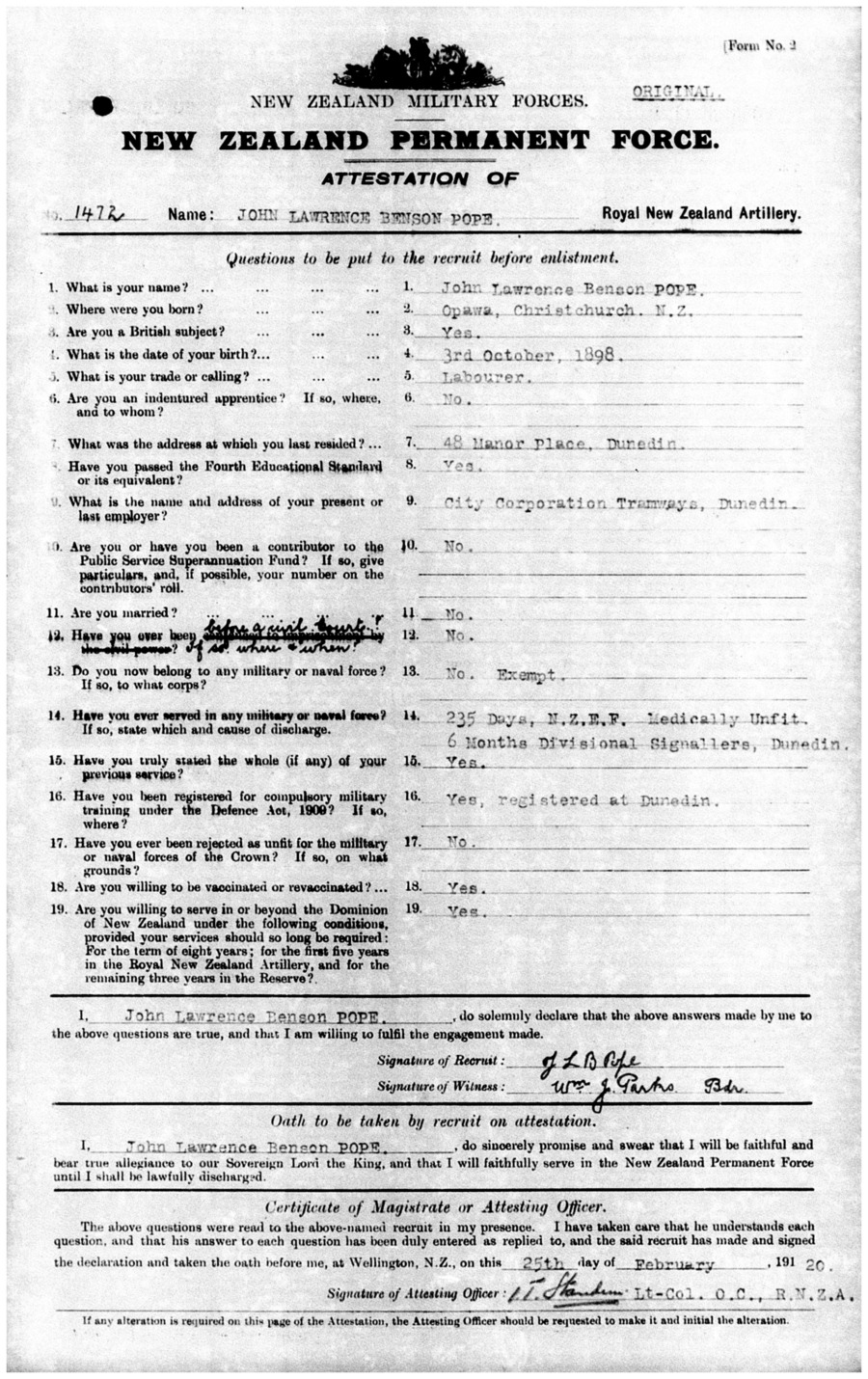
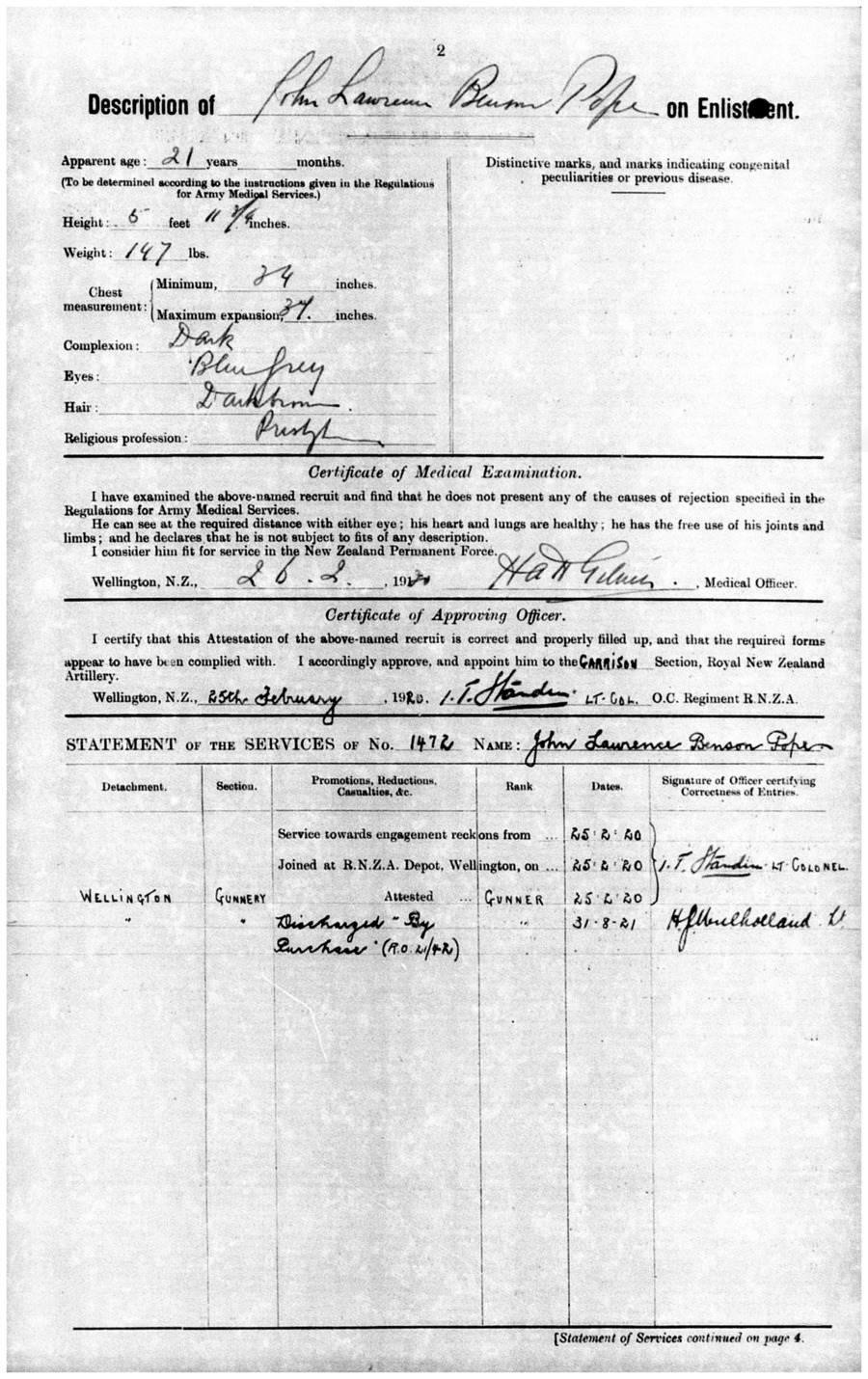
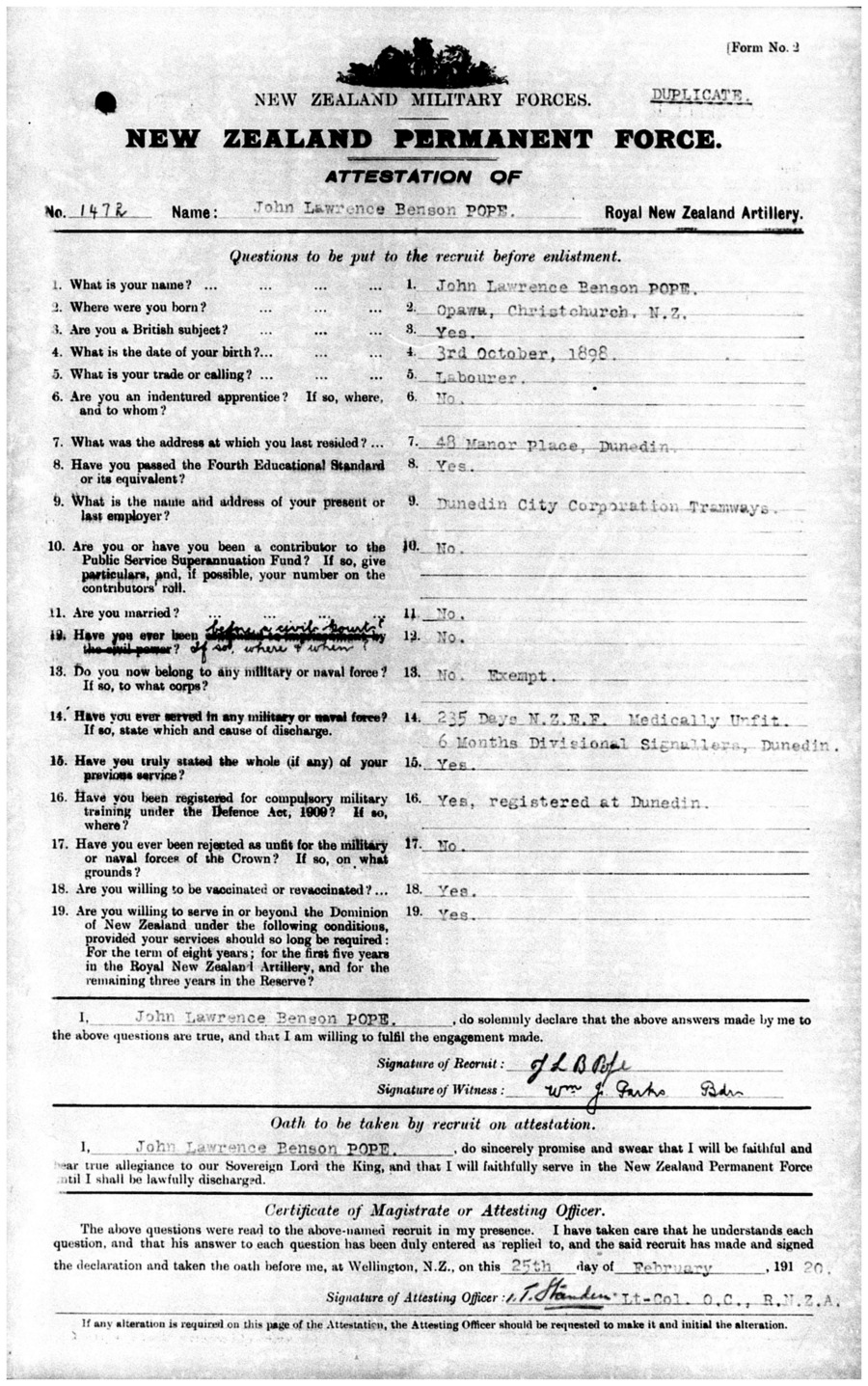
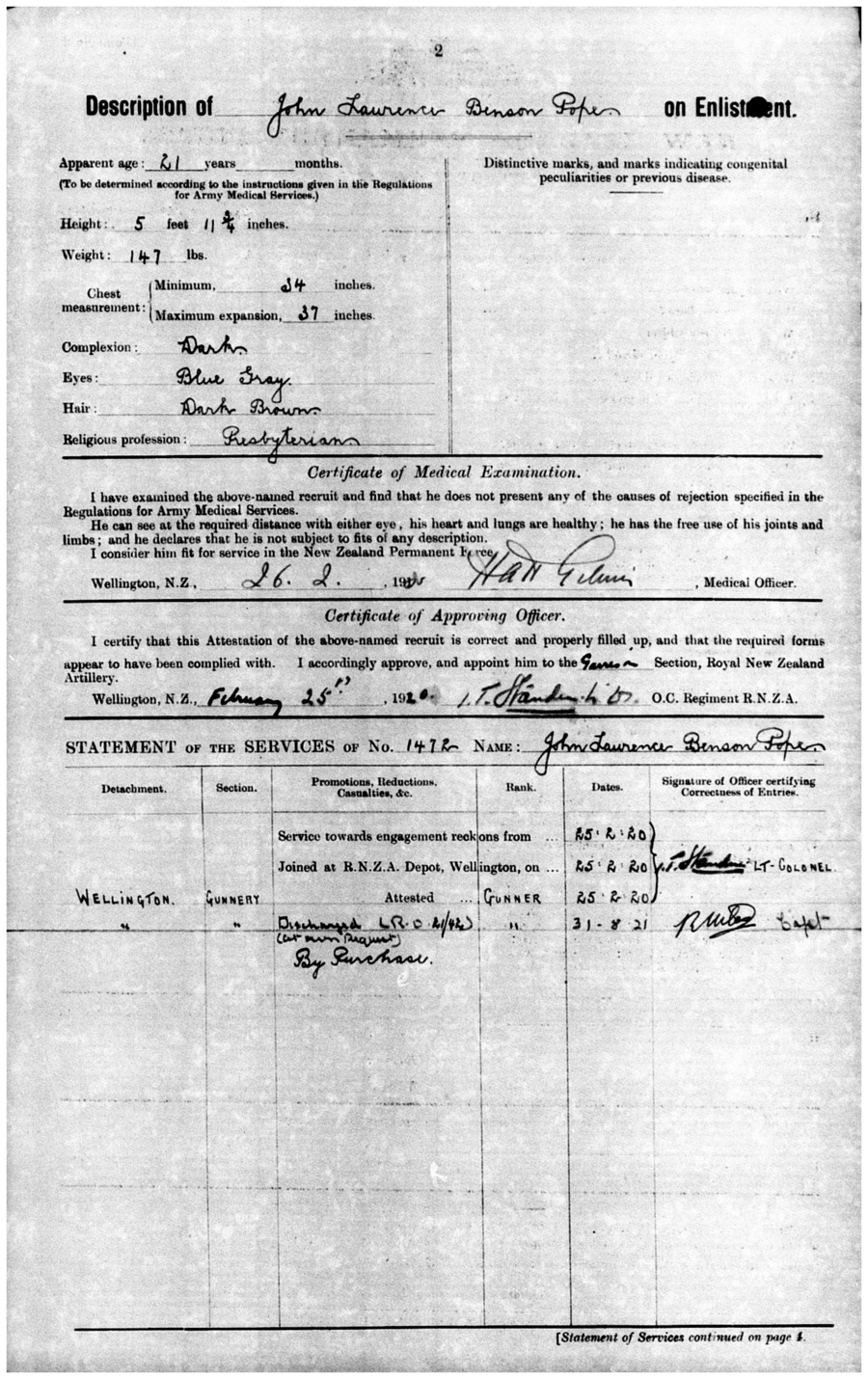
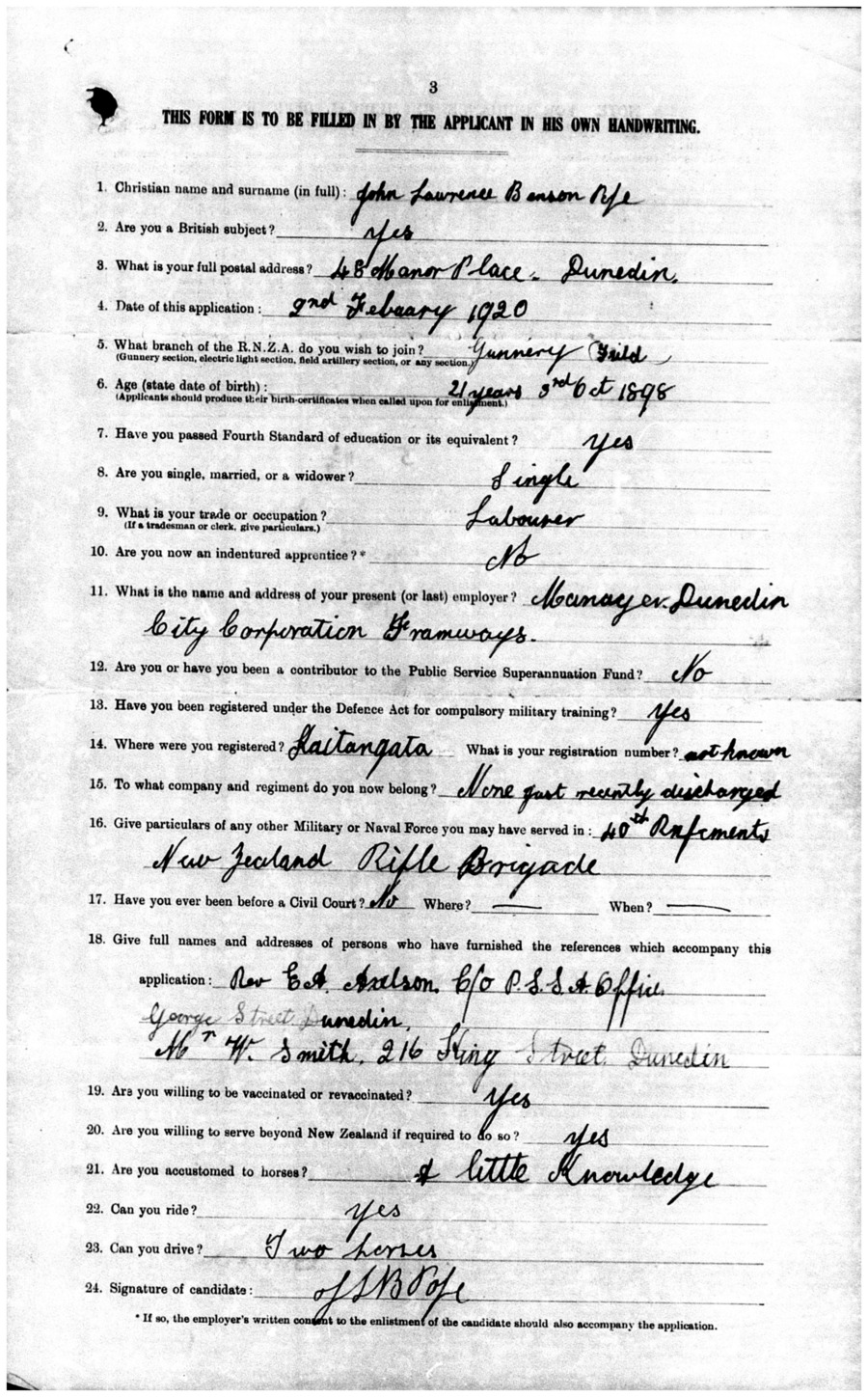
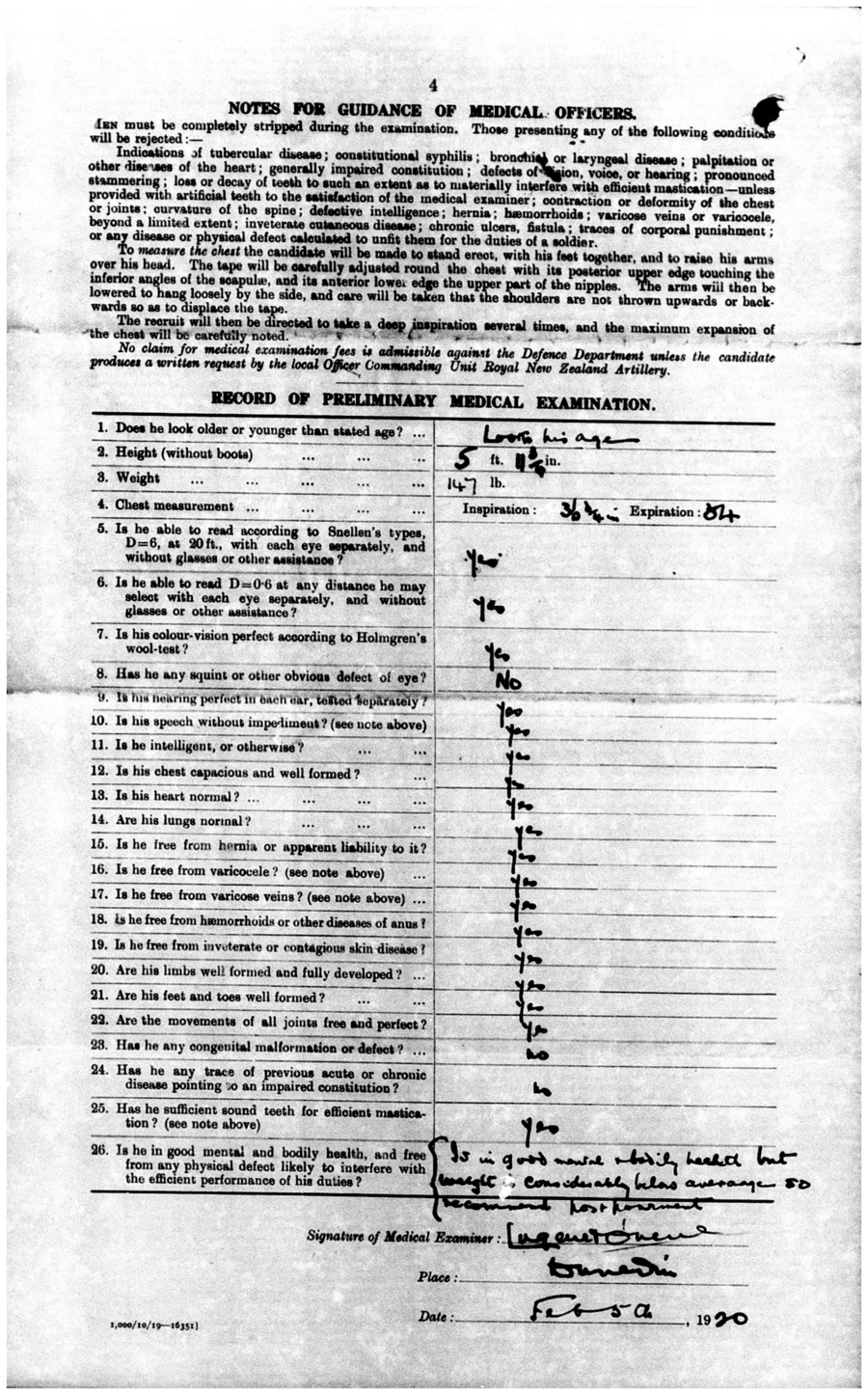
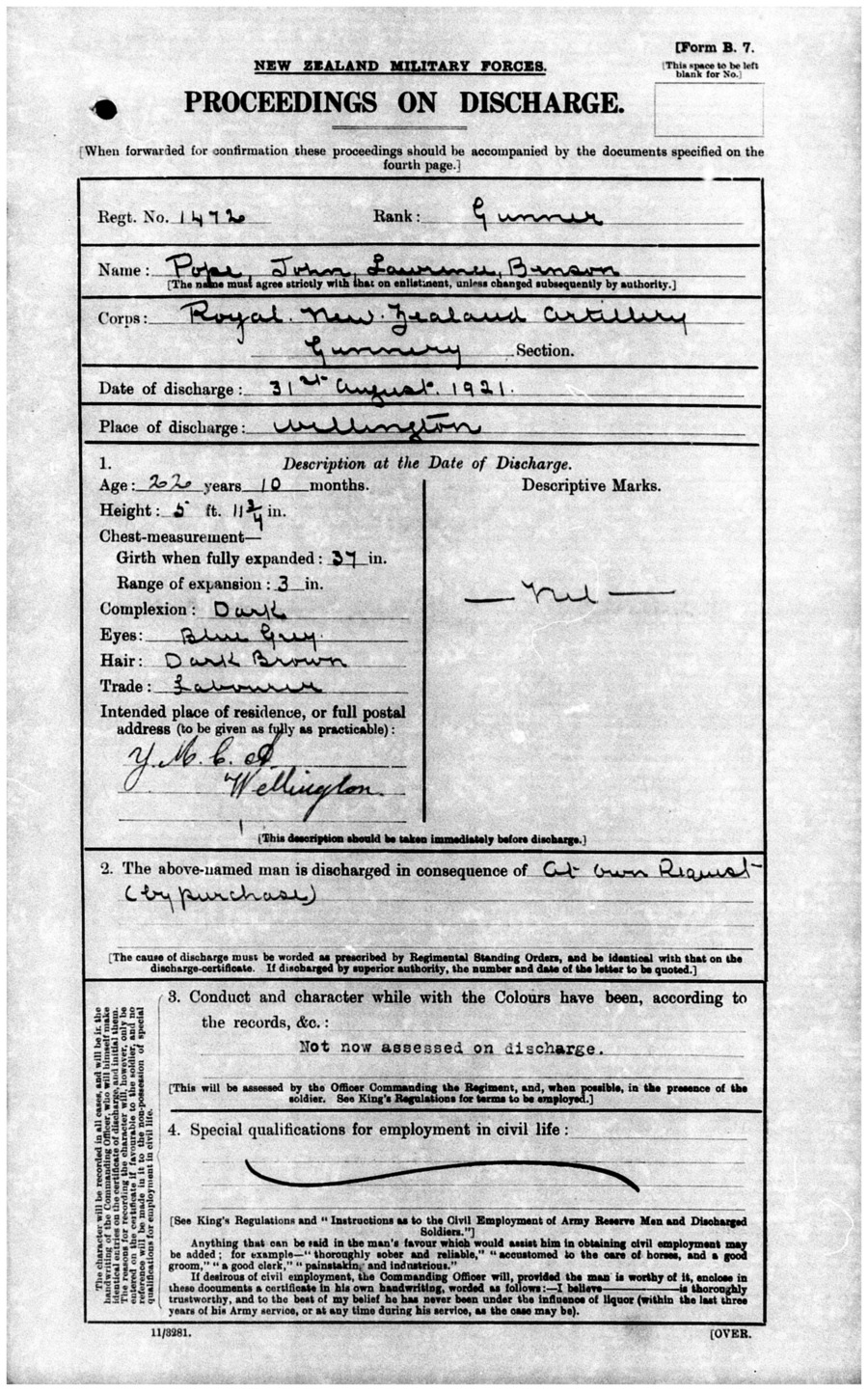
He then joined the Royal New Zealand Artillery’s full-time force and served from 1920 to 1921. The papers do not tell a simple heroic story. They show a young man being moved across the world, repeatedly examined and treated, and finally sent home.

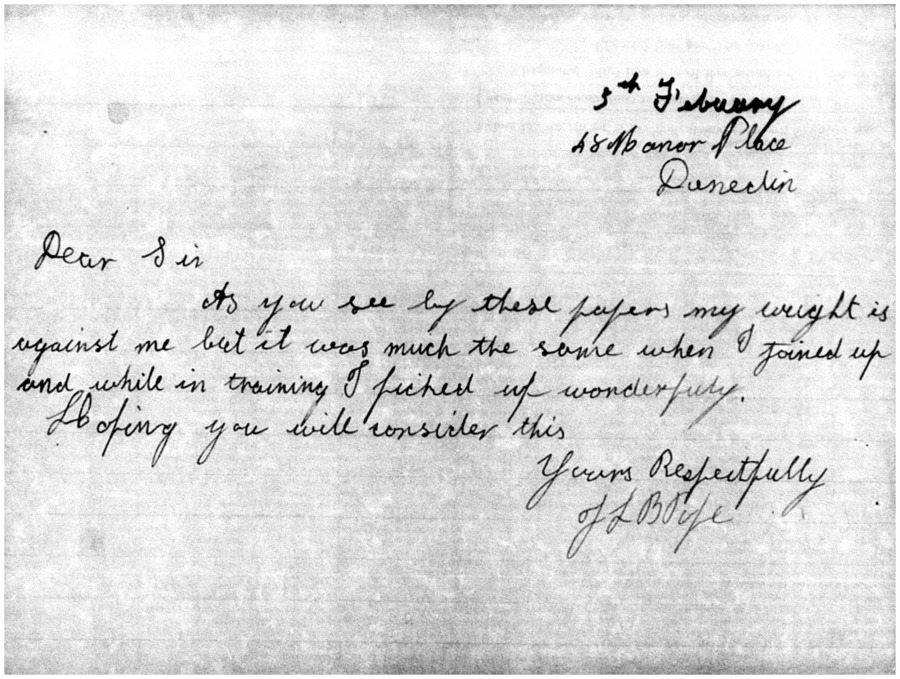
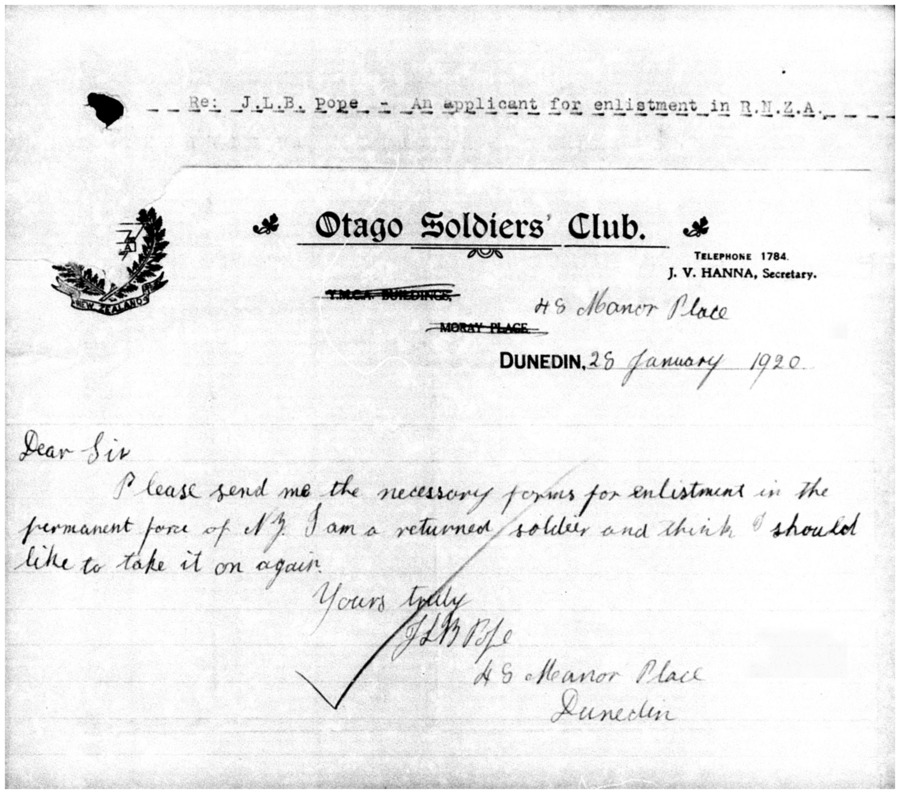
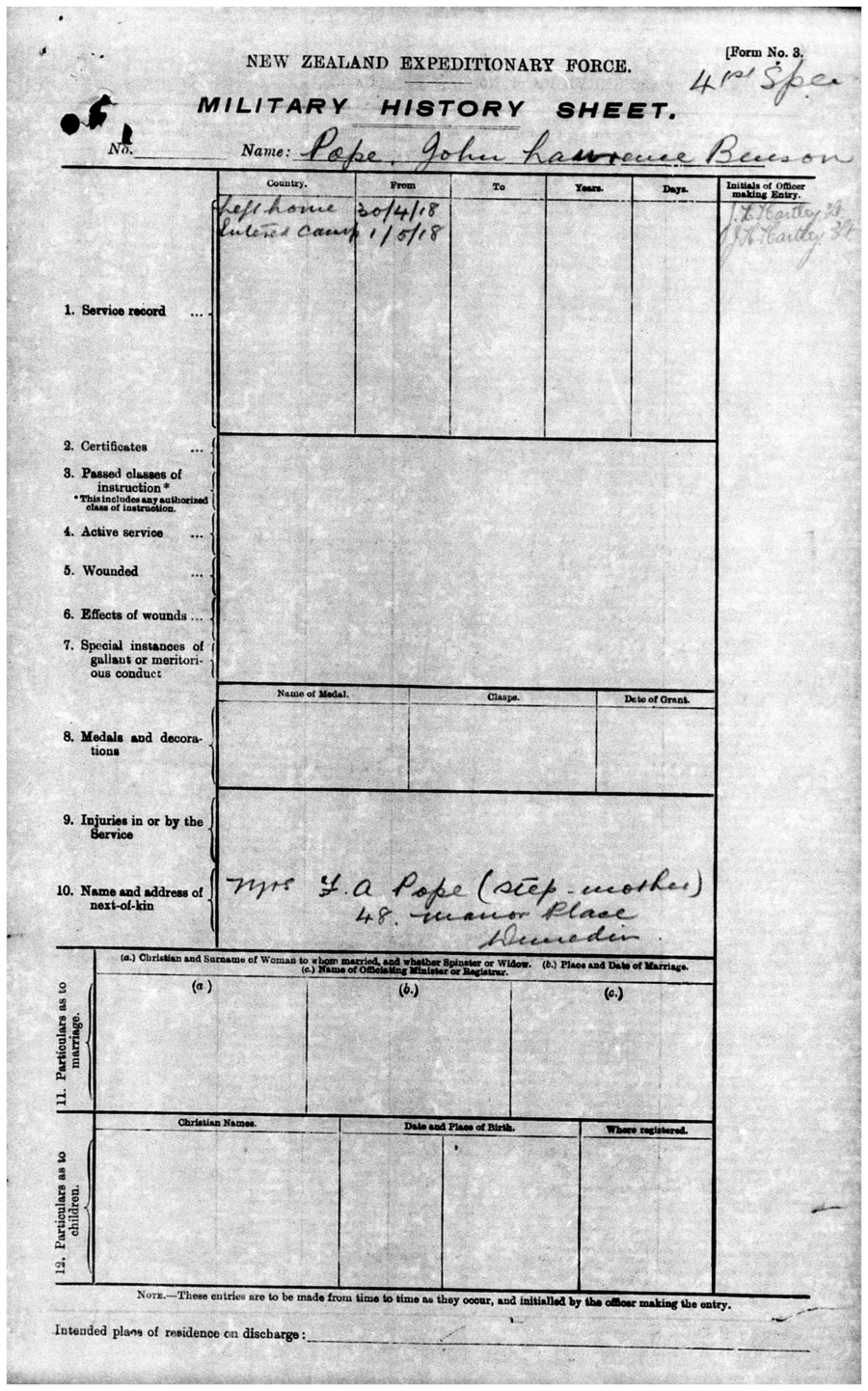
Open the official service record Read every page below

The vessels behind two typed names

Out on Tahiti.
Home on Zealandic.

John’s personnel papers turn the ships into dates and movements. The photographs restore their physical scale—but were taken later, so they show the same vessels rather than John’s own departure or return.

The steamship Tahiti in Wellington Harbour in 1928 or 1929
OUTBOUND · 10 JULY 1918Tahiti

John sailed with B Company of the 40th Reinforcements. This c.1928–29 photograph shows the same vessel in Wellington Harbour.

William Hall Raine · Alexander Turnbull Library 1/2-099858-G · no known copyright restrictionsOpen image record ↗
The steamship Zealandic in a 1923 photograph
RETURN VOYAGE · 1919Zealandic

After illness and medical boards at Brocton, John was sent back to New Zealand. This 1923 image shows the vessel that carried him home.

Allan C. Green · State Library Victoria H91.250/940 · public domainOpen image record ↗

The outward route · 62 days

Five ports across a world at war.

Sidney James Anton, another man in the 40th Reinforcements aboard Tahiti, kept a daily diary of the ship’s progress and the life of its company.

  1. Wellington · New ZealandLeft the wharf and passed the Heads that evening.
  2. Albany · Western AustraliaCoaled at Princess Royal Harbour. Some troops marched through town to Middleton Beach.
  3. Cape Town · South AfricaBerthed for two days; Anton records general leave.
  4. Freetown · Sierra LeoneEntered through a minefield and coaled. Malaria risk kept troops aboard before a guarded convoy sailed.
  5. Plymouth · EnglandLeft the convoy at midday and berthed that afternoon.

Alongside the best-known lives

Sylvia and Dorothy,
seen in their own right.

Family histories often describe women only as someone’s daughter or wife. Sylvia and Dorothy’s own education, work and property records reveal much more.

Sylvia Mary White · born 1913

Education became a public skill.

After crossing the world at ten, Sylvia won recognition at Little River School and completed a Diploma in Home Science at the University of Otago in 1933. Newspapers later reported her giving public cookery demonstrations. Her training had become skilled work performed before an audience.

She later married John Lawrence Benson Pope. Together they raised five children: Paul, Steve, Christine, Richard and Kenny—the family in whom the White and Pope journeys meet.

Open the school record Open the diploma record Open the cookery notice

Dorothy Helen White · died 1937

A stenographer with property of her own.

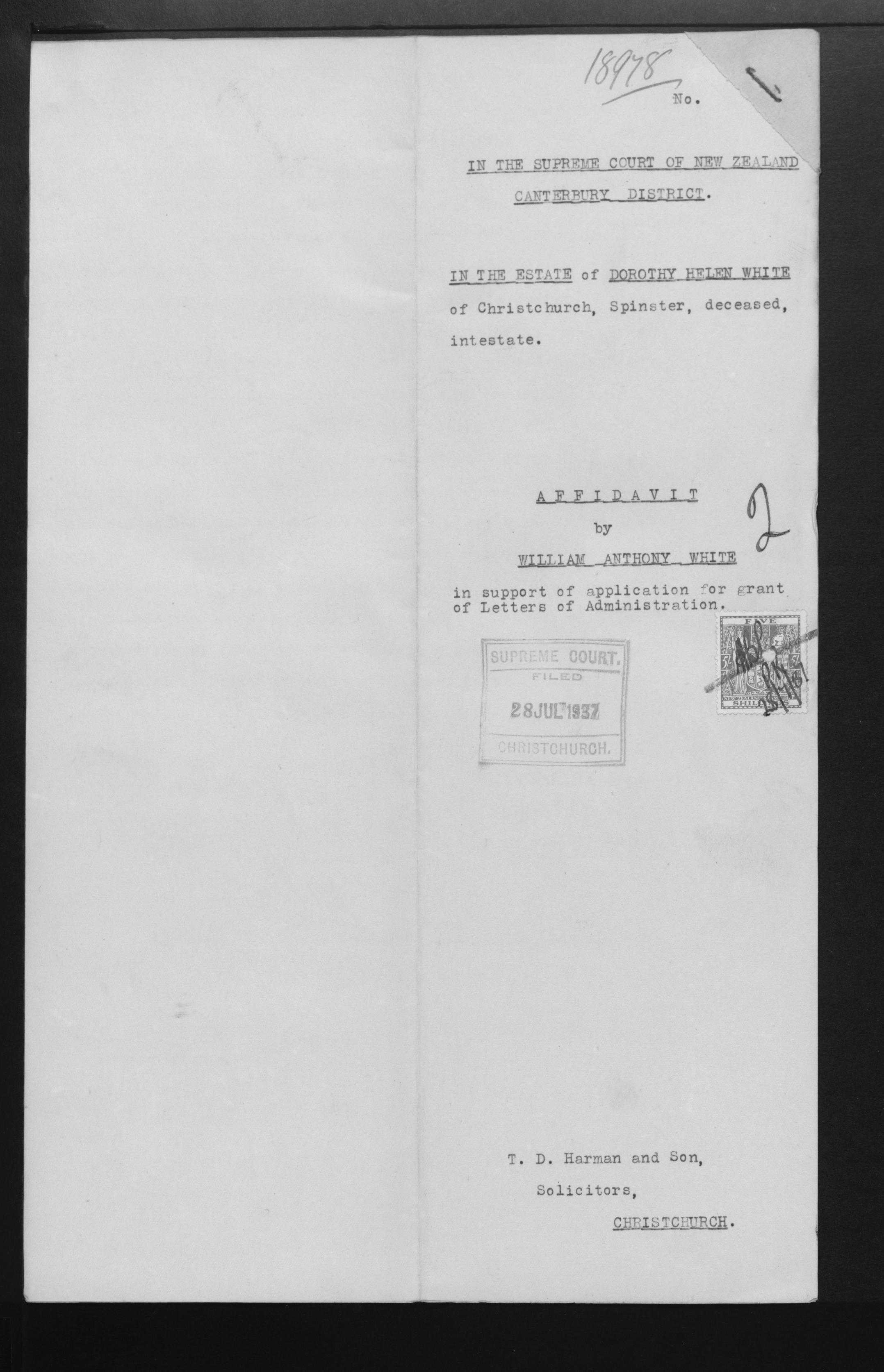
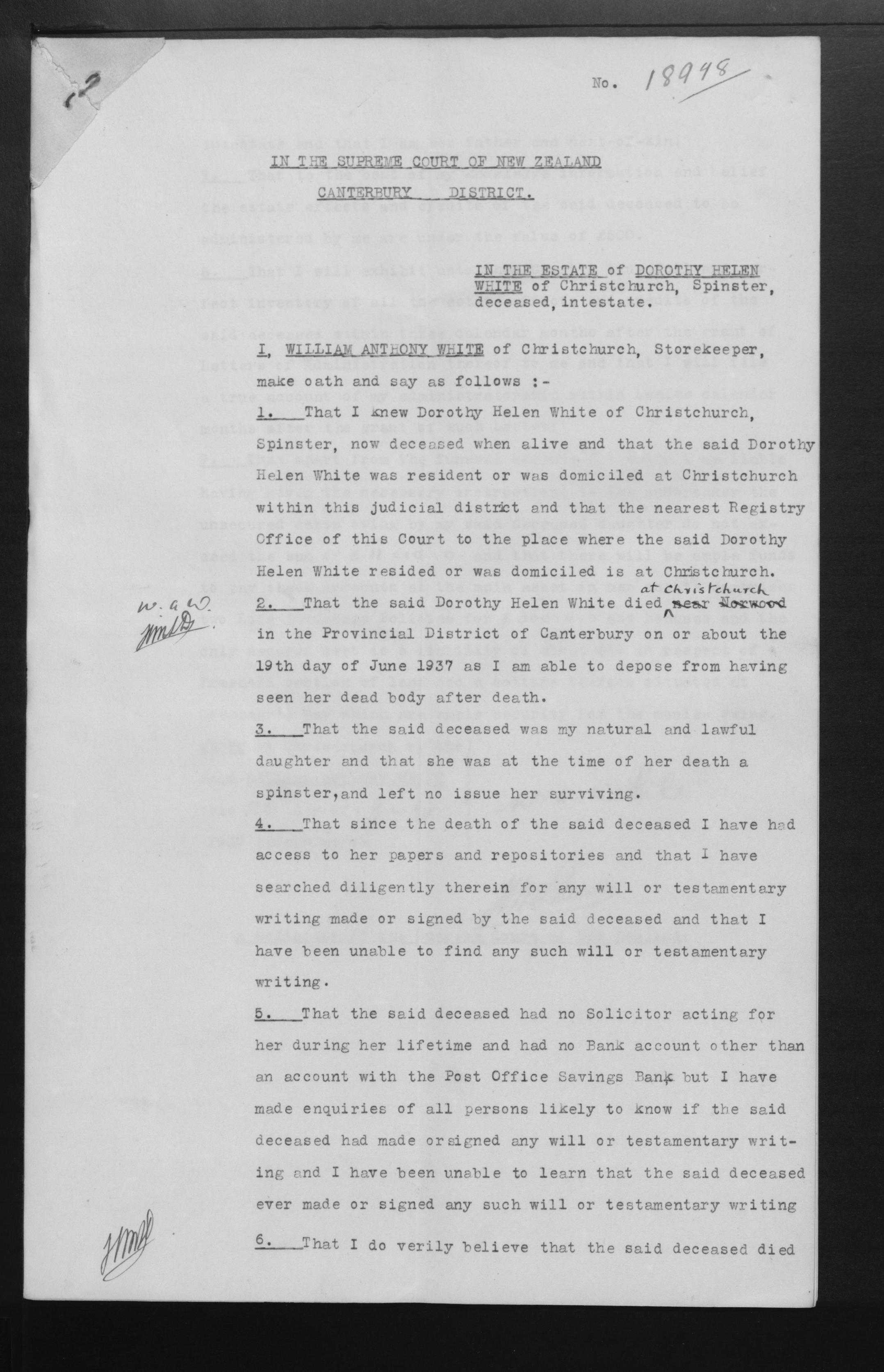
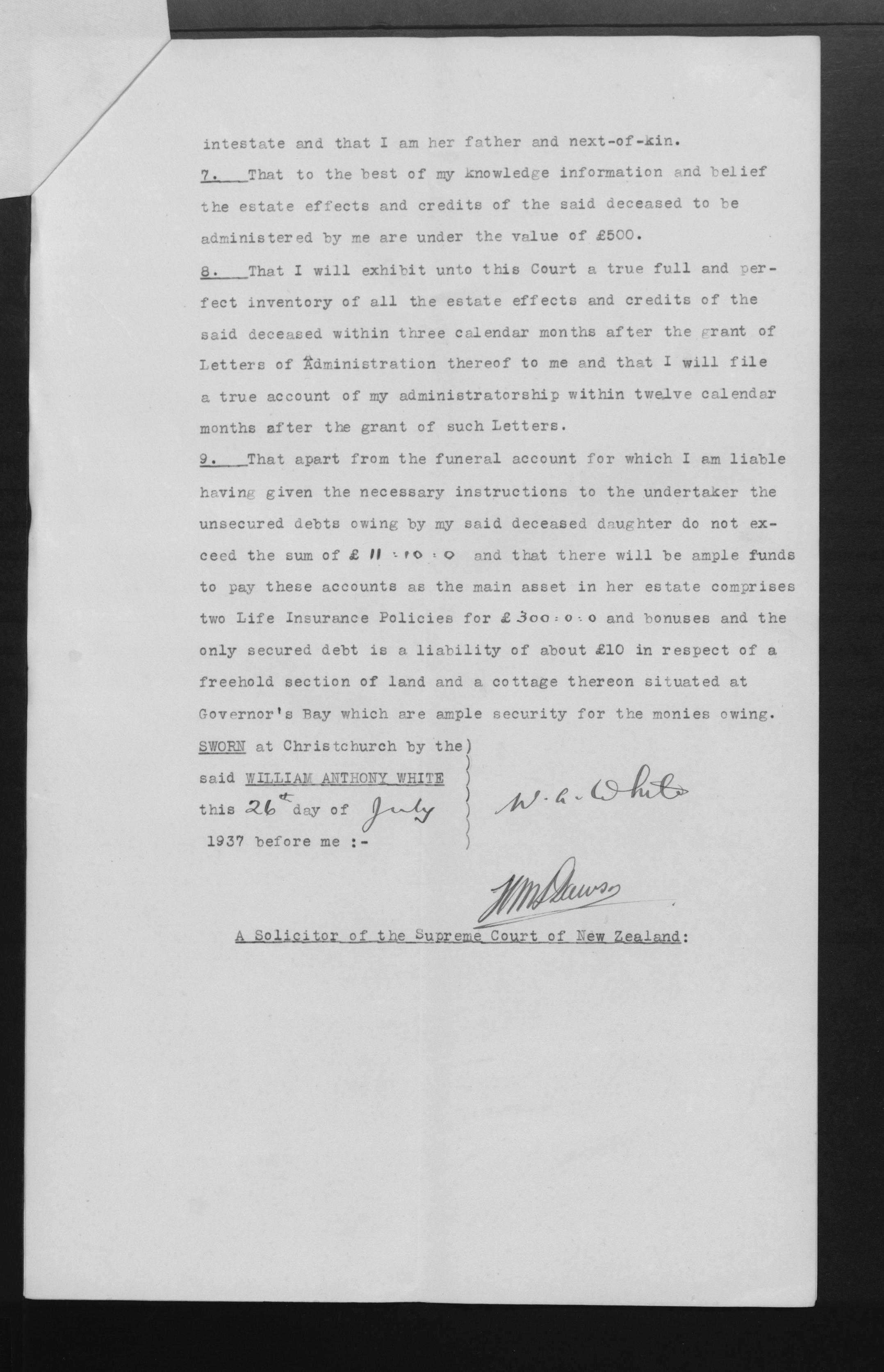
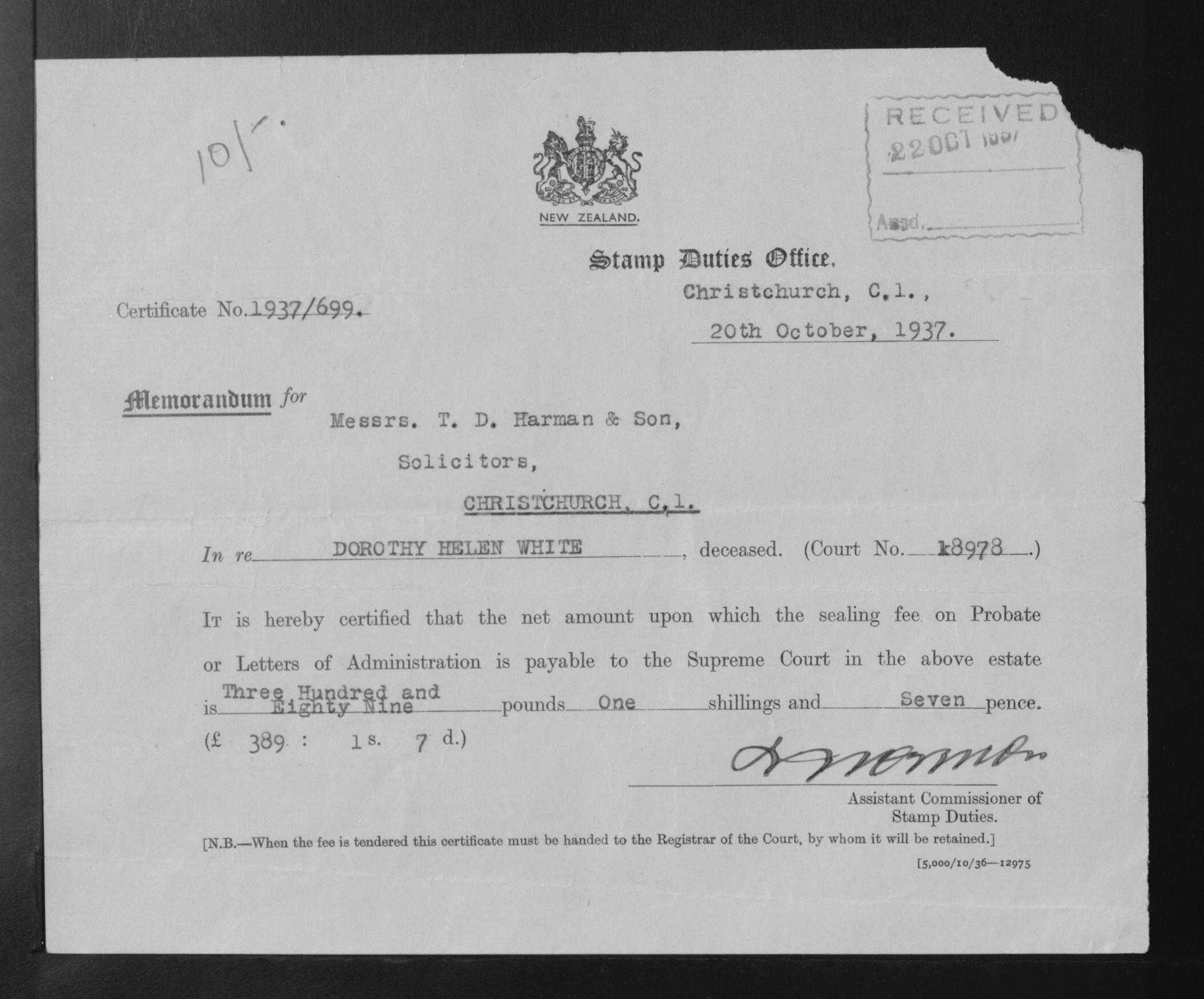
The papers used to settle Dorothy’s estate record her occupation, two life-insurance policies worth £300 plus bonuses, and a section and cottage that she owned at Governor’s Bay. She died after a motorcycle accident near Norwood; the official investigation could not determine what caused it.

After debts and expenses, her estate was worth £389 1s 7d. The figure lets us see more than a tragic death: Dorothy was a young woman who worked, insured her future and owned property.

Open the estate papers below Open the accident report Open the coroner’s finding

Episode six

The family scatters—
then the lines meet.

Migration did not end with New Zealand. Members of the White family moved to Canada, while Pope descendants spread across New Zealand and Australia.

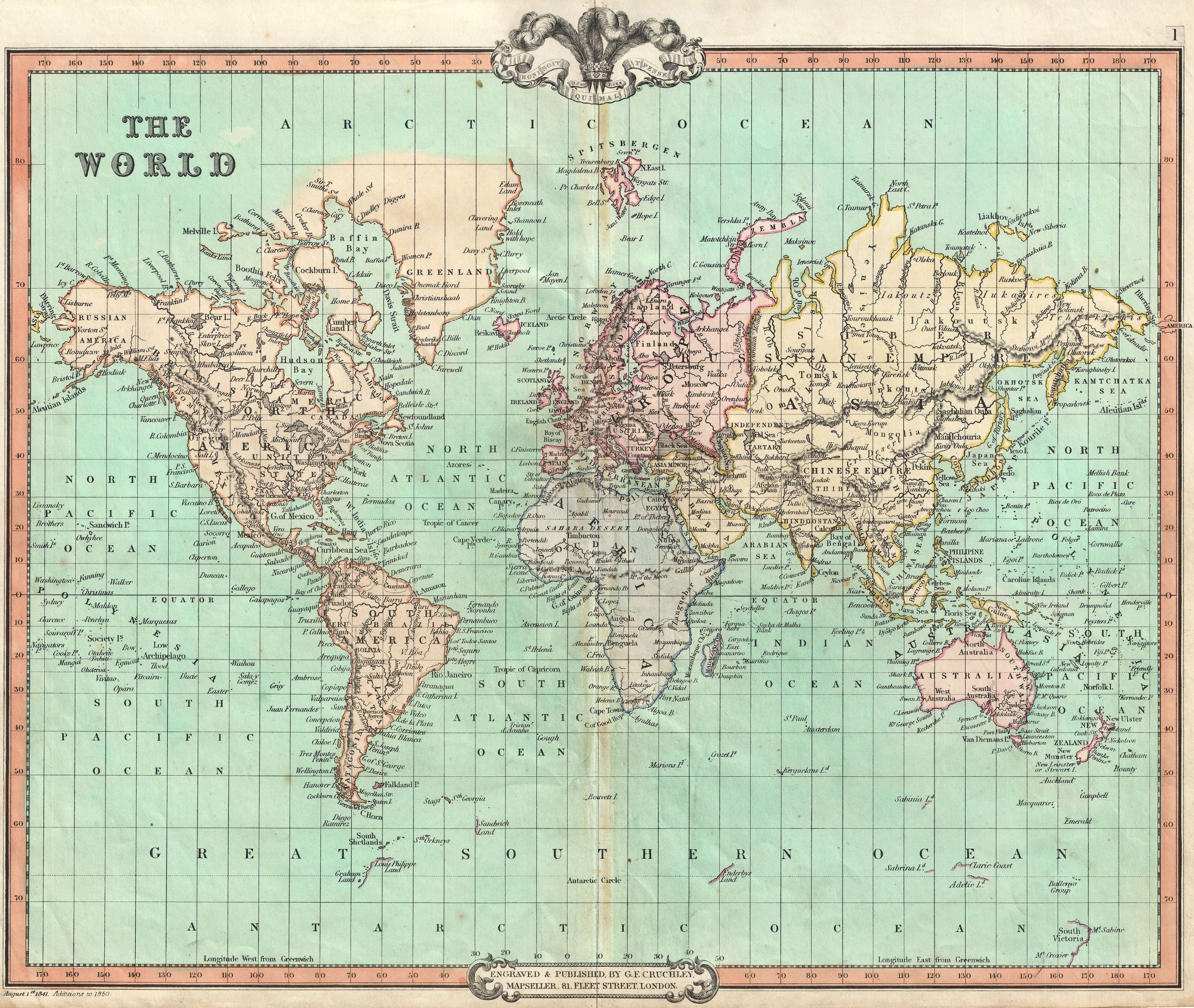
George Cruchley's map of the world published in 1850EghamBelfastGlasgowSaskatchewanArnpriorPanamaCape of Good HopeWellingtonCanterbury
A world crossed by successive generationsBritain and Ireland → Canada and New Zealand

The Pope family moved from Belfast to Glasgow and then sailed down the Atlantic, around the Cape of Good Hope and across to Canterbury. The White family spread west into Canada and, in 1923, travelled through the Panama Canal and across the South Pacific to New Zealand. The routes appear over a map published in 1850, showing the world as the earliest migrants would have known it.

George Cruchley, The World, 1850 · public domain · open map ↗
Pope voyages · via Cape of Good Hope · 1861–63White voyage via Panama and the South Pacific · 1923White migration to Canada · 1913–20

One sentence joins the families

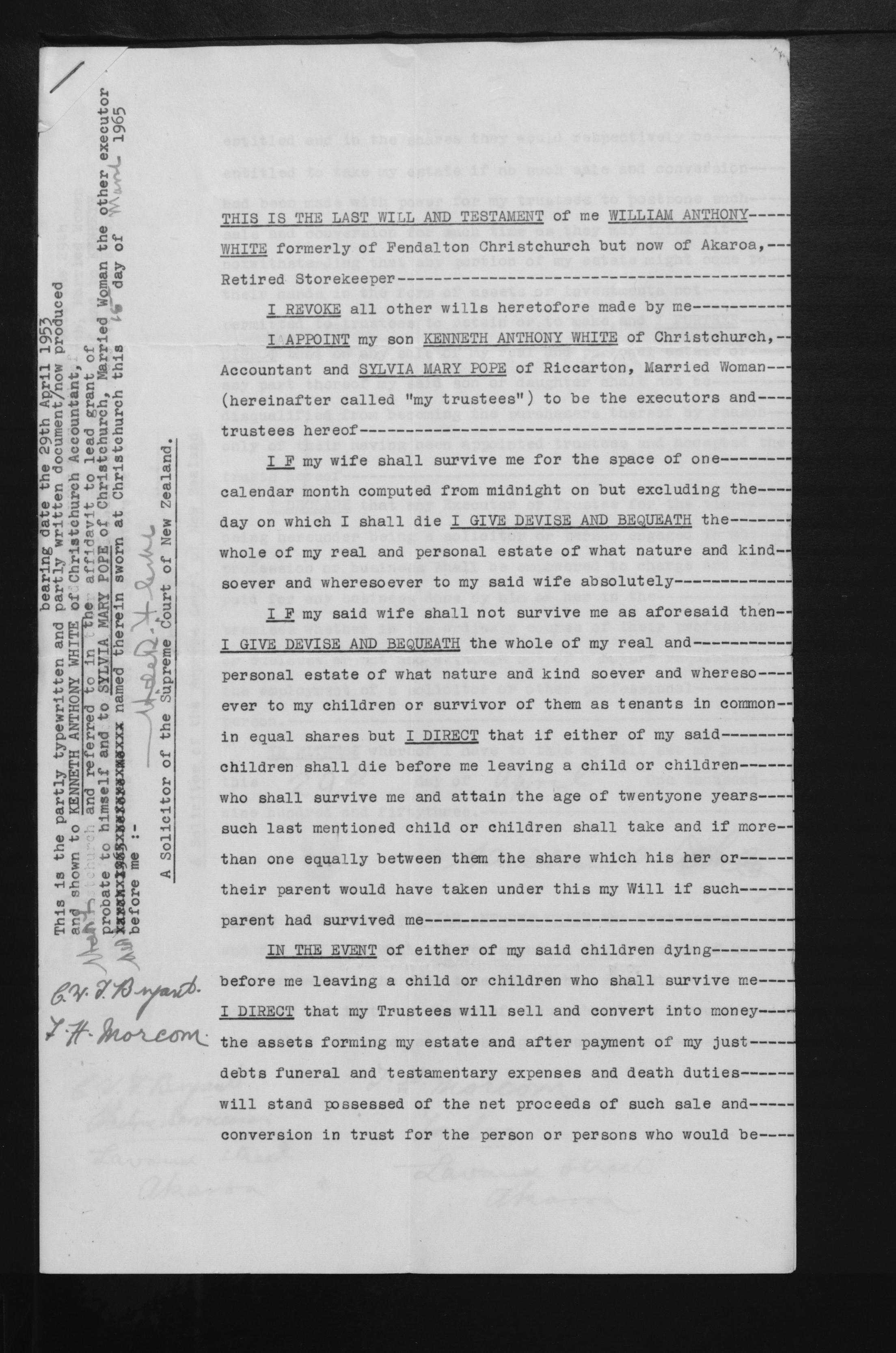
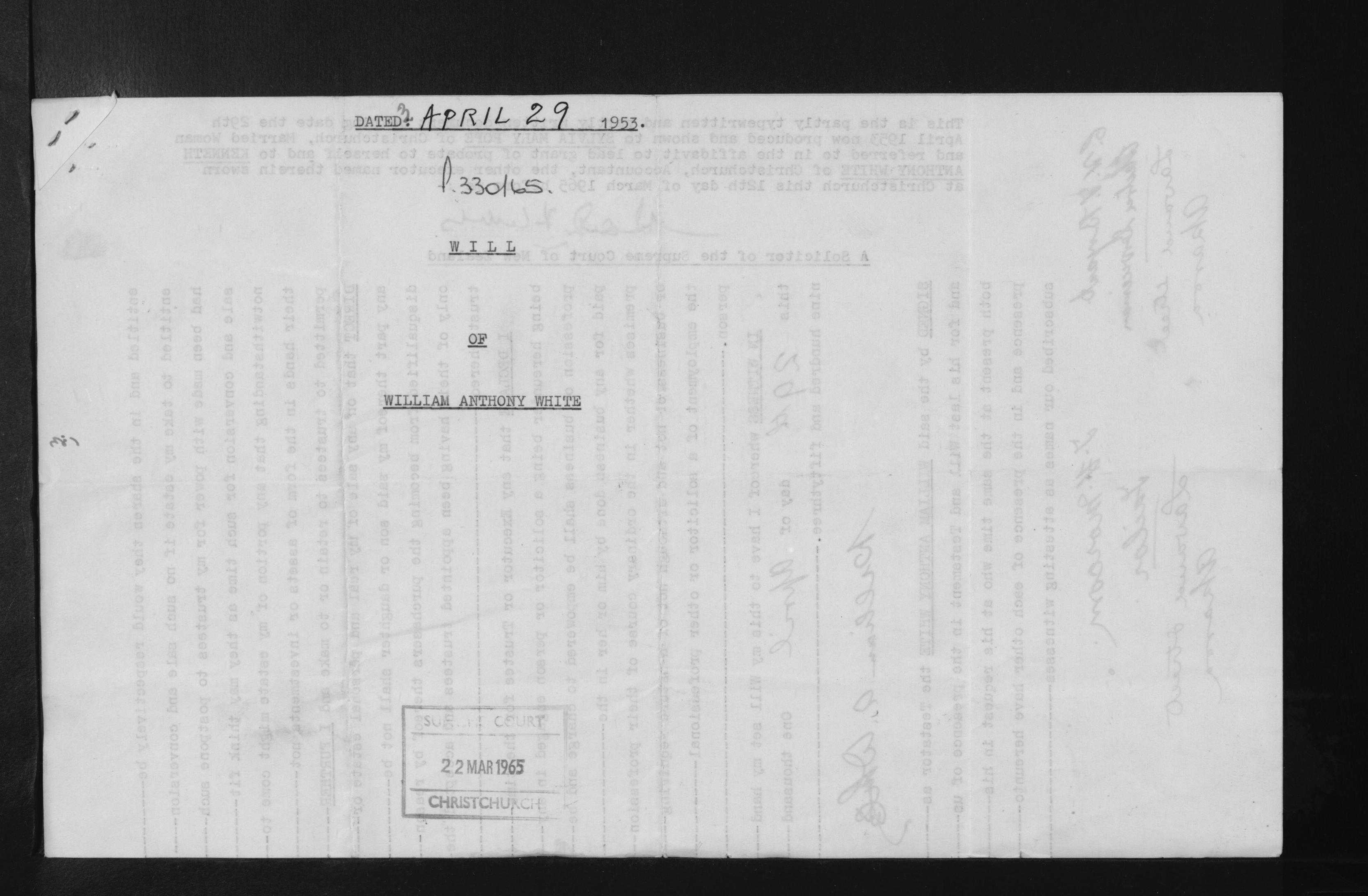
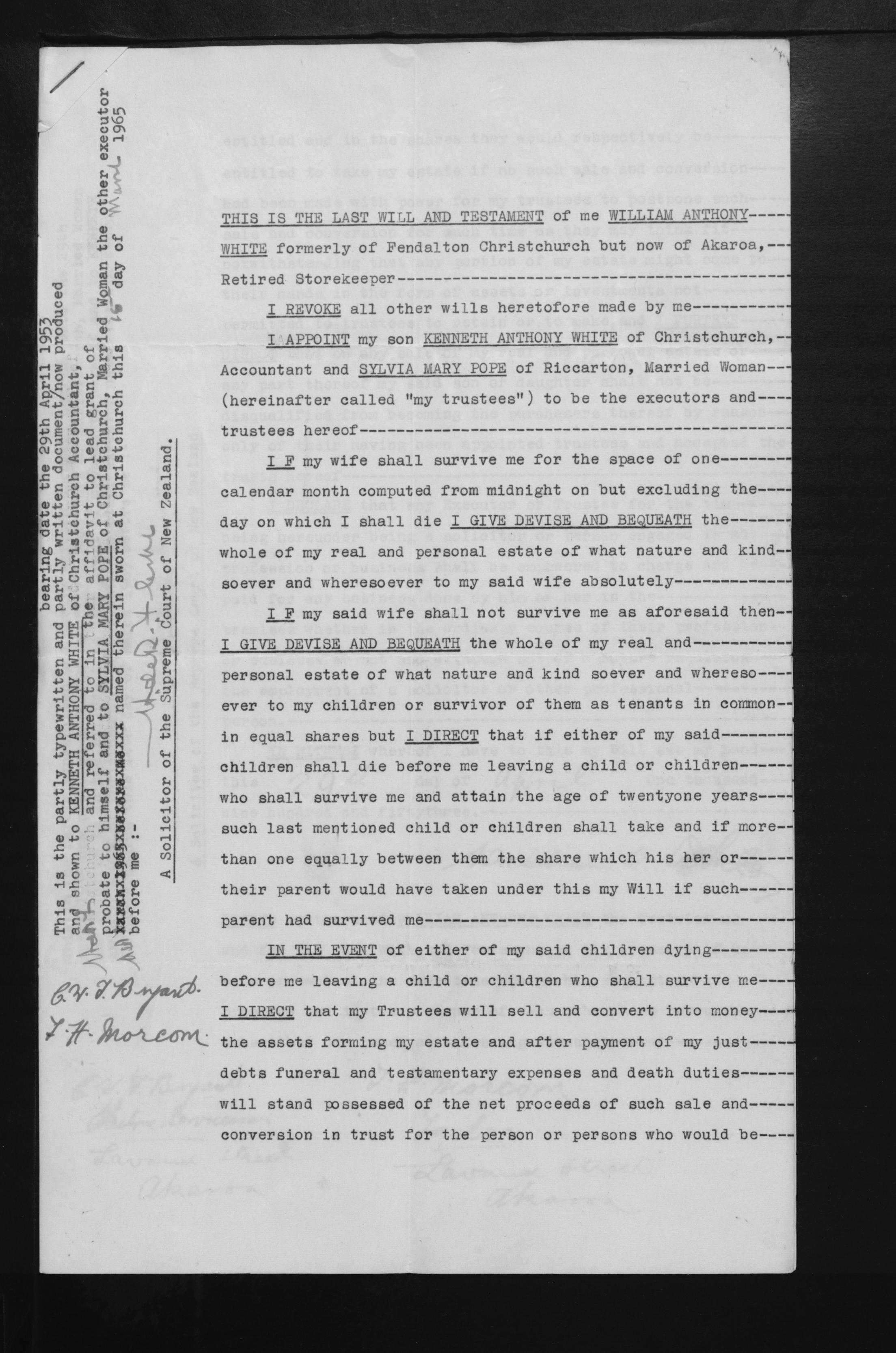
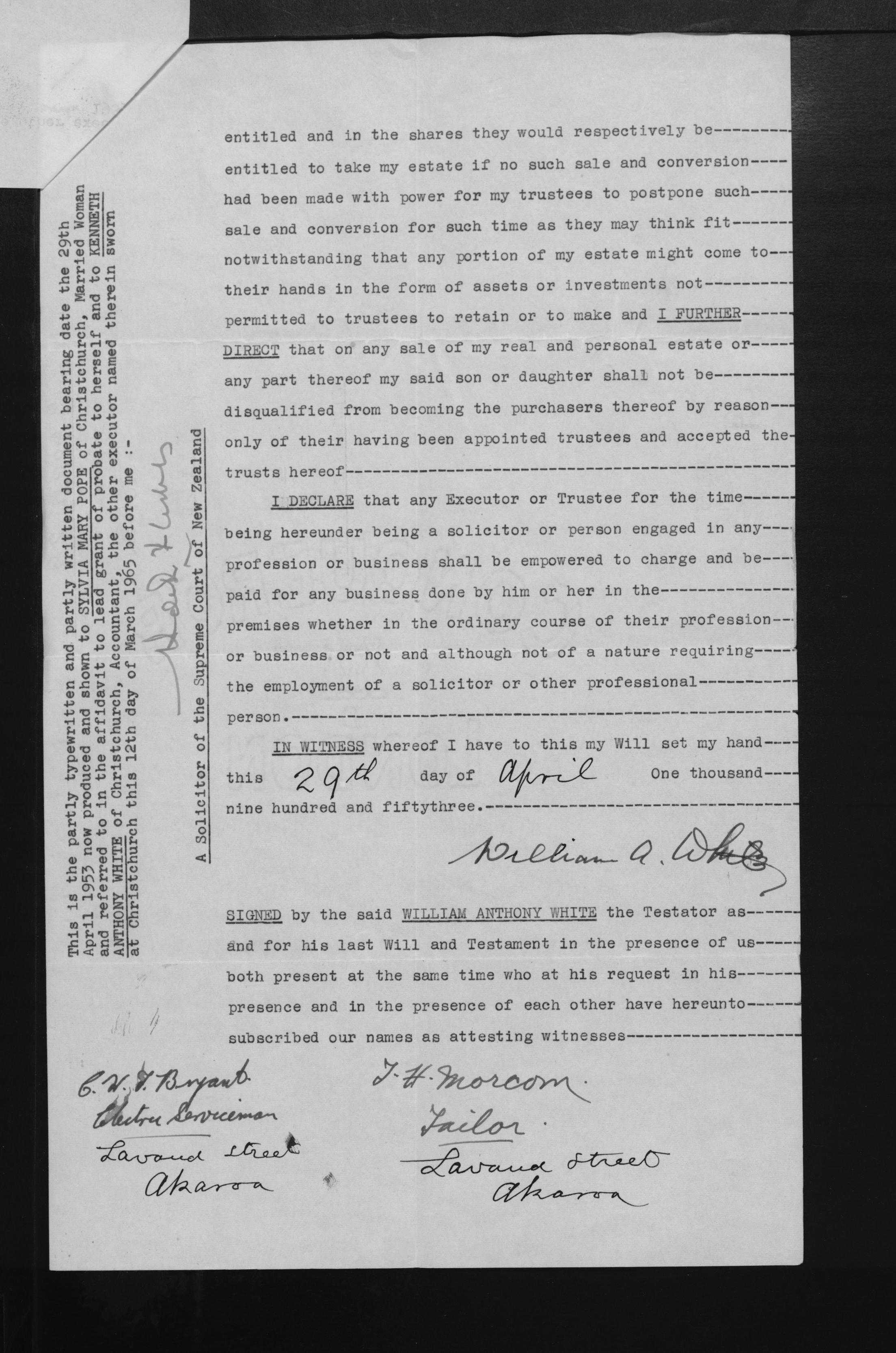
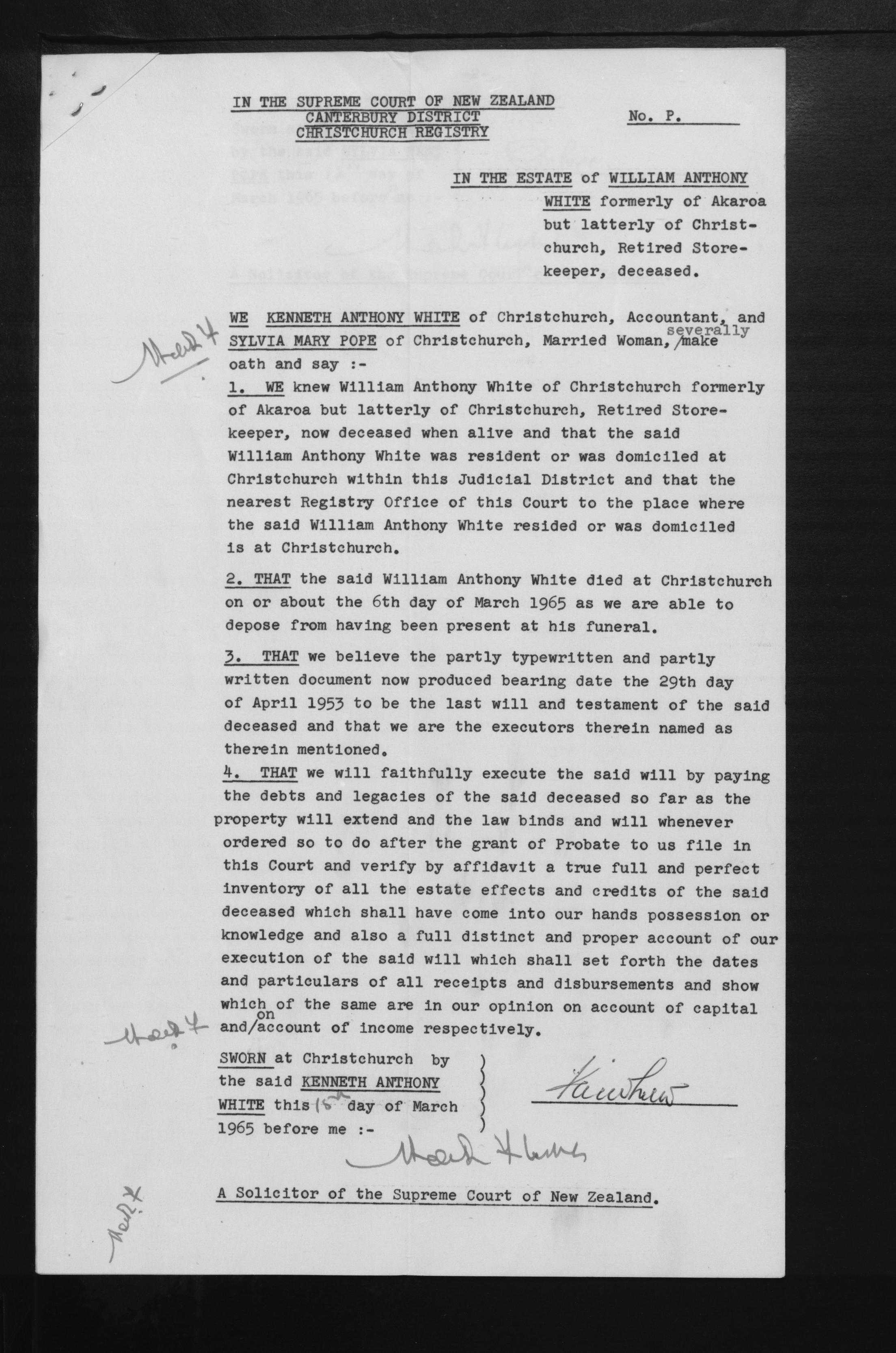
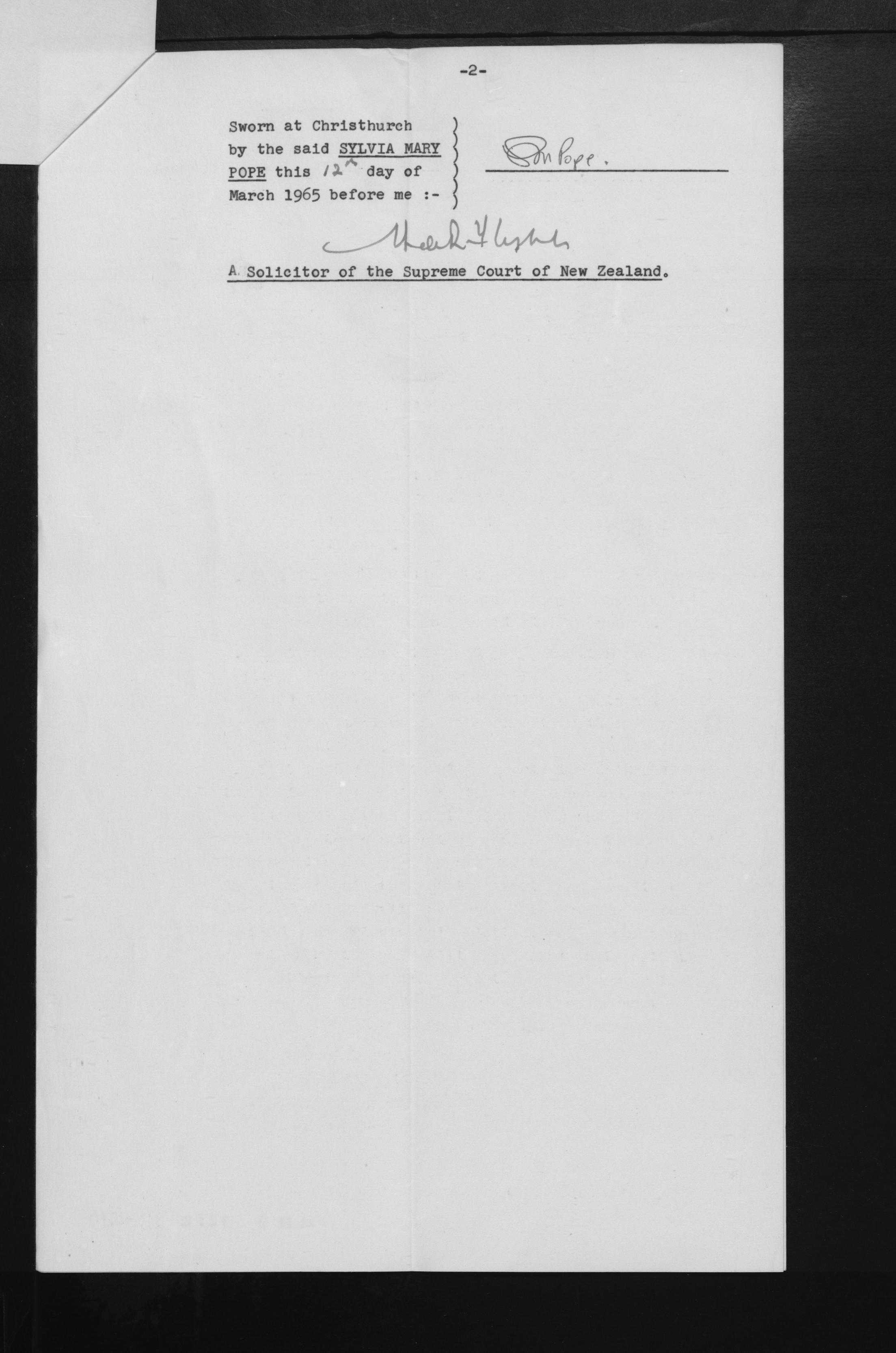
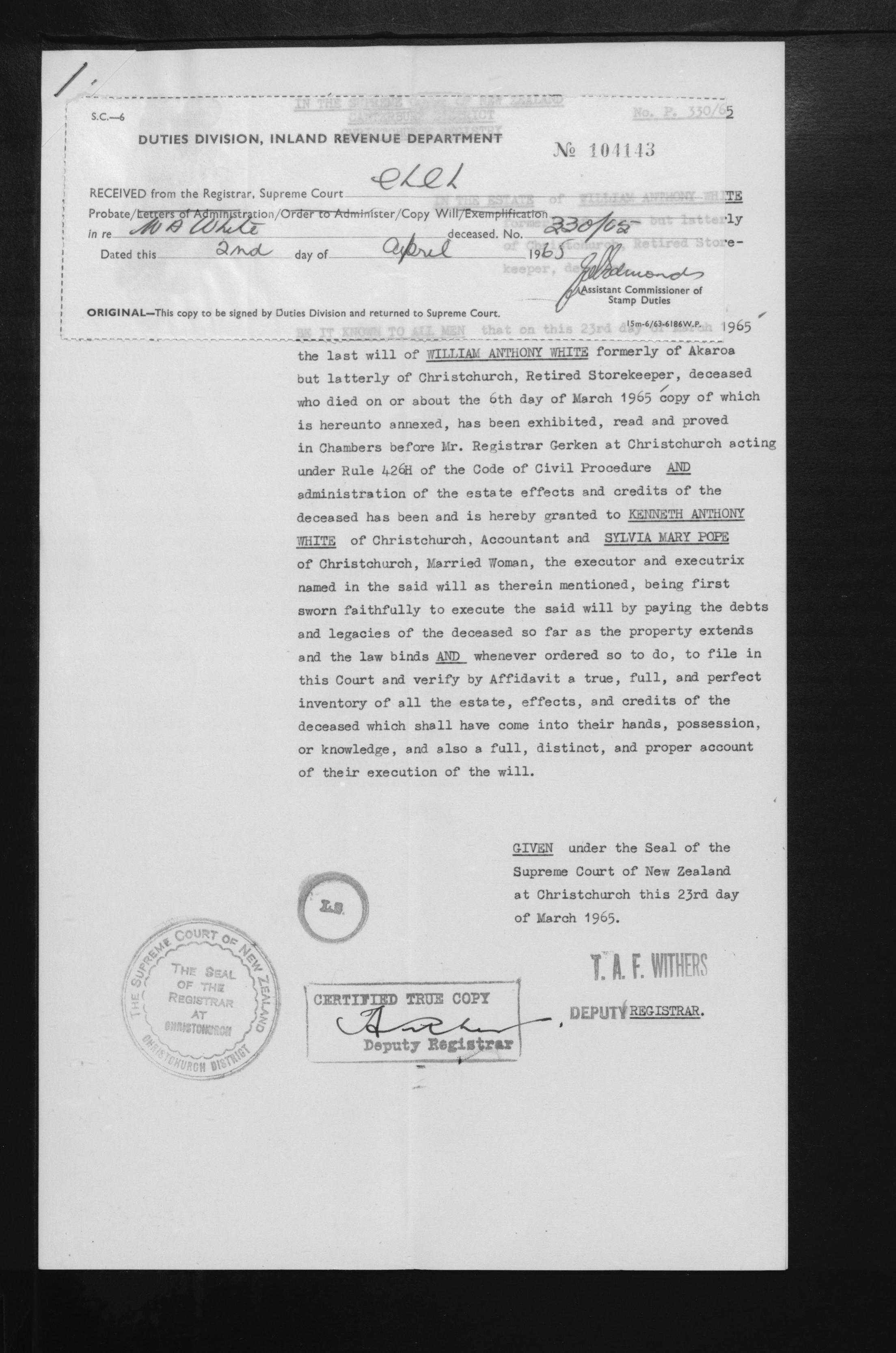
William Anthony White signed his will on 29 April 1953. Among its formal language is one wonderfully clear phrase: “my daughter Sylvia Mary Pope.” Those five words prove that the White girl who left Isleworth became Sylvia Pope and built a life in Christchurch with John.

Open William’s will below
Page of William Anthony White’s will naming Sylvia Mary Pope
The document that joins the families · 1953“my daughter Sylvia Mary Pope”

Archives New Zealand R22351397, page 2. Open the complete eleven-page file in the record room ↓

The evidence beneath the story

The record room.

175

pages and memorial images across eleven collections

Open any image below to see it at full size. The galleries contain public files from Archives New Zealand, five selected government pages from Library and Archives Canada, and two memorial images. Each collection keeps its archive reference and a link back to the source so another researcher can retrace the evidence. Two unrelated pages that appeared after David Pope’s file on the same roll of microfilm have been left out.

01

Archives New Zealand · R20180218 · CH11327/1921 · 10 pages

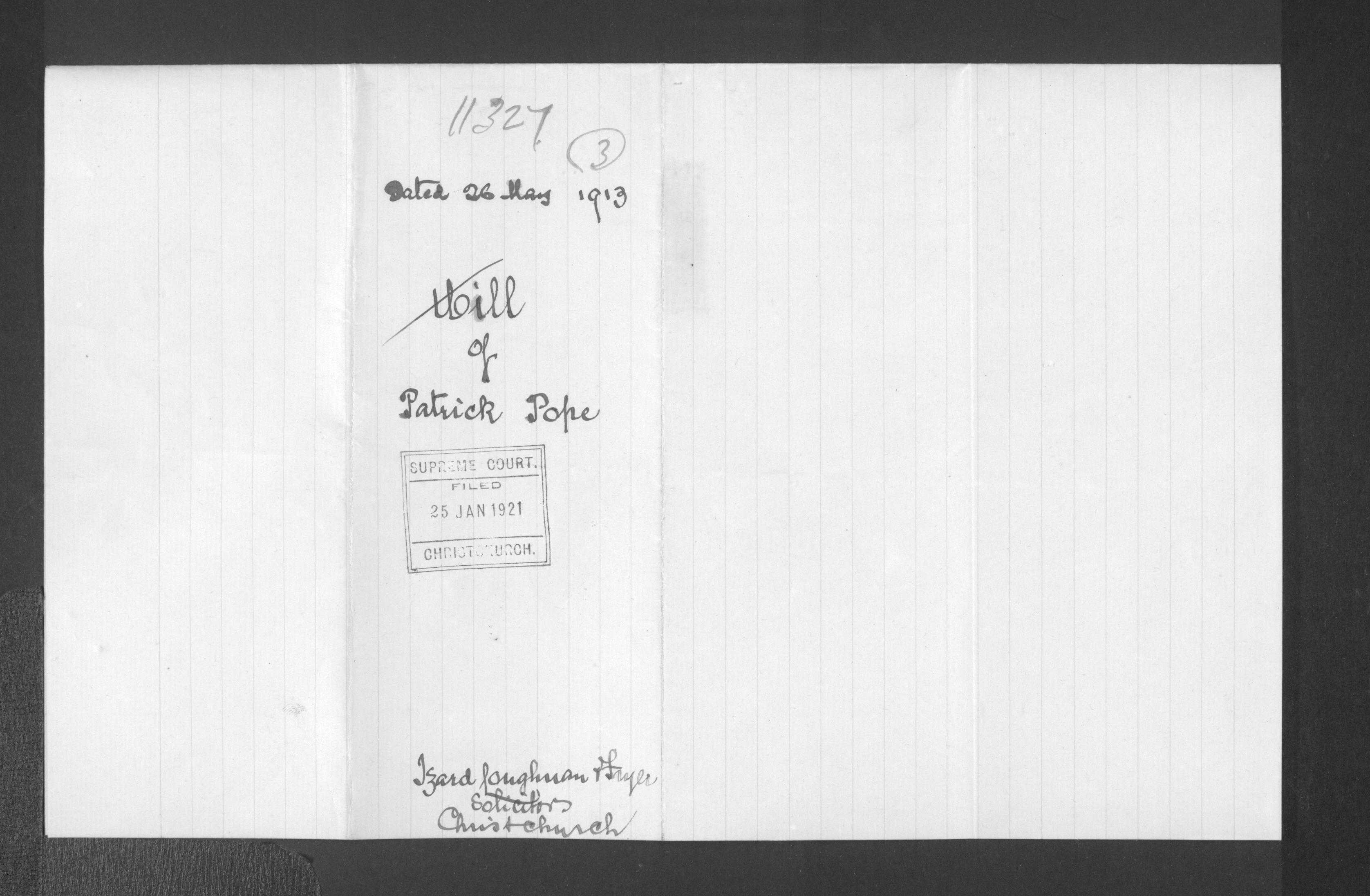
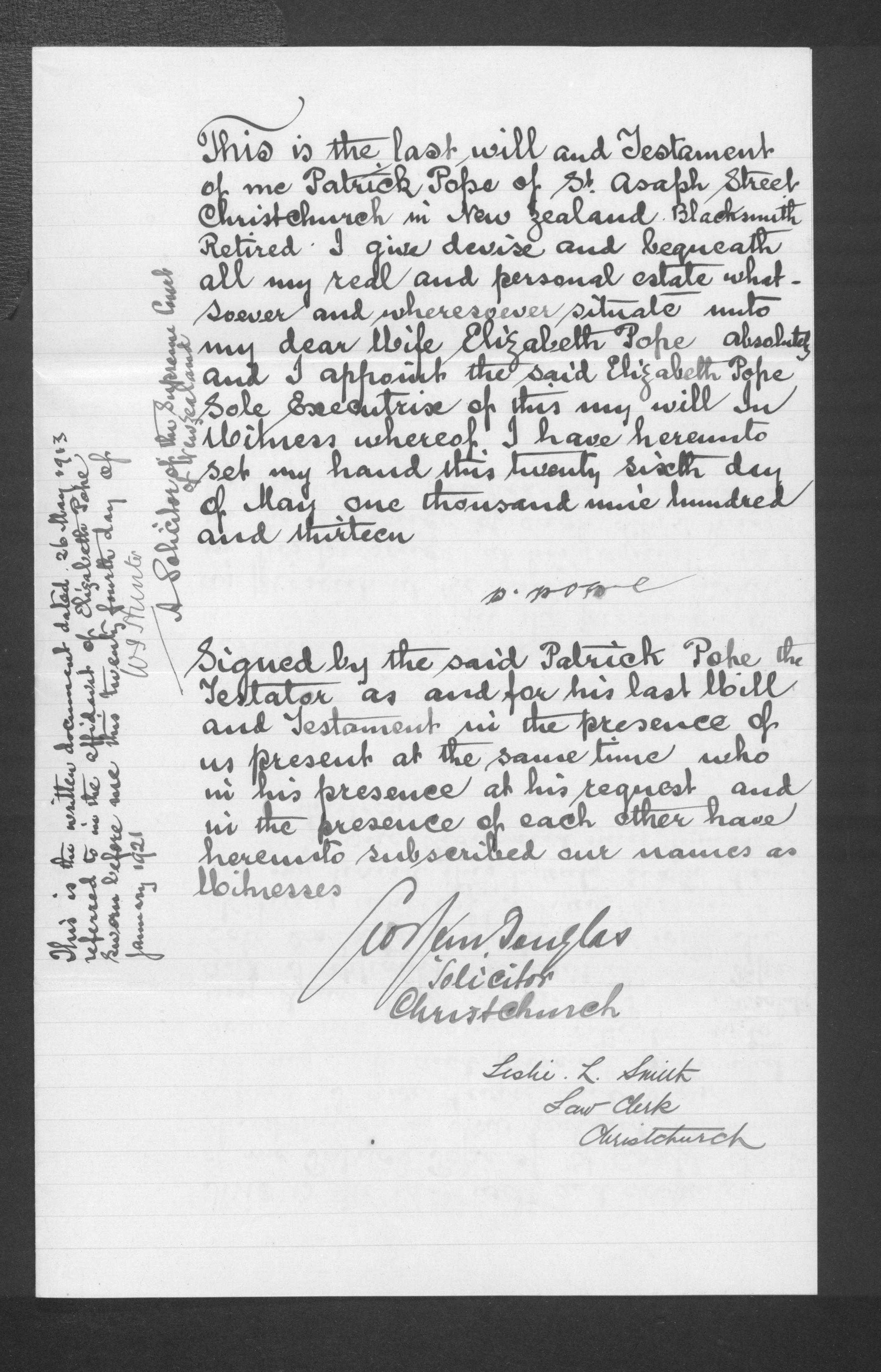
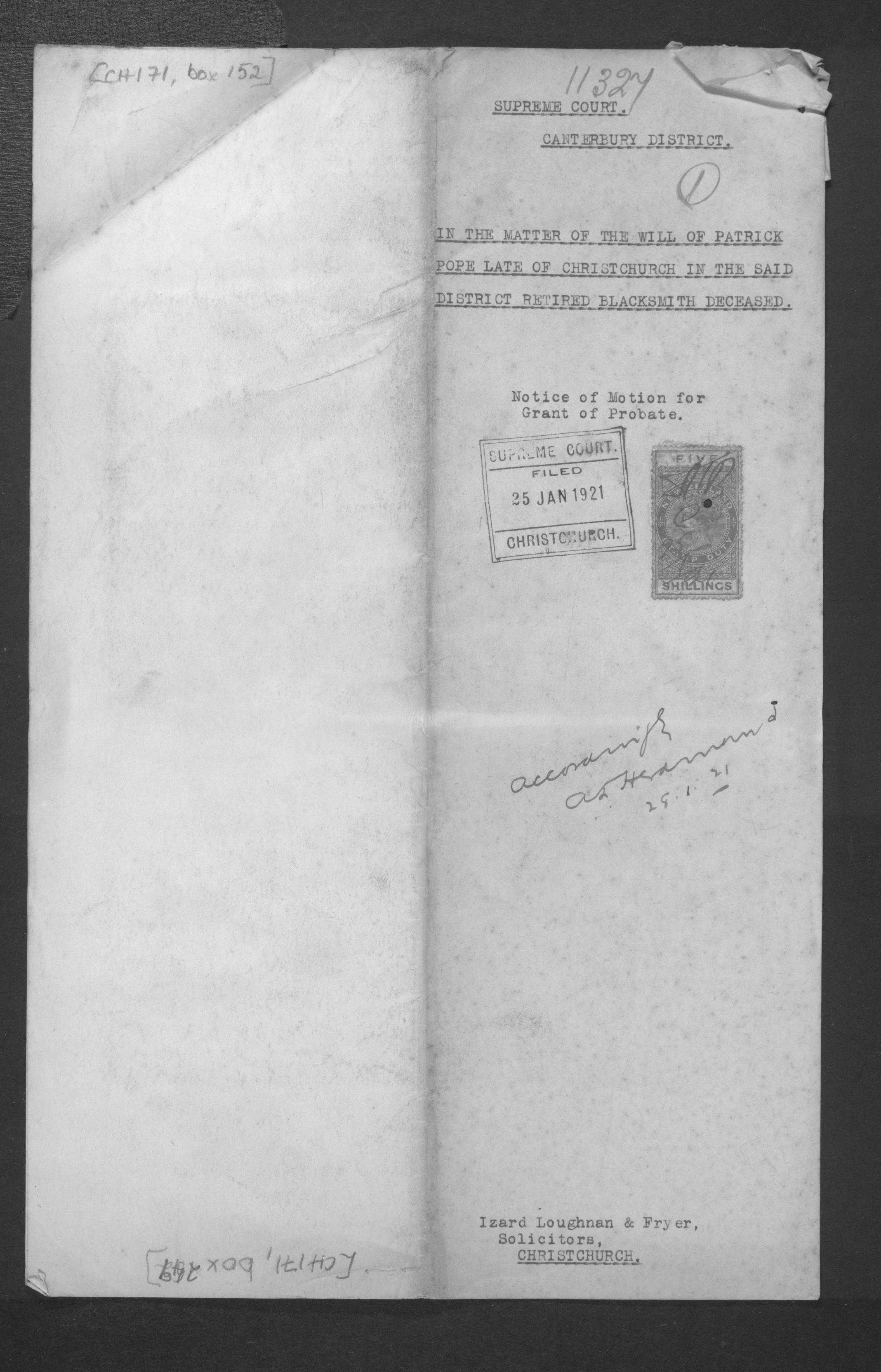
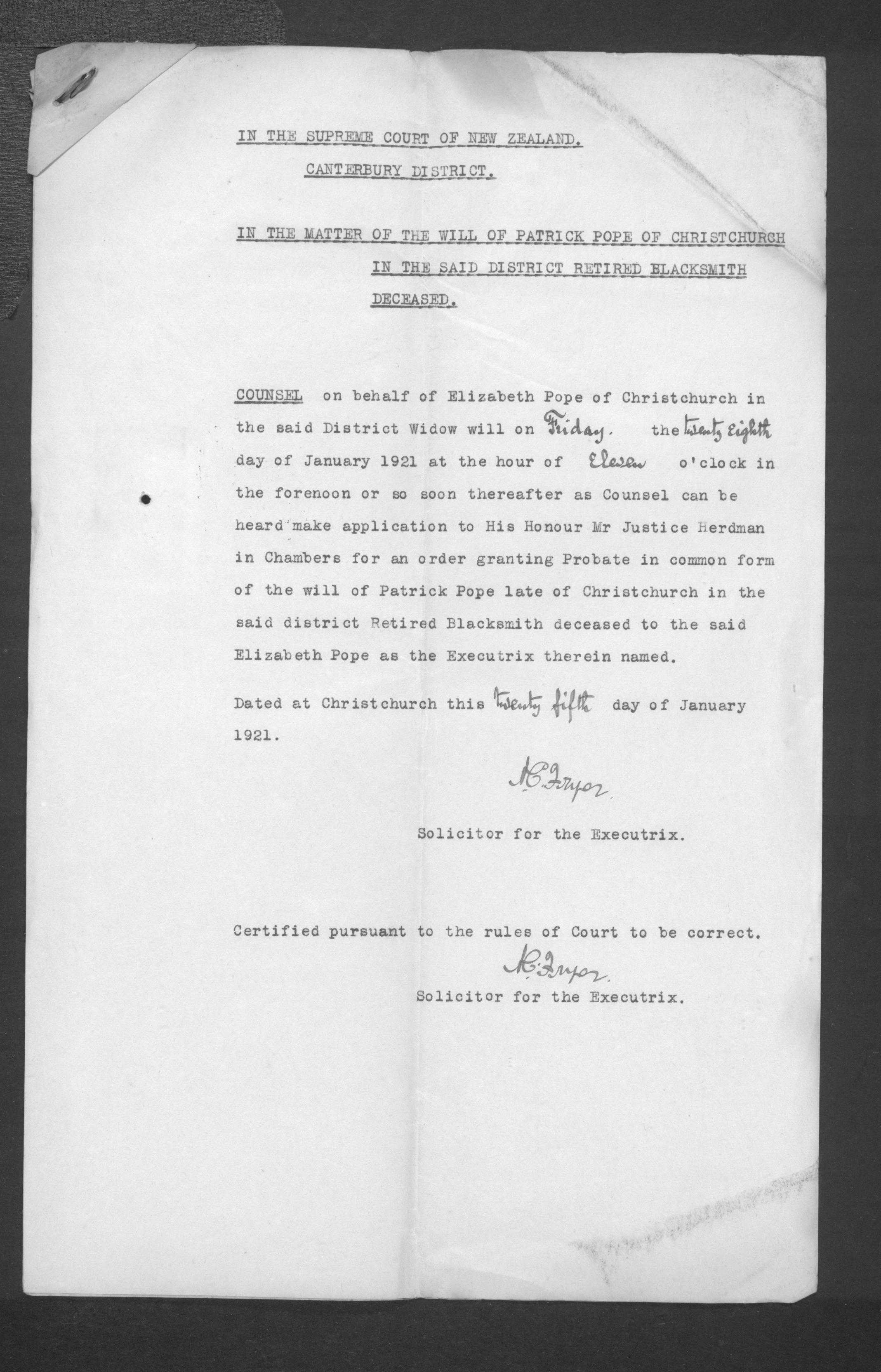
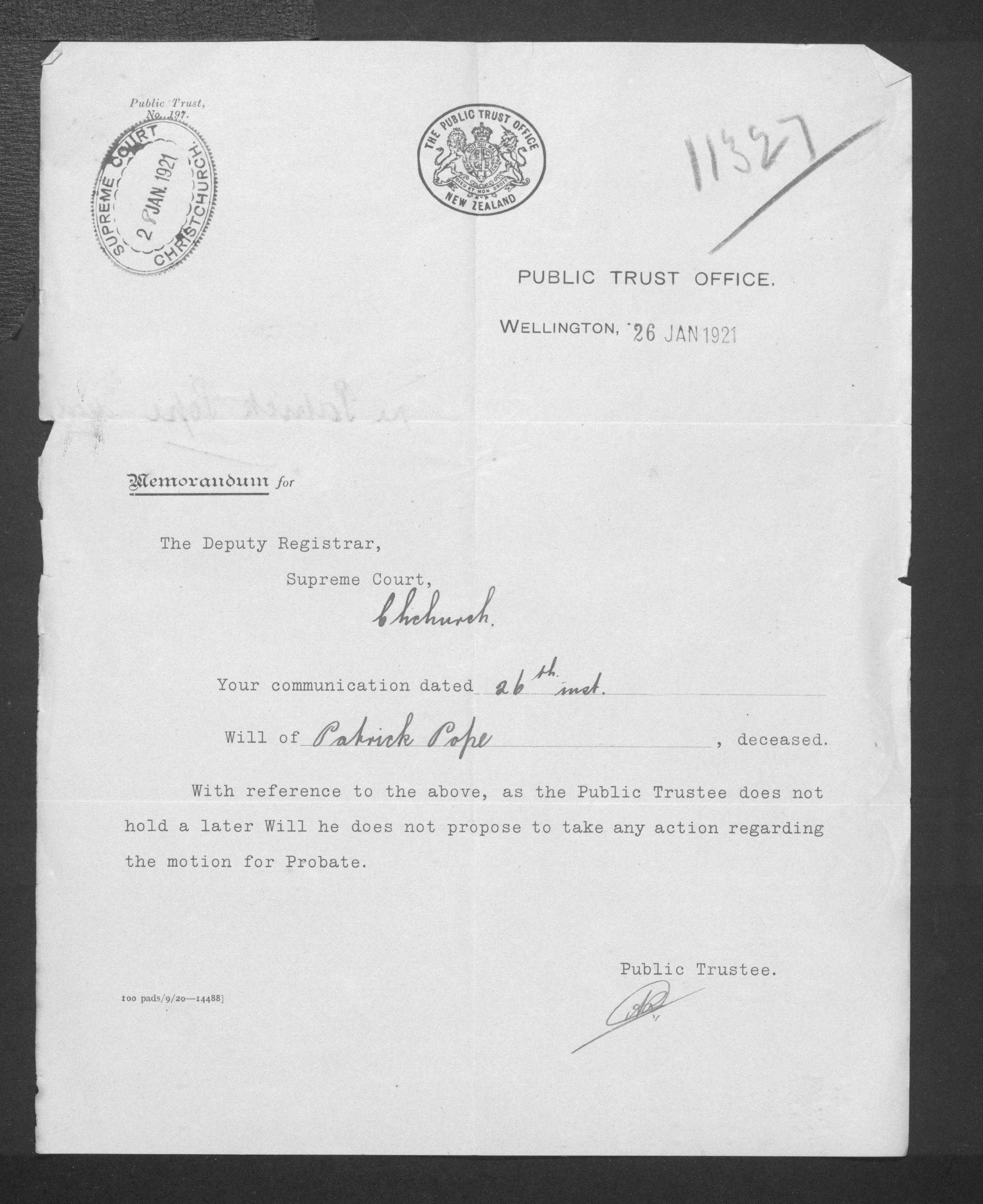
Patrick Pope’s will and estate papers

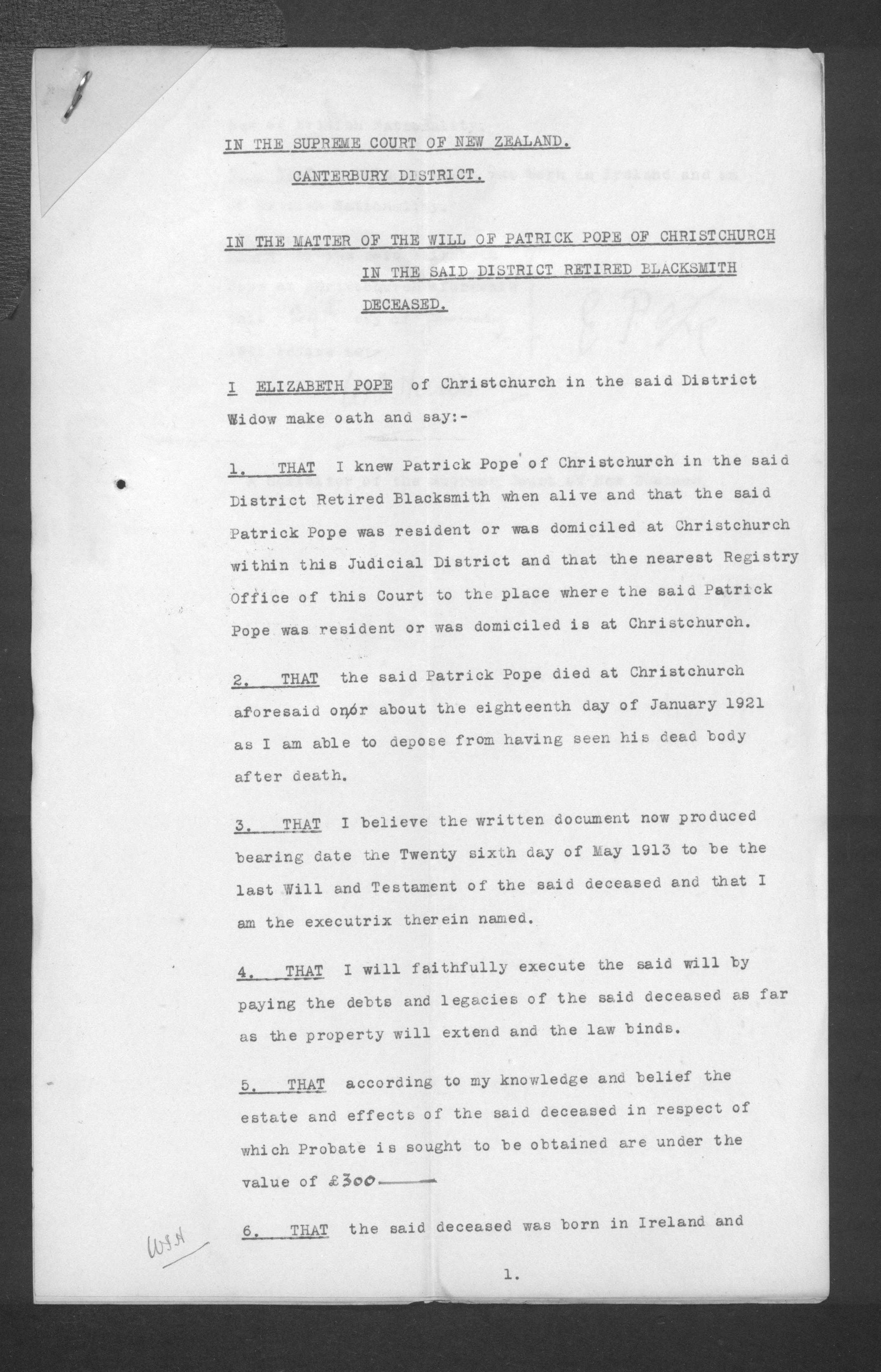
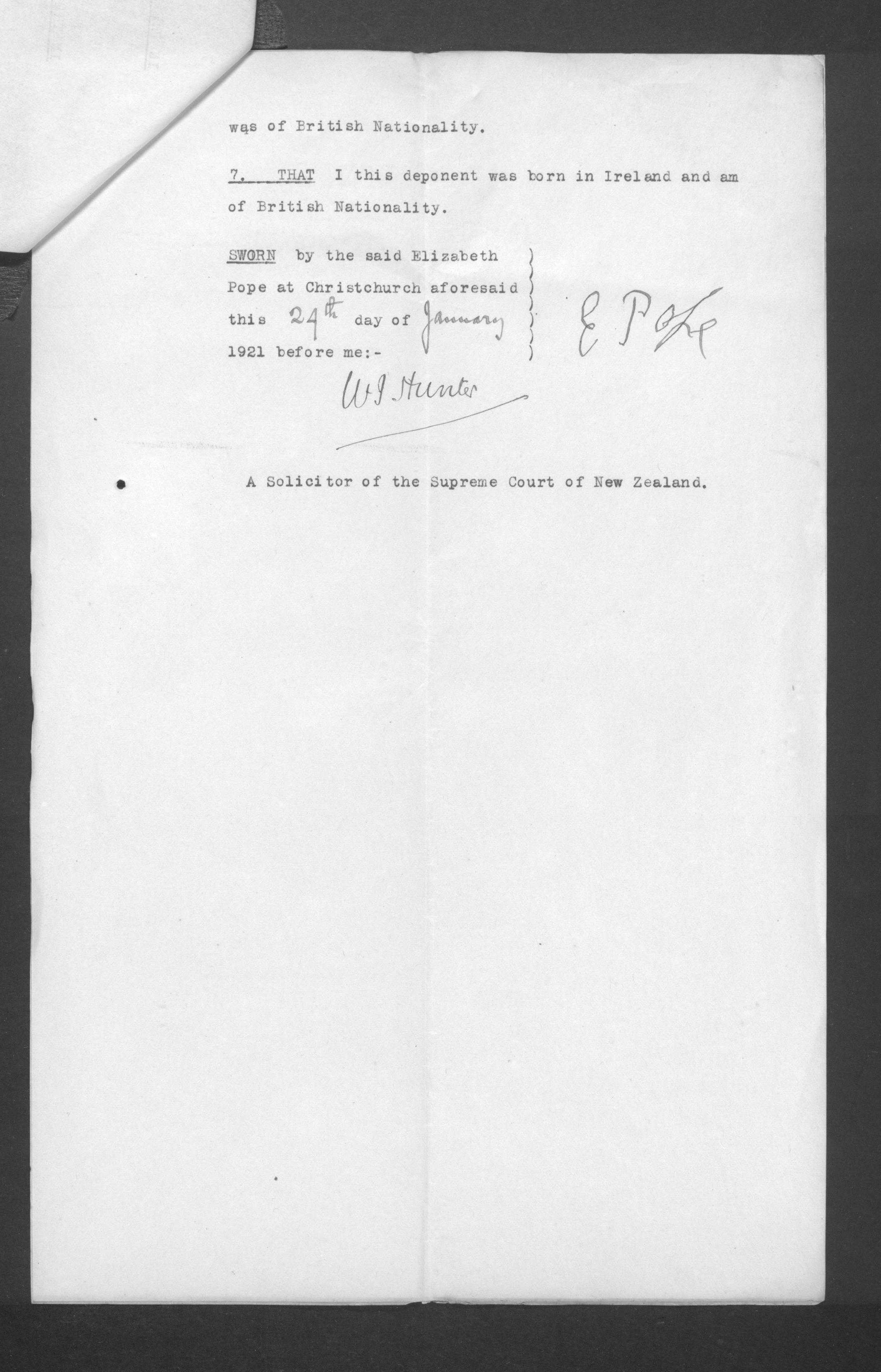
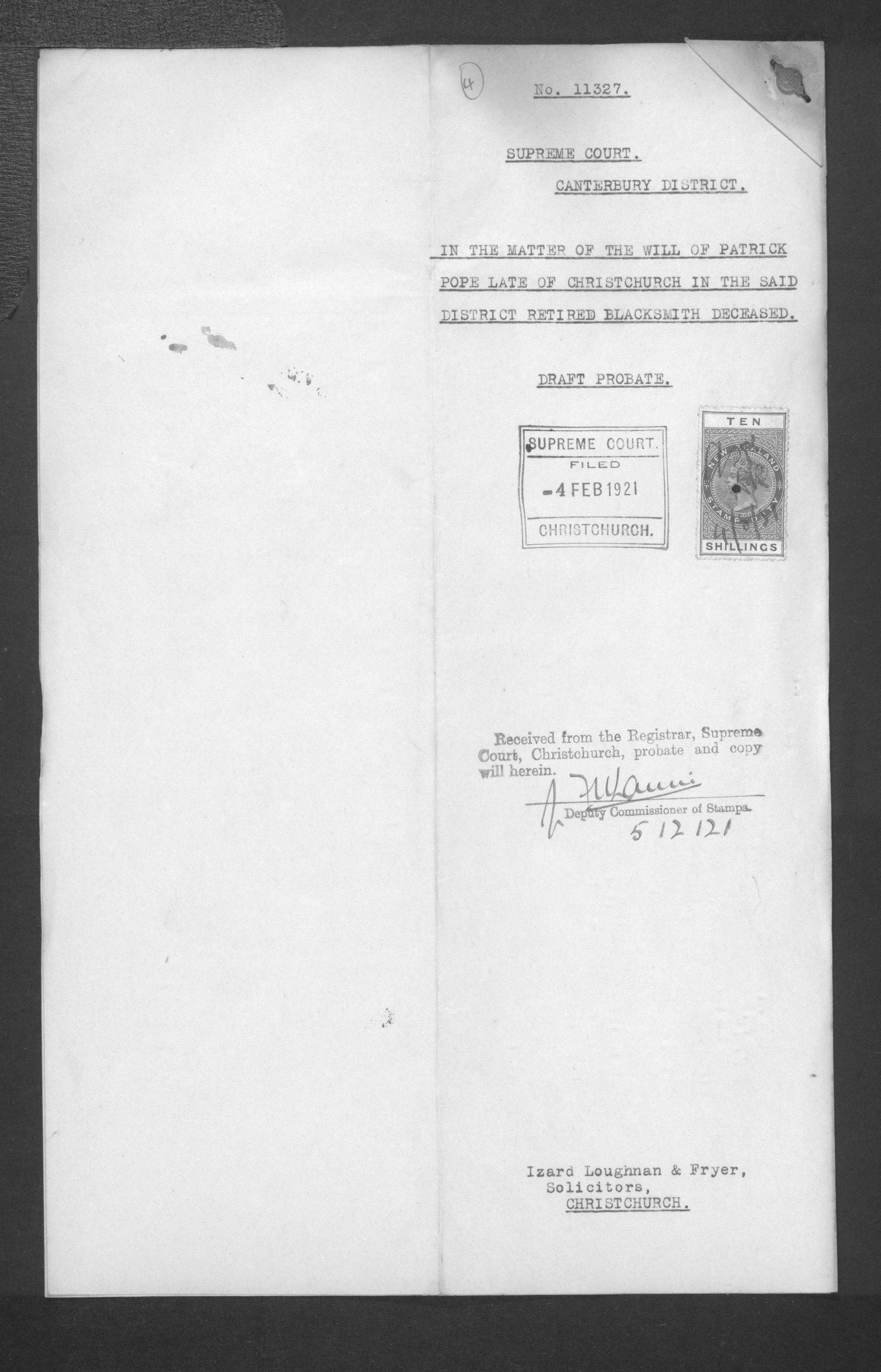
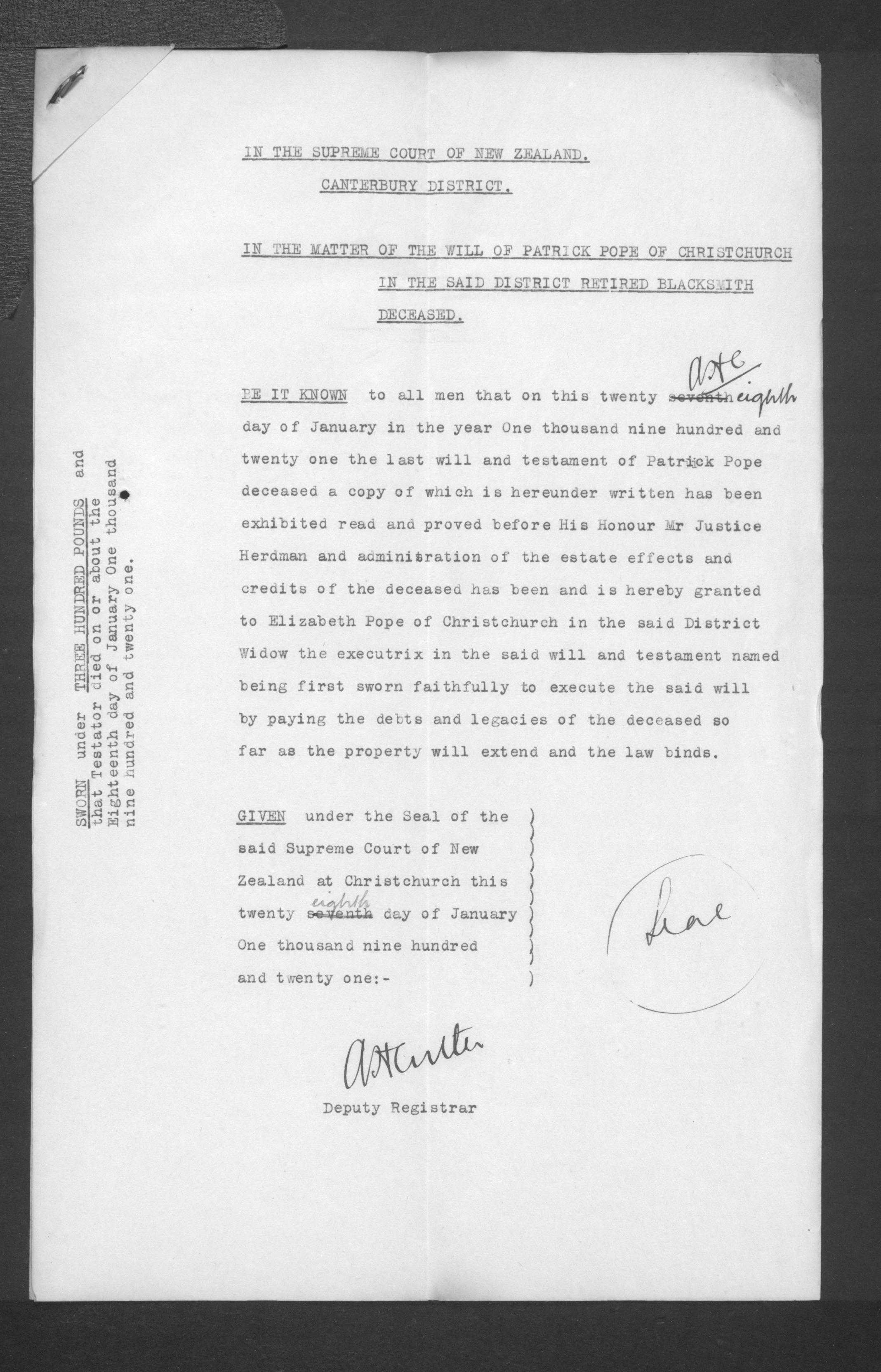
His will and the papers used to settle his estate: retired blacksmith, 54 St Asaph Street, estate under £300.
10 images

His will and the papers used to settle his estate: retired blacksmith, 54 St Asaph Street, estate under £300.

Open the official catalogue record ↗
02

Archives New Zealand · R23809235 · COR1930/695 · 6 relevant pages

David Benson Pope coroner file

The surviving official account of David’s final illness and death at Hokitika in June 1930.
6 images

The surviving official account of David’s final illness and death at Hokitika in June 1930.

Open the official catalogue record ↗
03

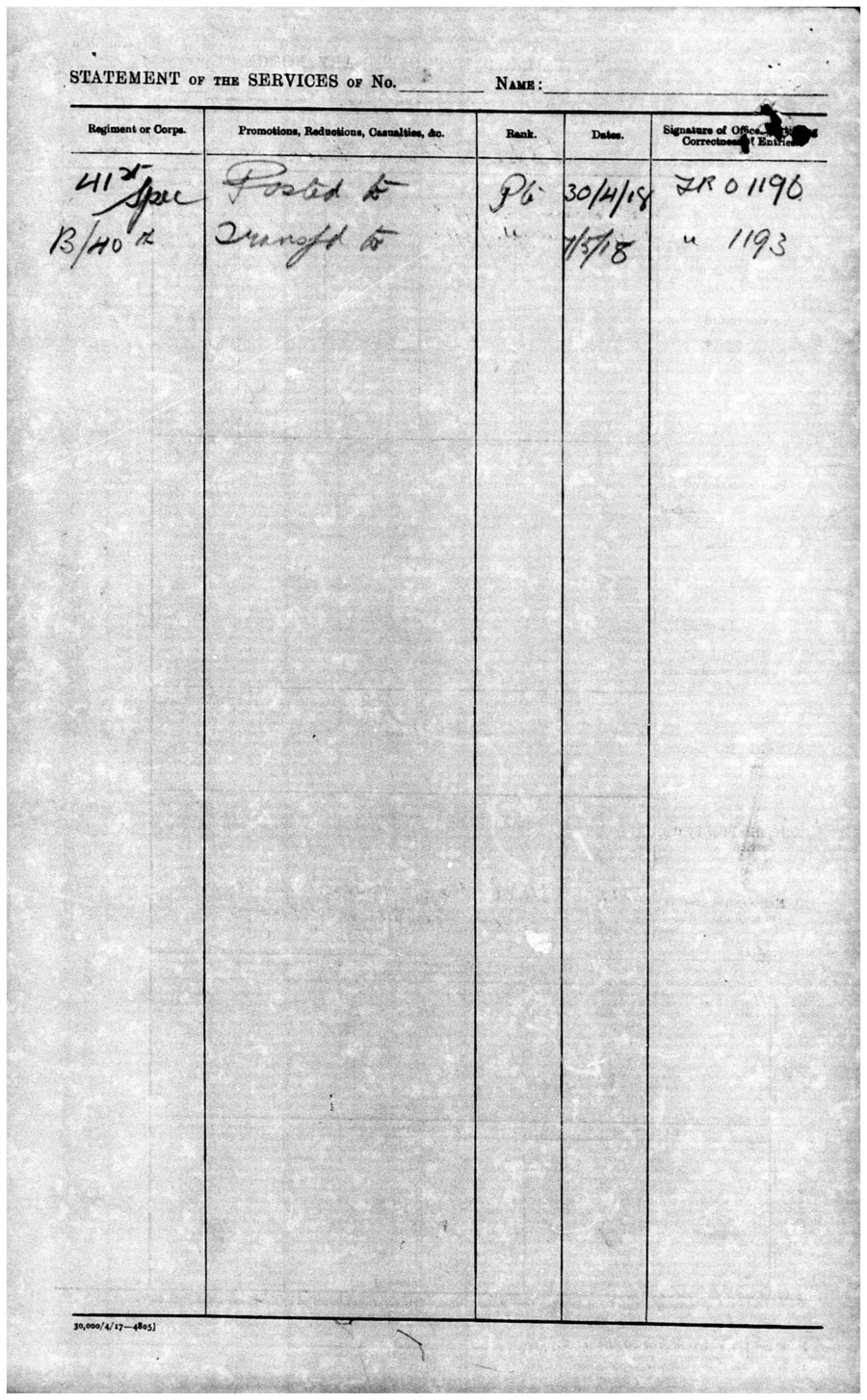
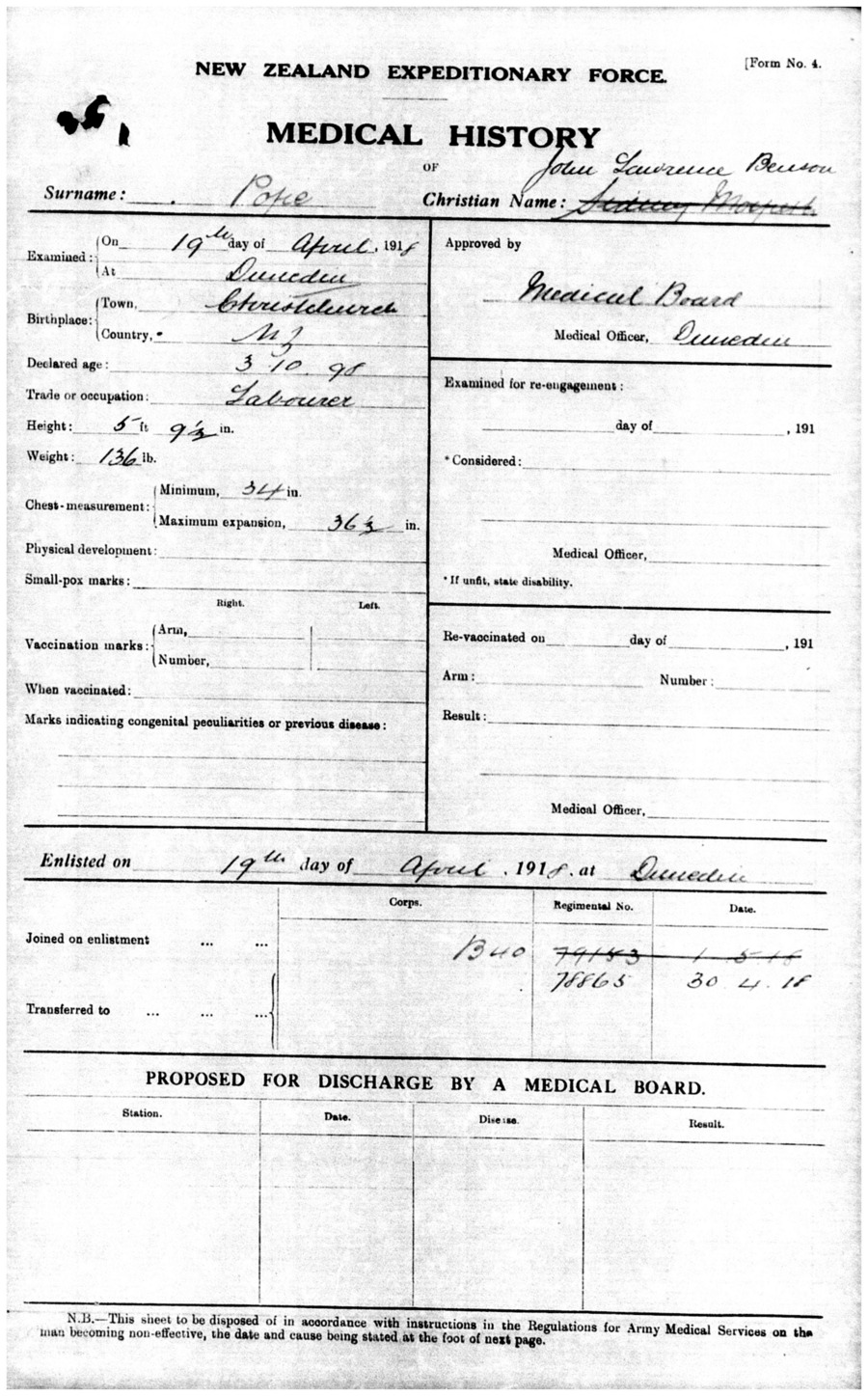
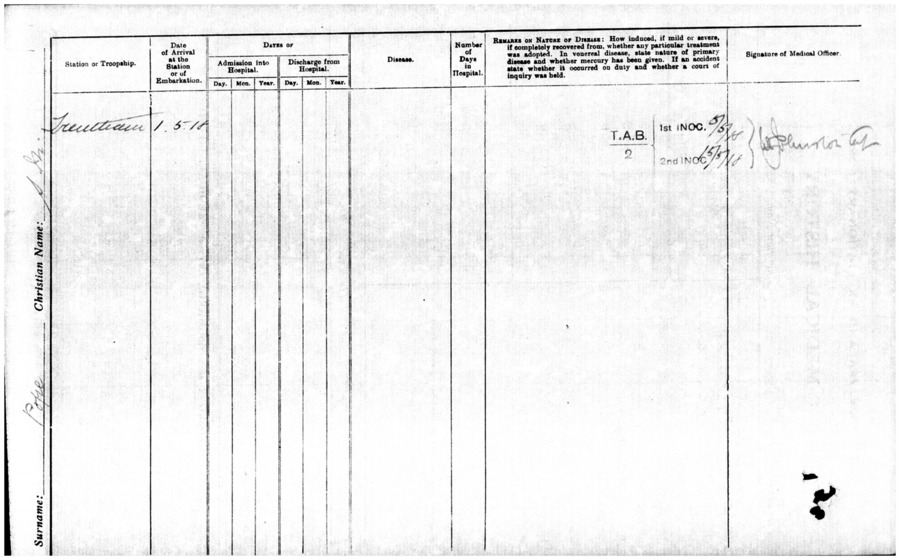
Archives New Zealand · R20802064 · WWI 78865 · 50 pages

J. L. B. Pope main military file

Enlistment papers, the Tahiti voyage, illness at Brocton, return on Zealandic and later service in the permanent artillery force.
50 images

Enlistment papers, the Tahiti voyage, illness at Brocton, return on Zealandic and later service in the permanent artillery force.

Open the official catalogue record ↗
04

Archives New Zealand · R20550205 · DPF · 32 pages

J. L. B. Pope’s second military file

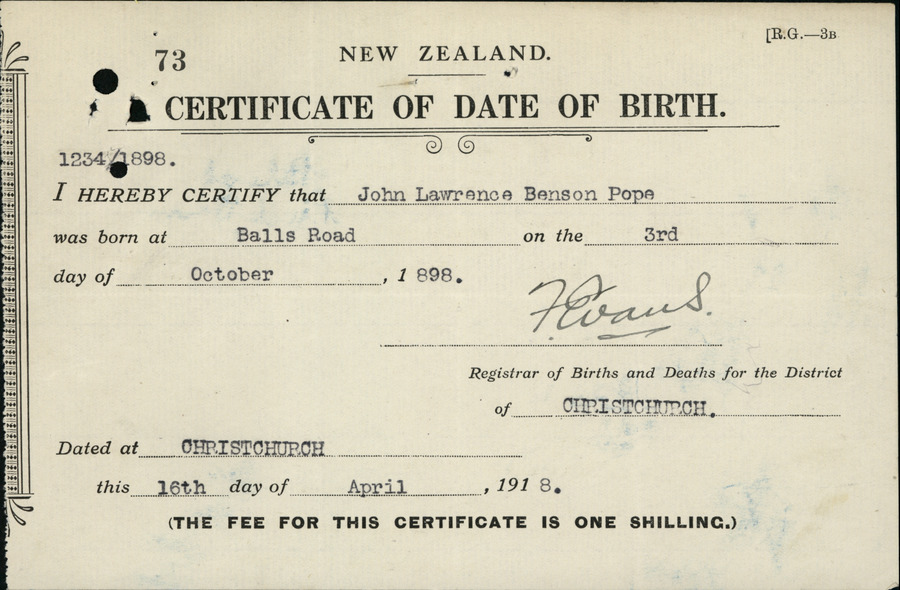
Although the archive calls this a duplicate, it adds the Balls Road birth extract, an army medical report and the 1918 guardian letter.
32 images

Although the archive calls this a duplicate, it adds the Balls Road birth extract, an army medical report and the 1918 guardian letter.

Open the official catalogue record ↗
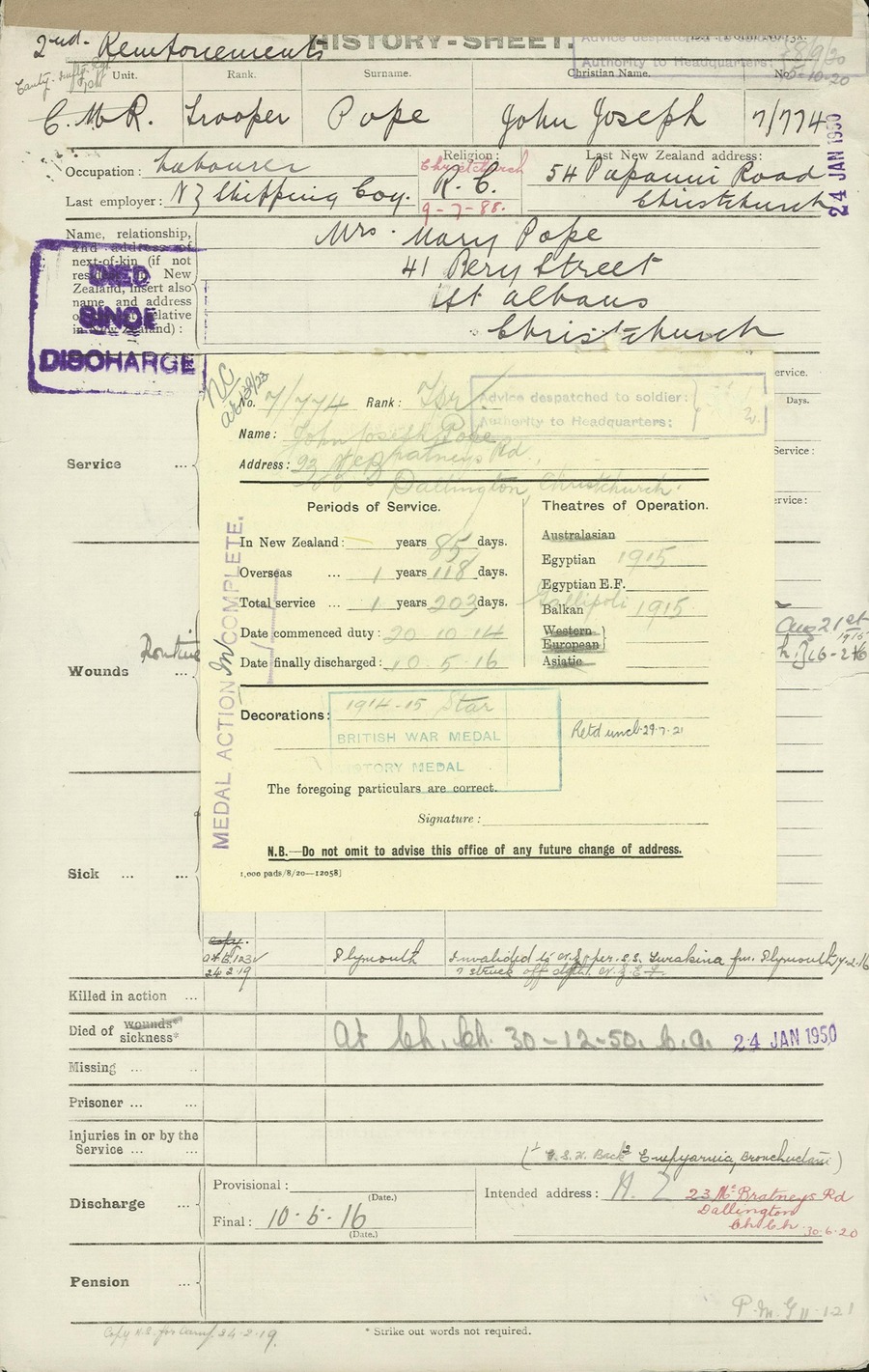
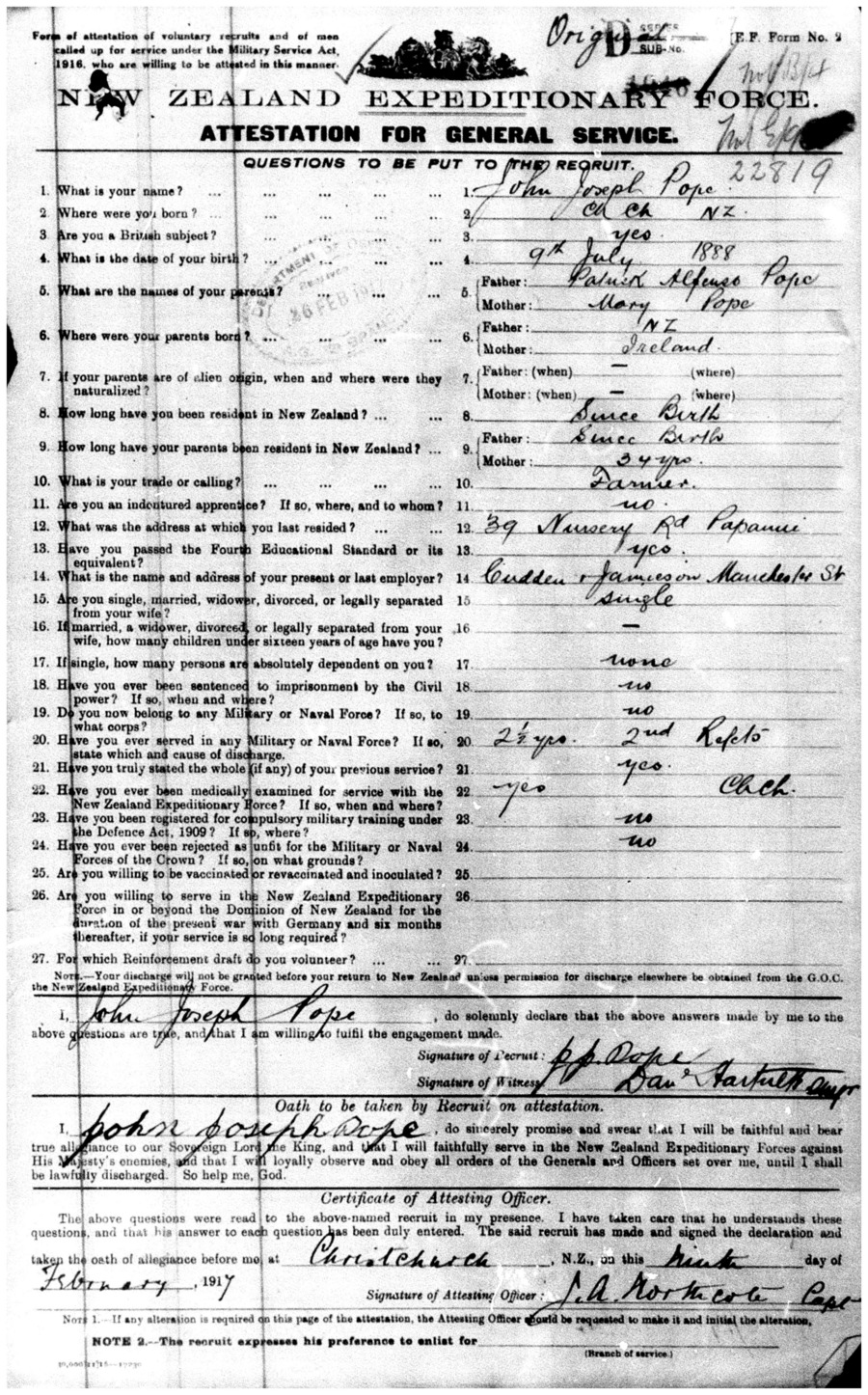
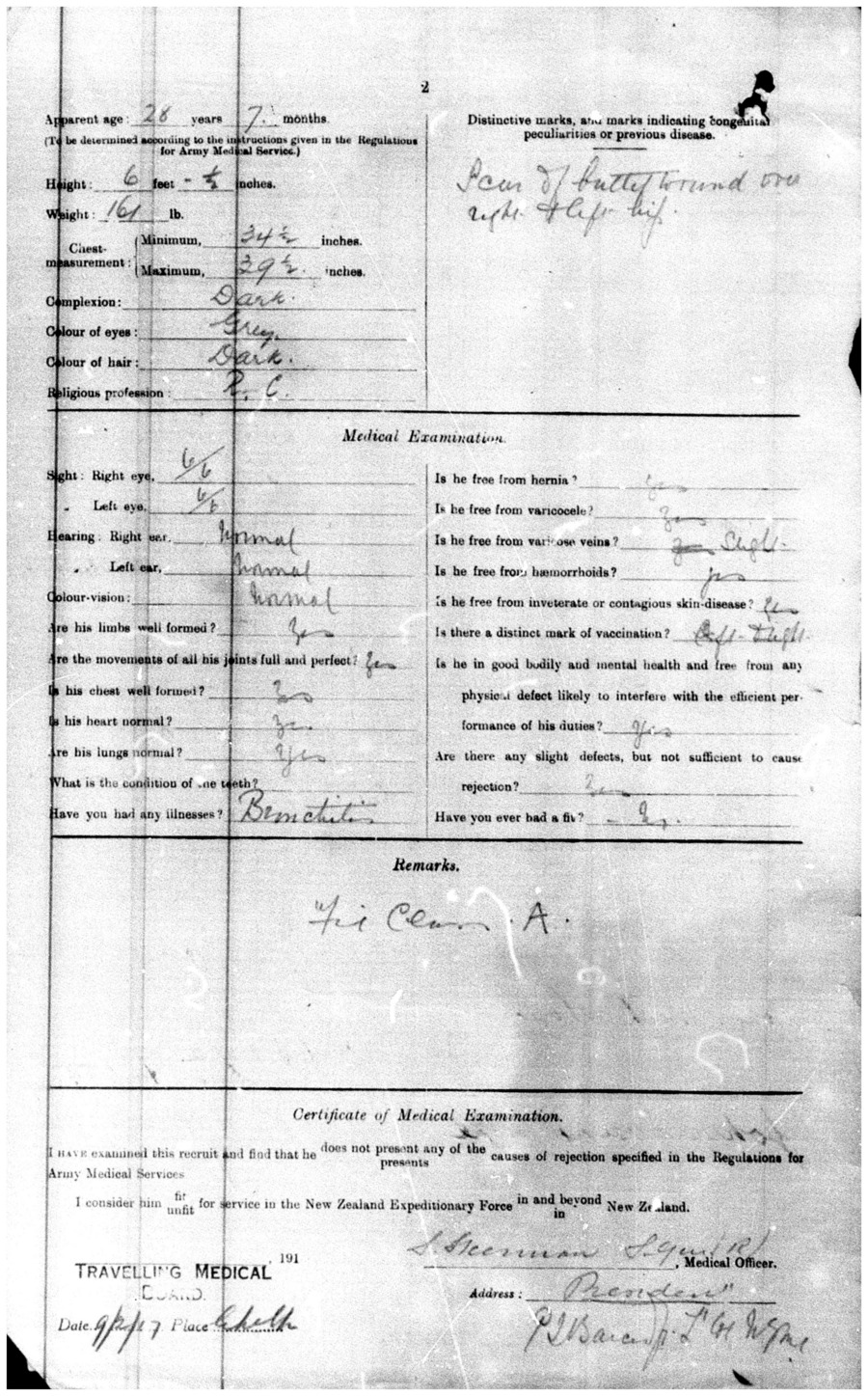
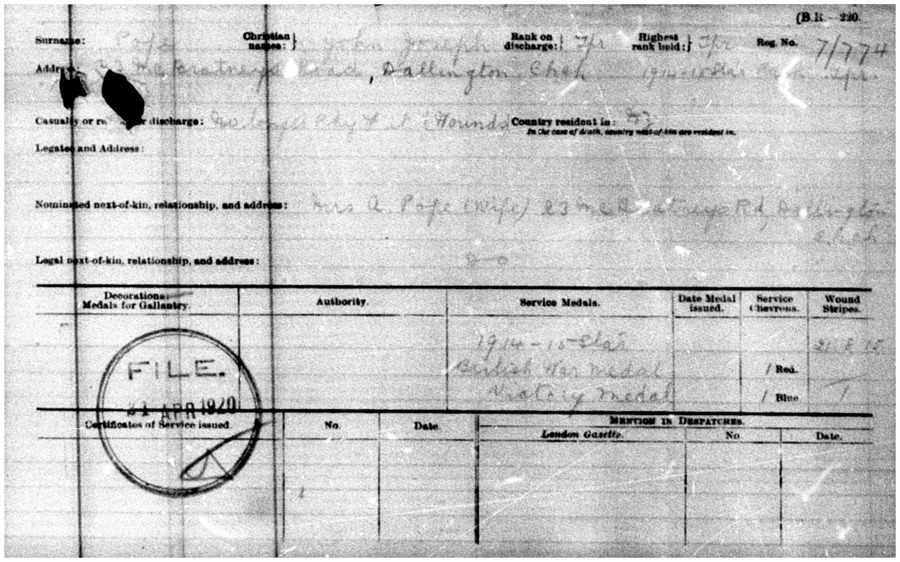
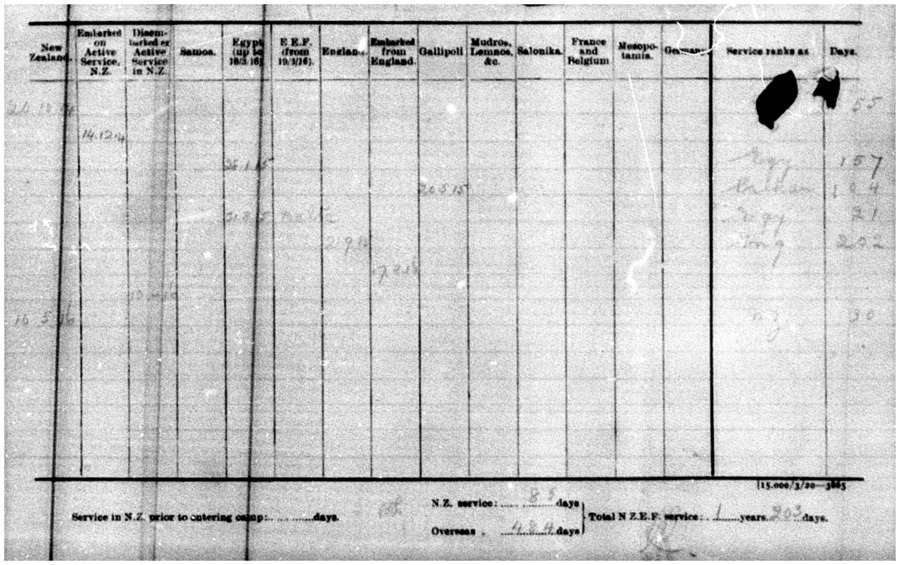
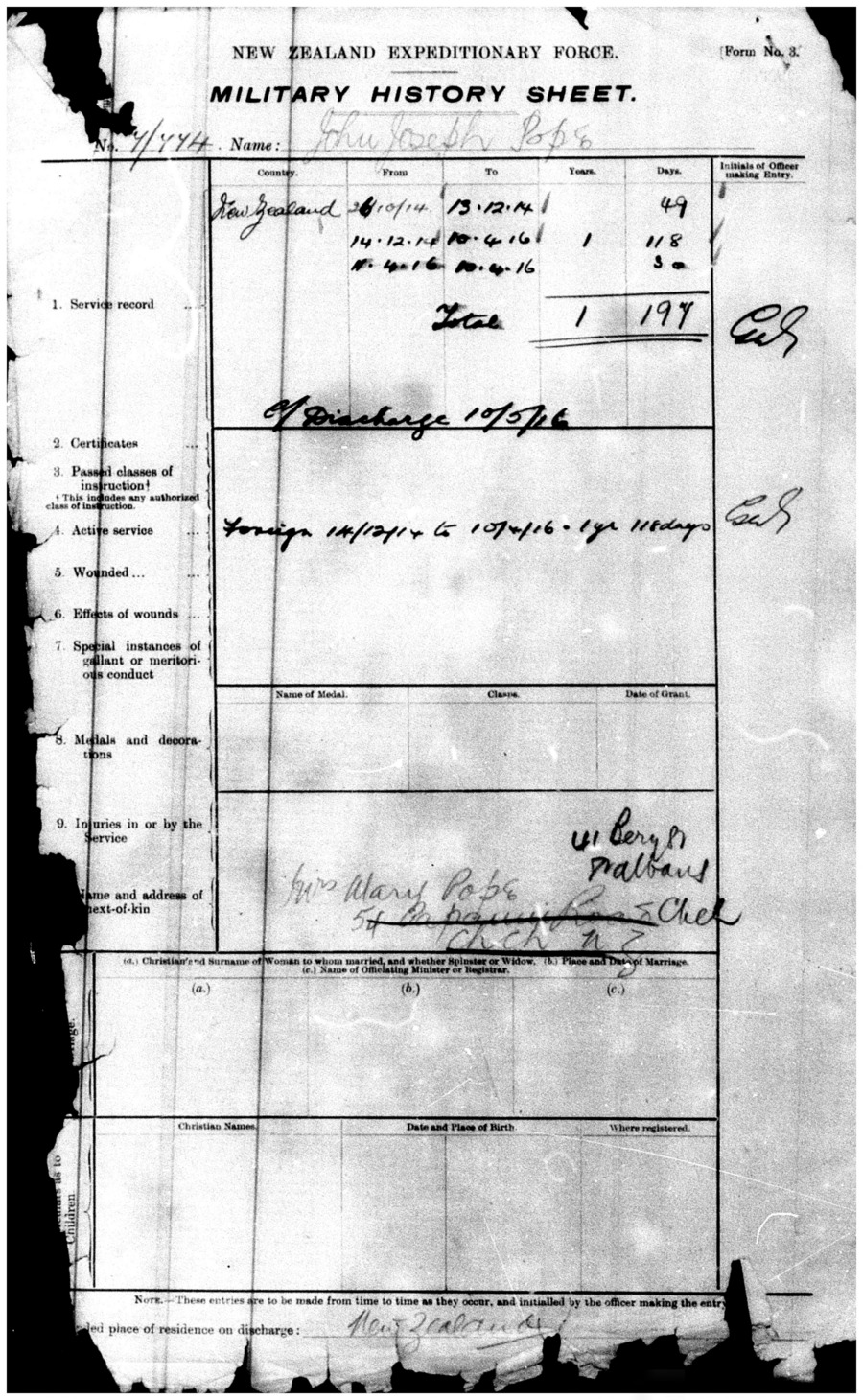
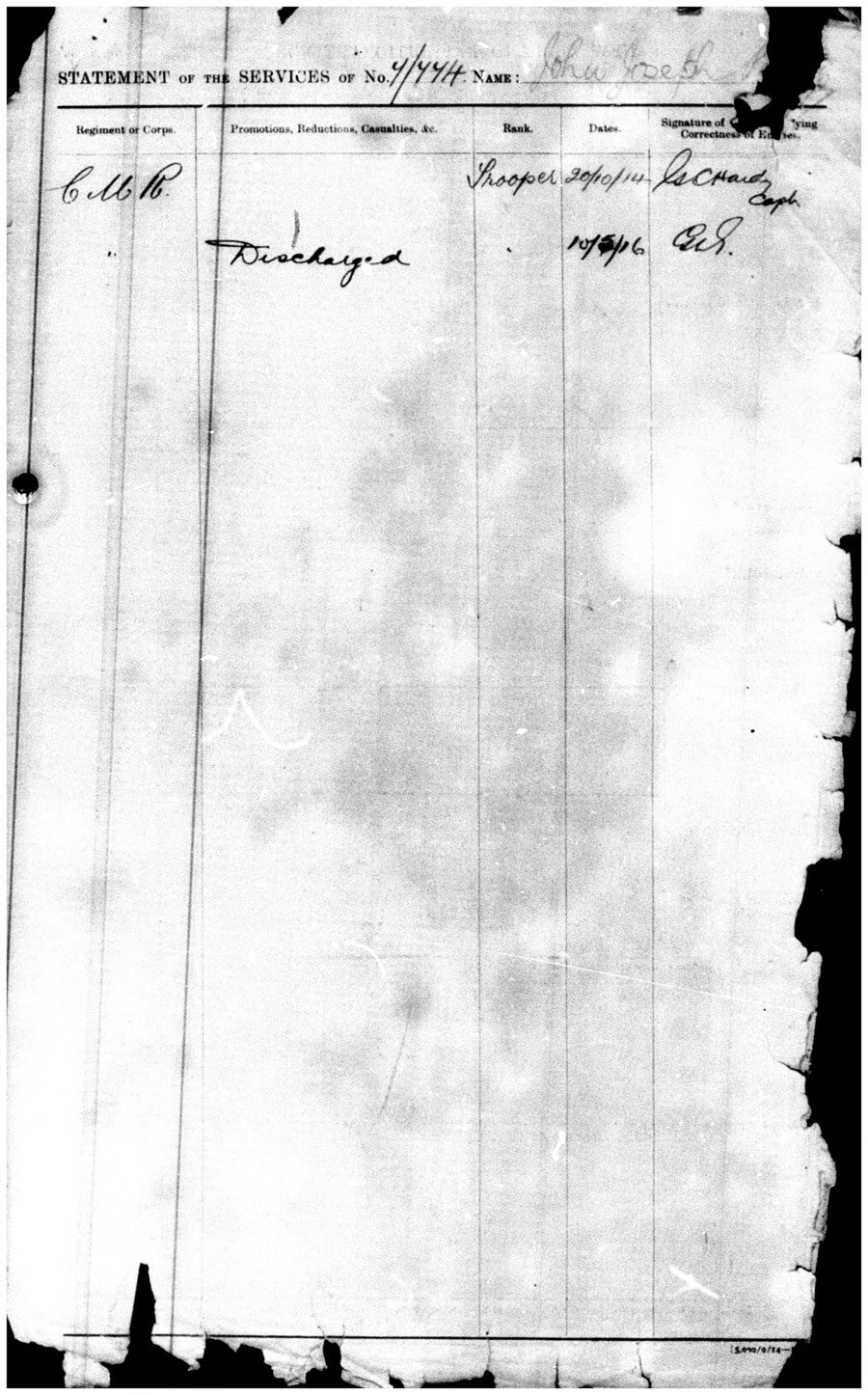
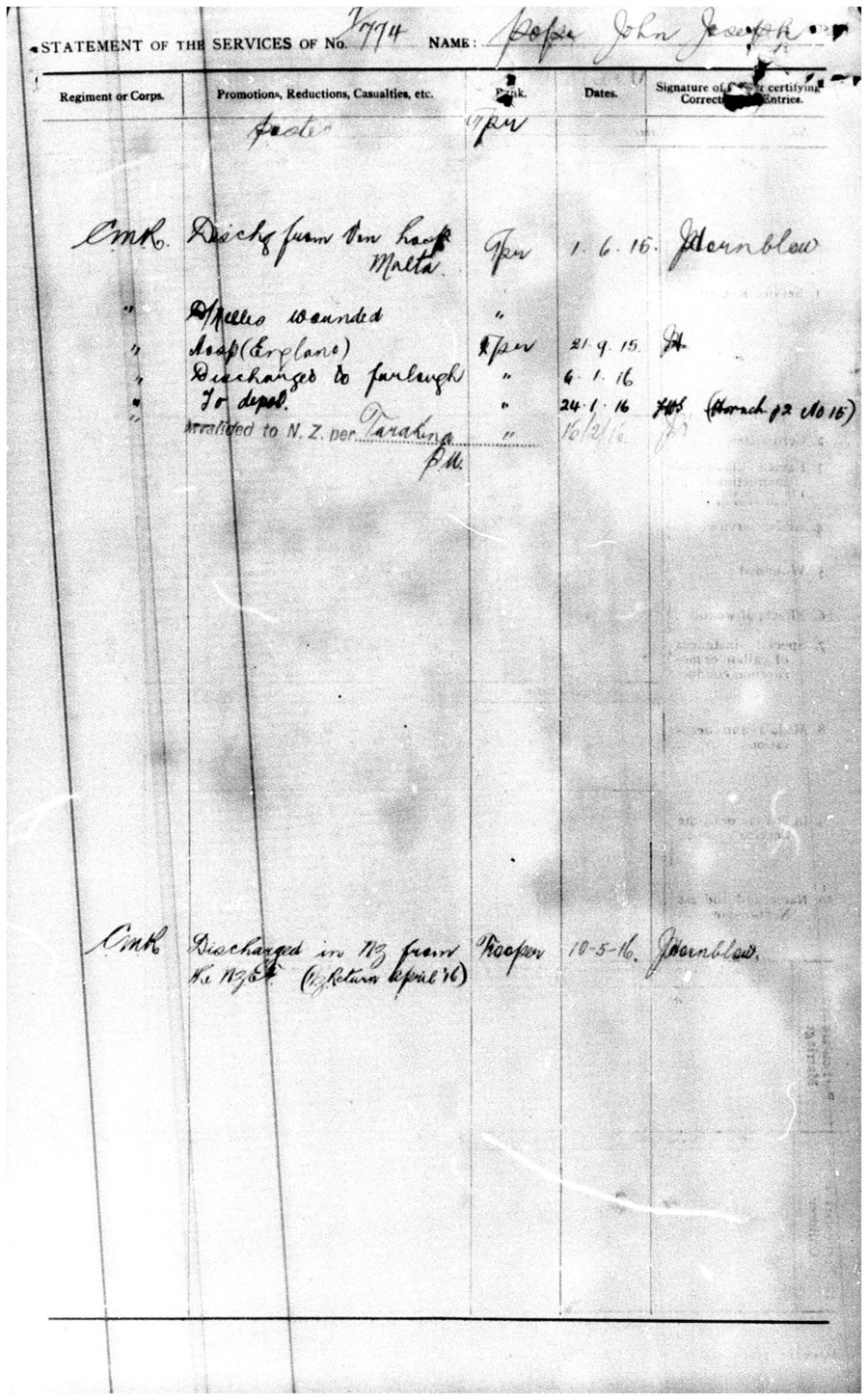
05

Archives New Zealand · R20802063 · WWI 7/774 · 25 pages

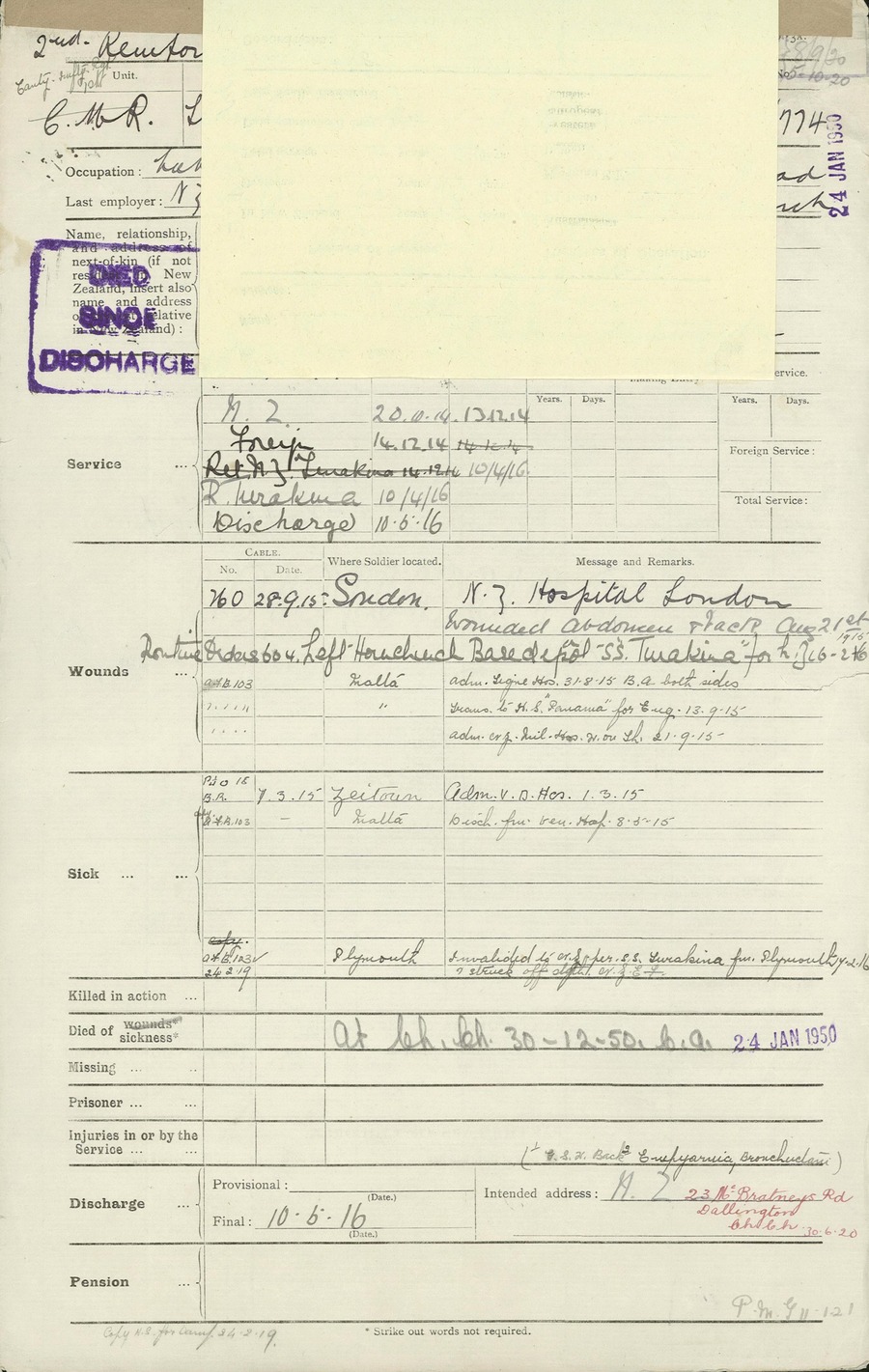
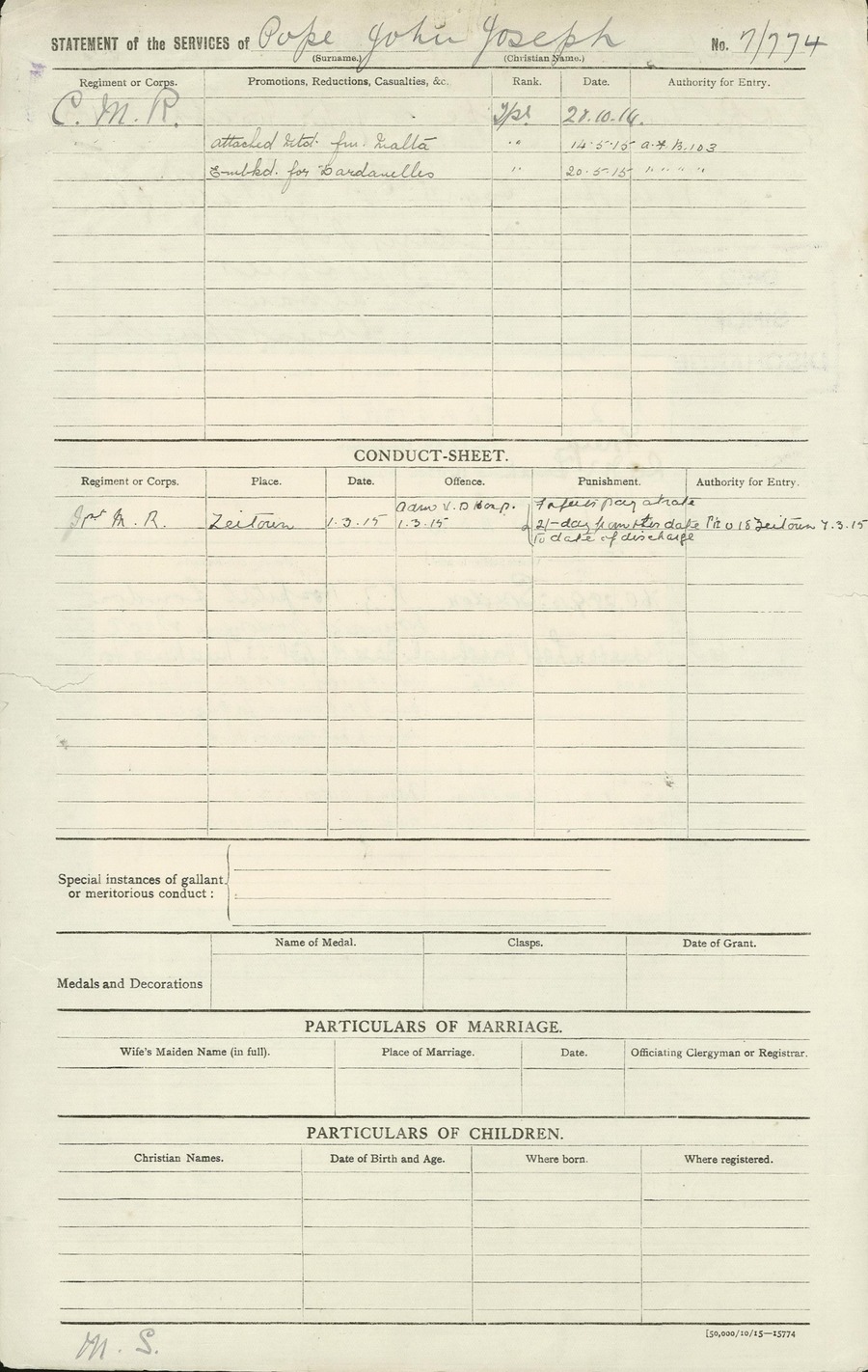
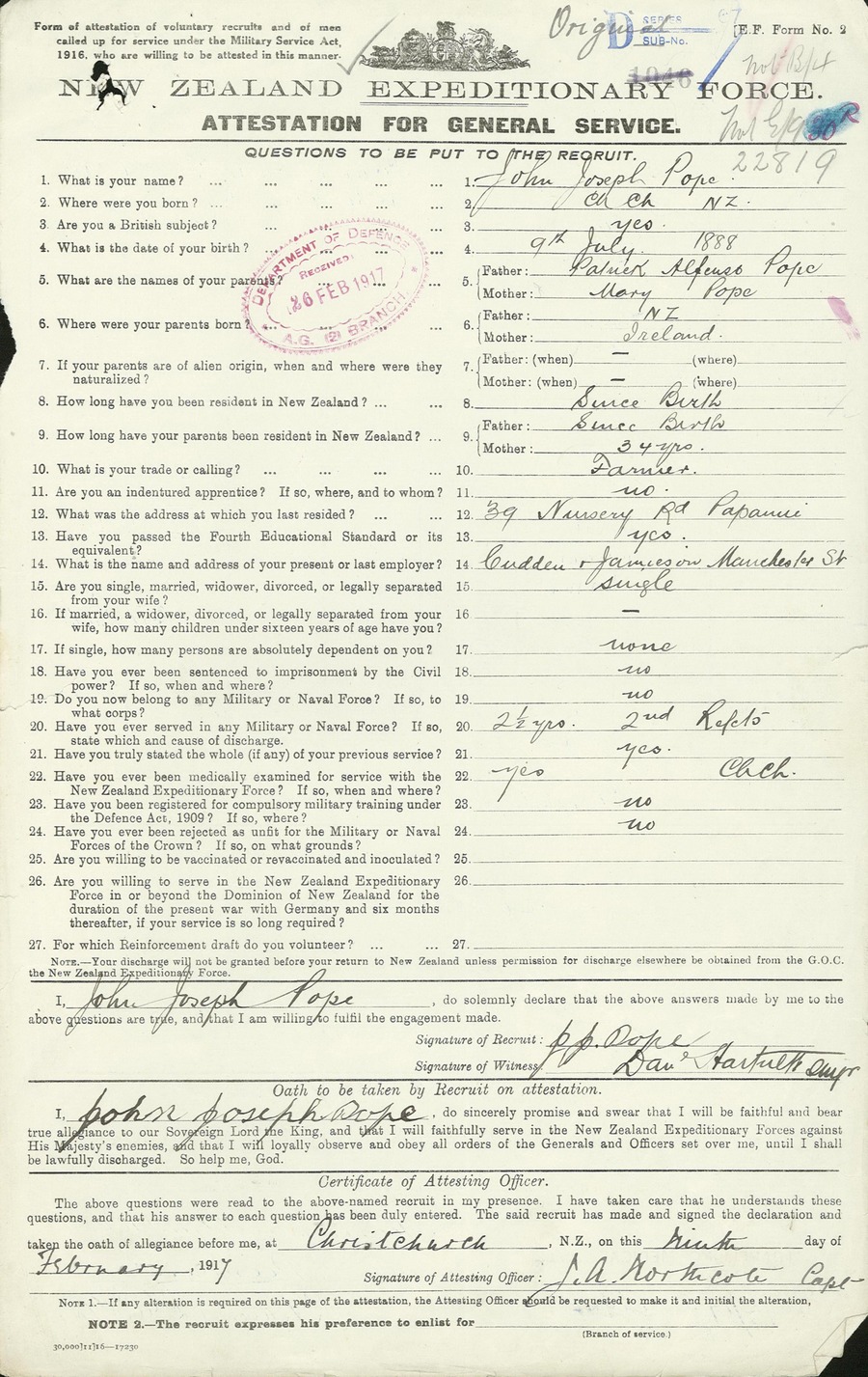
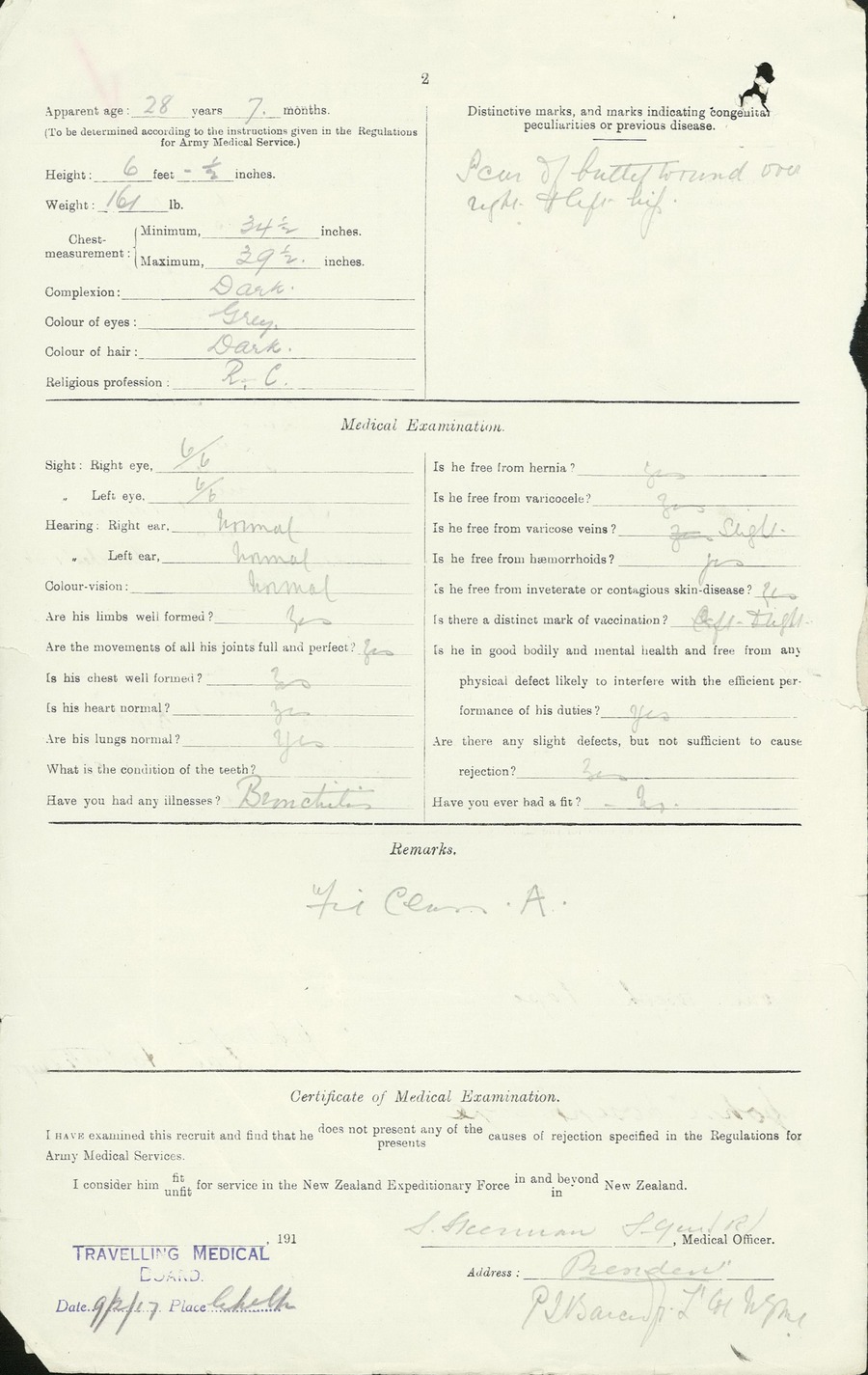
John Joseph Pope military file

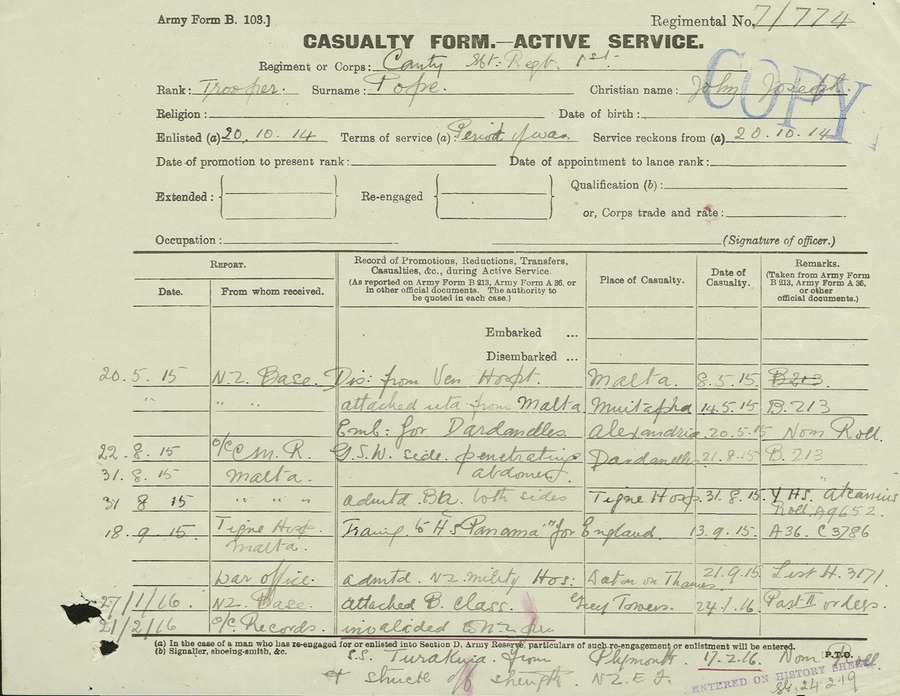
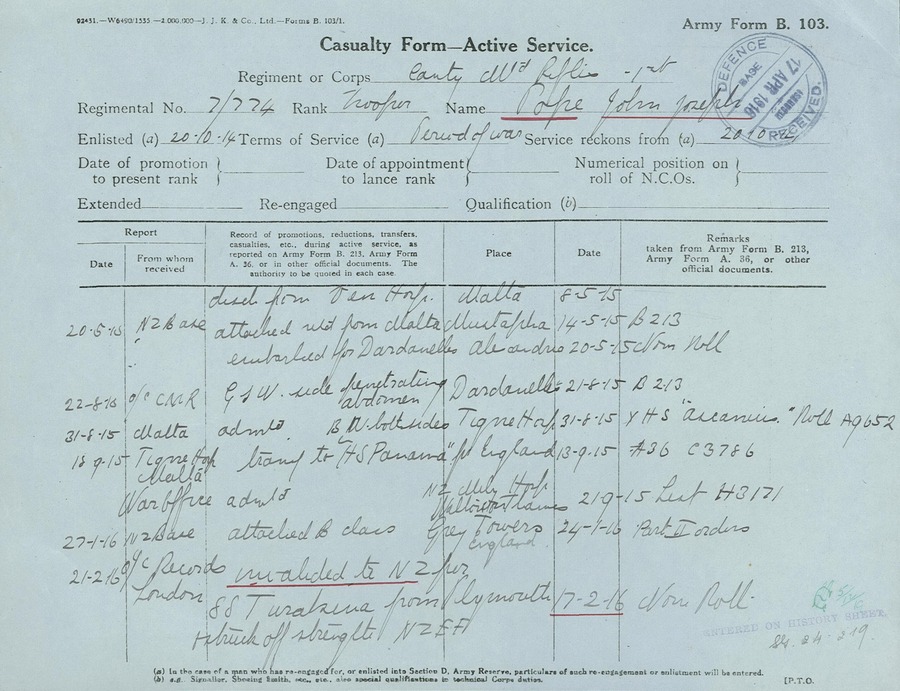
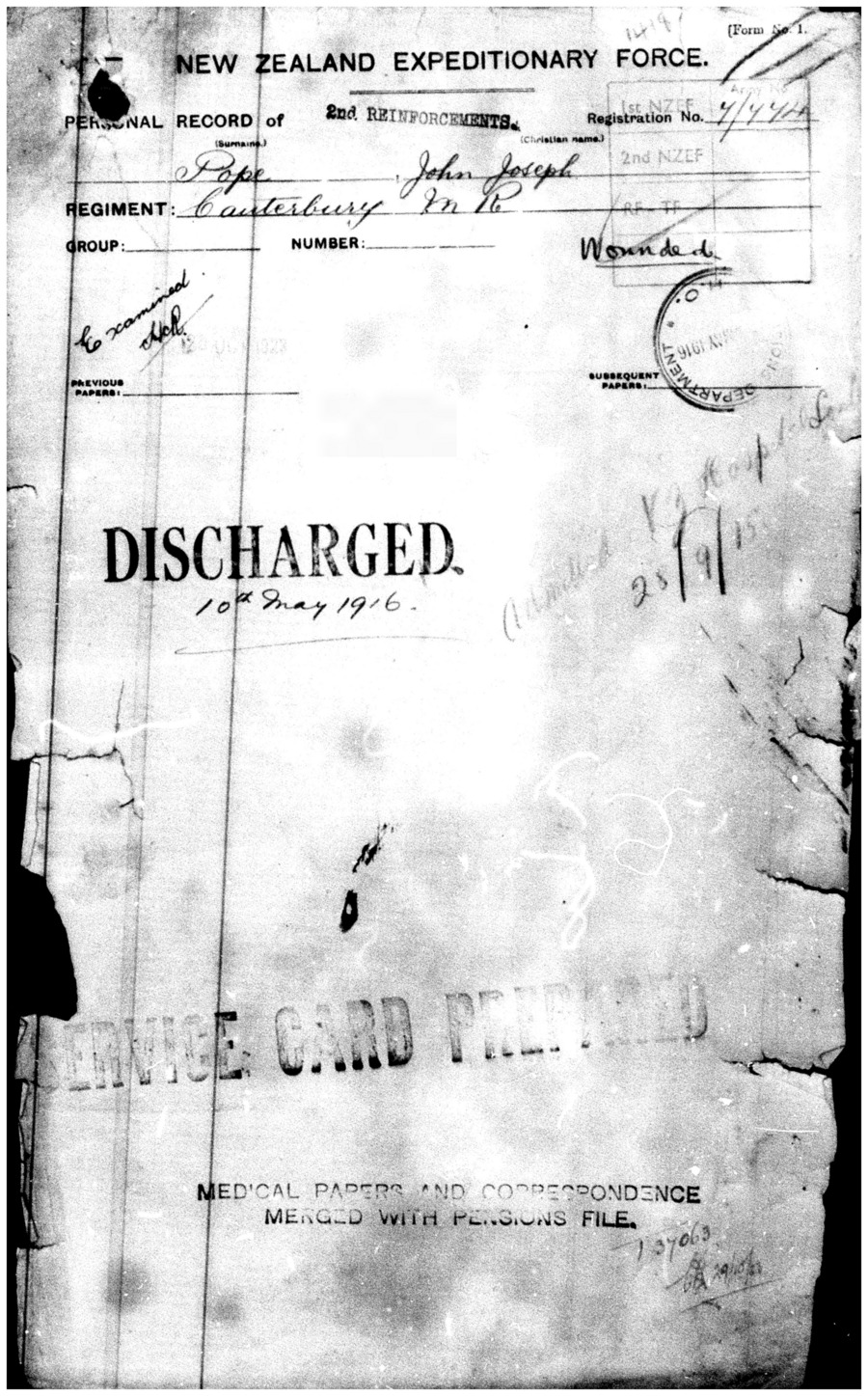
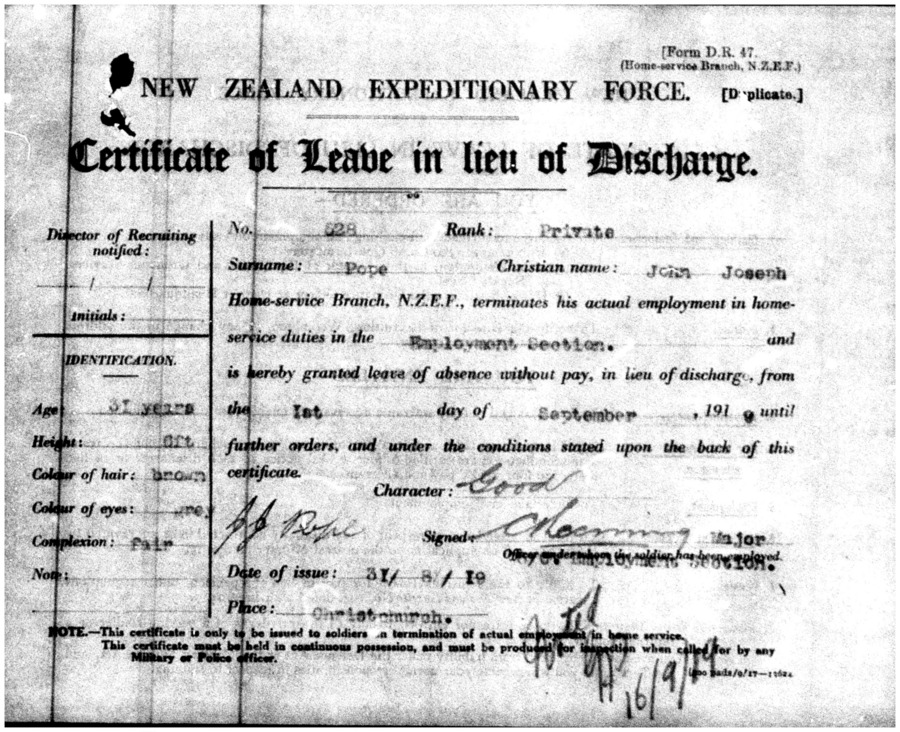
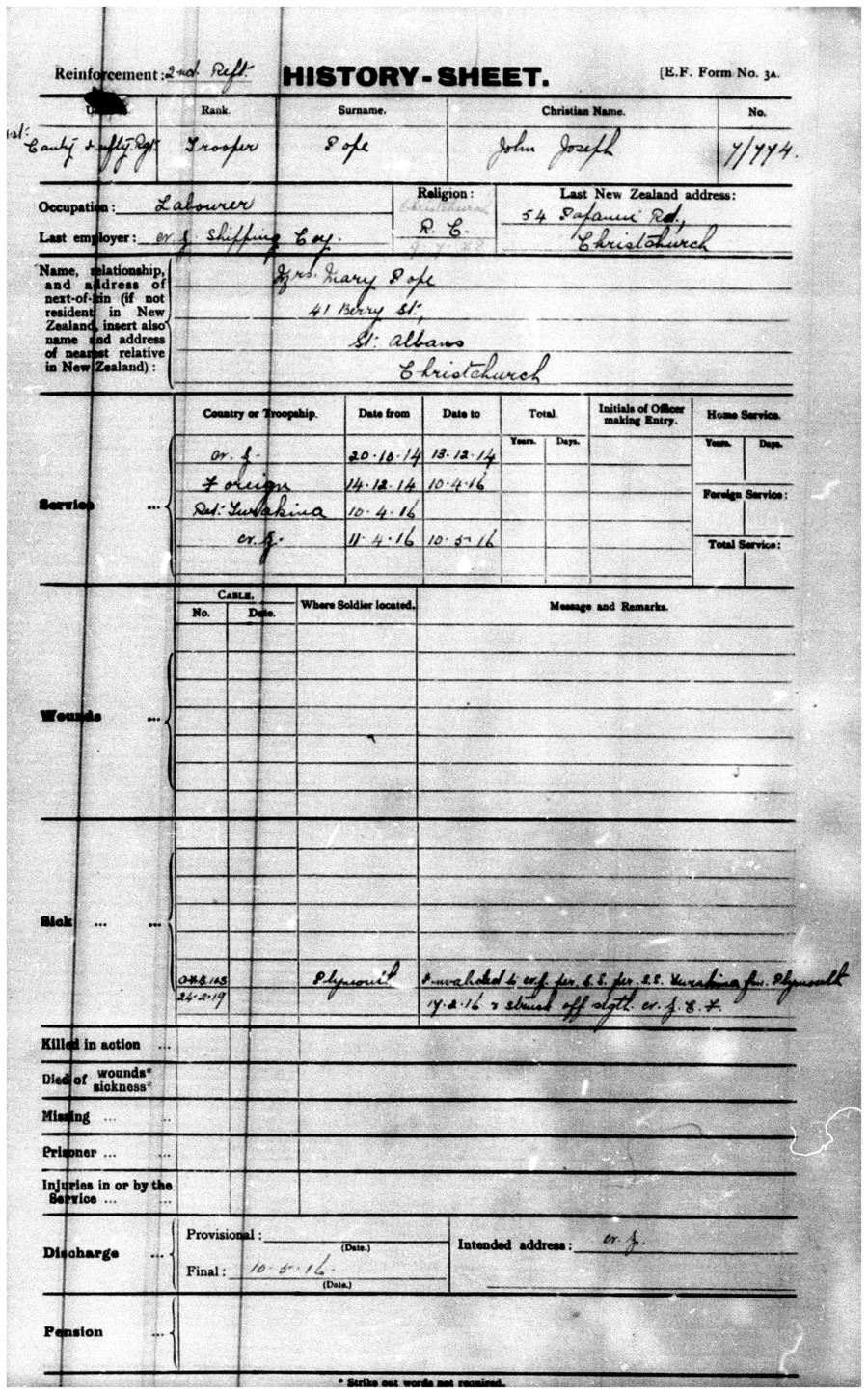
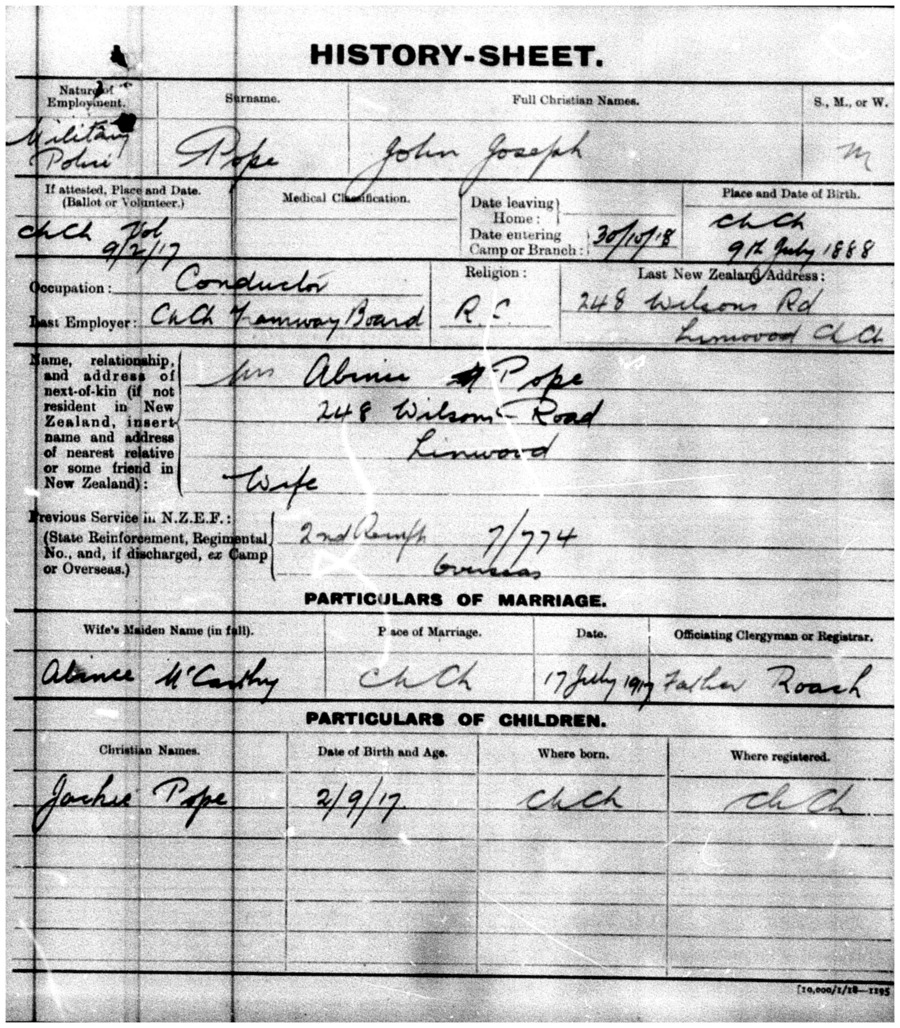
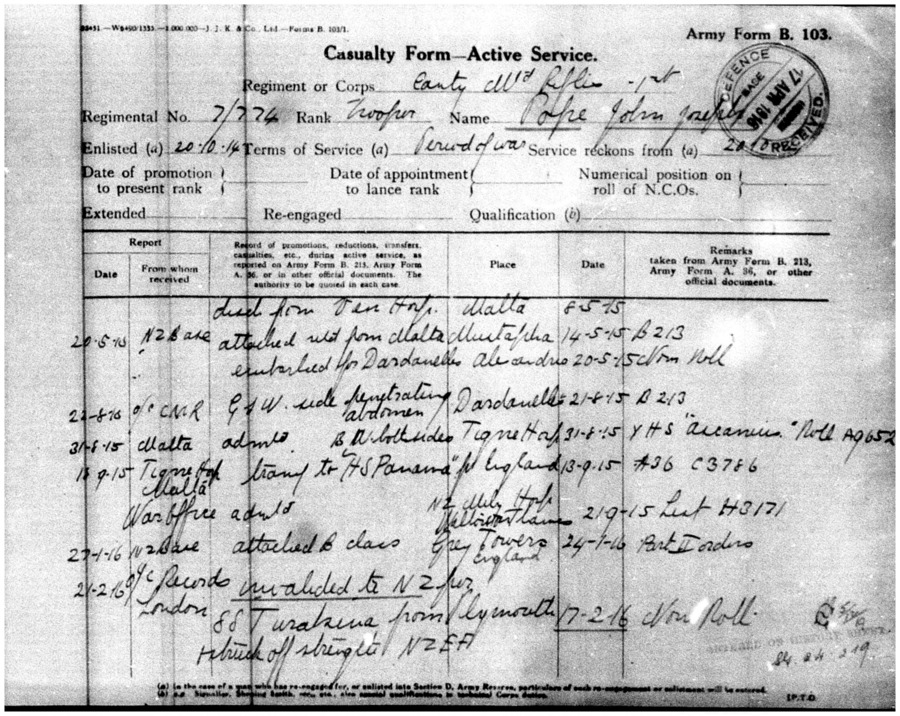
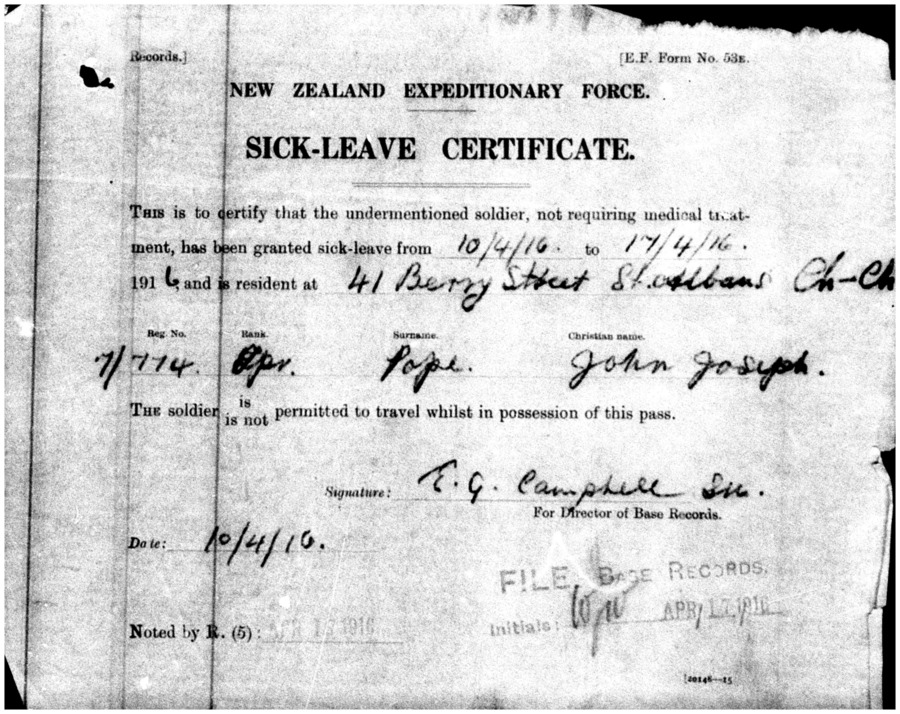
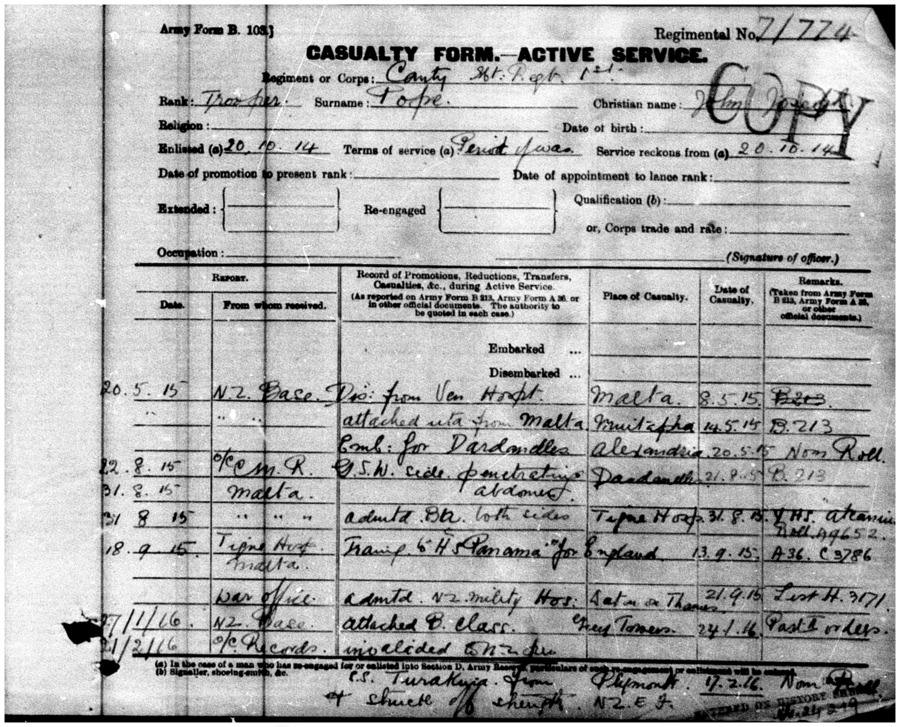
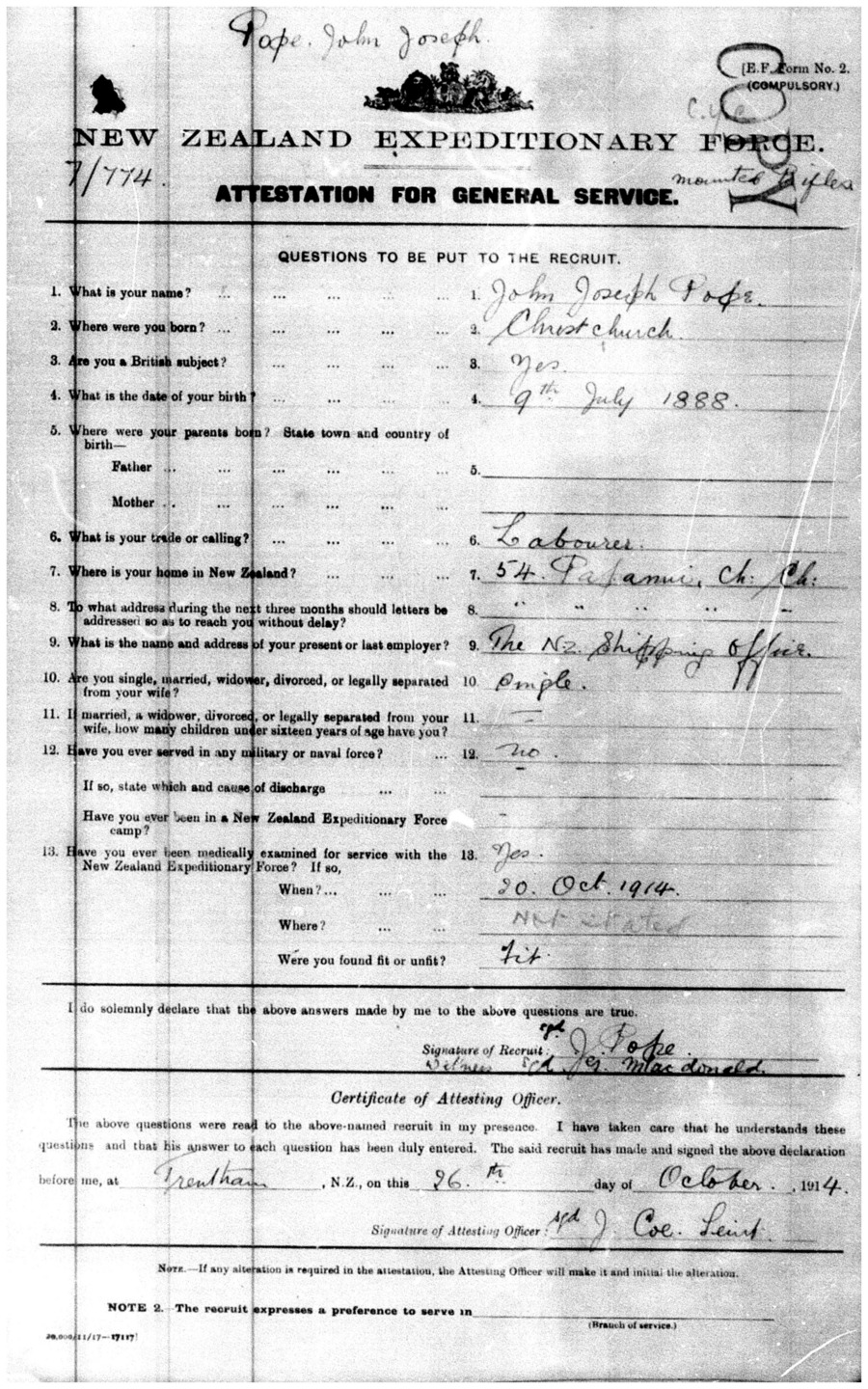
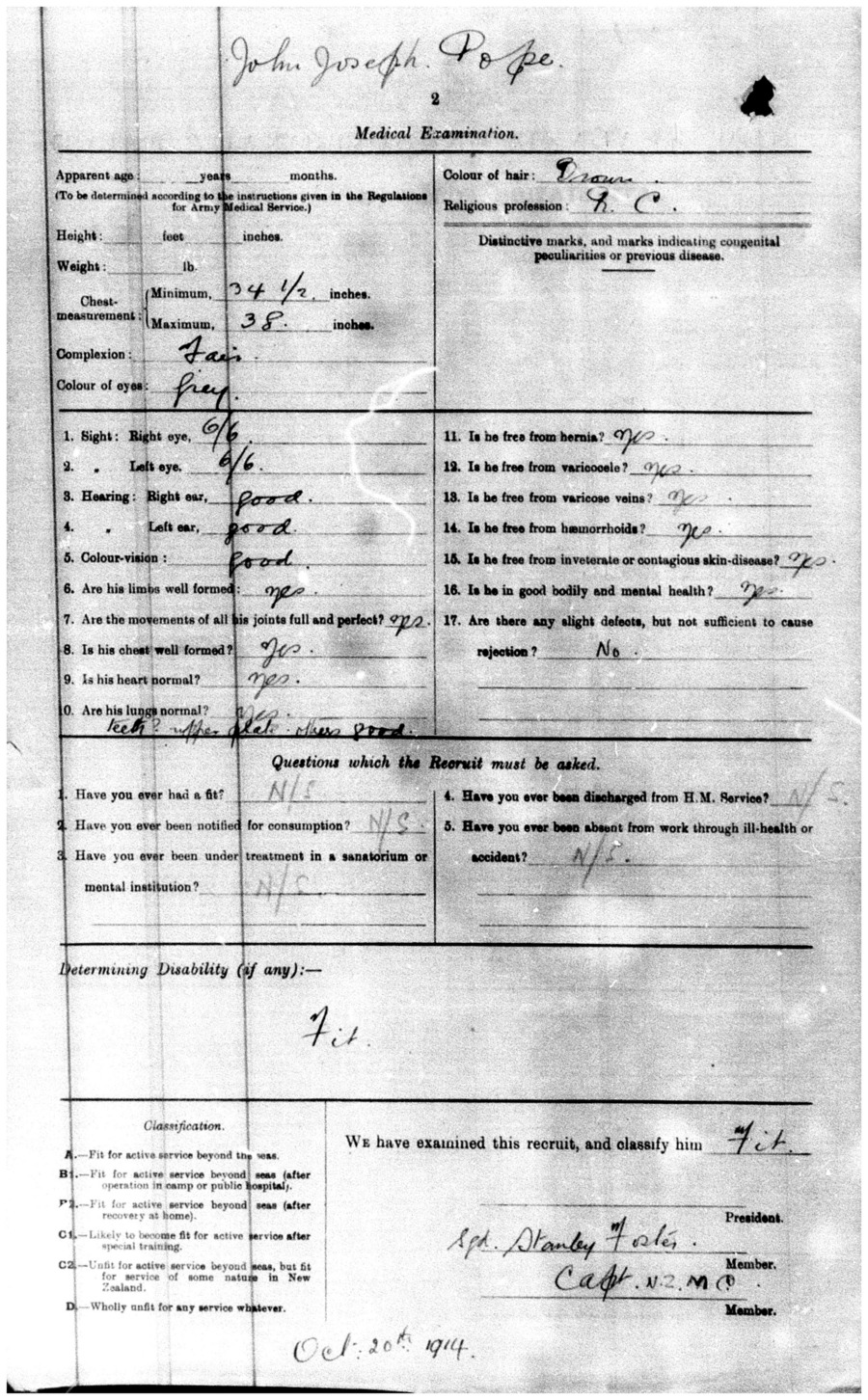
Canterbury Mounted Rifles, Gallipoli service, August 1915 gunshot wound and later home service.
25 images

Canterbury Mounted Rifles, Gallipoli service, August 1915 gunshot wound and later home service.

Open the official catalogue record ↗
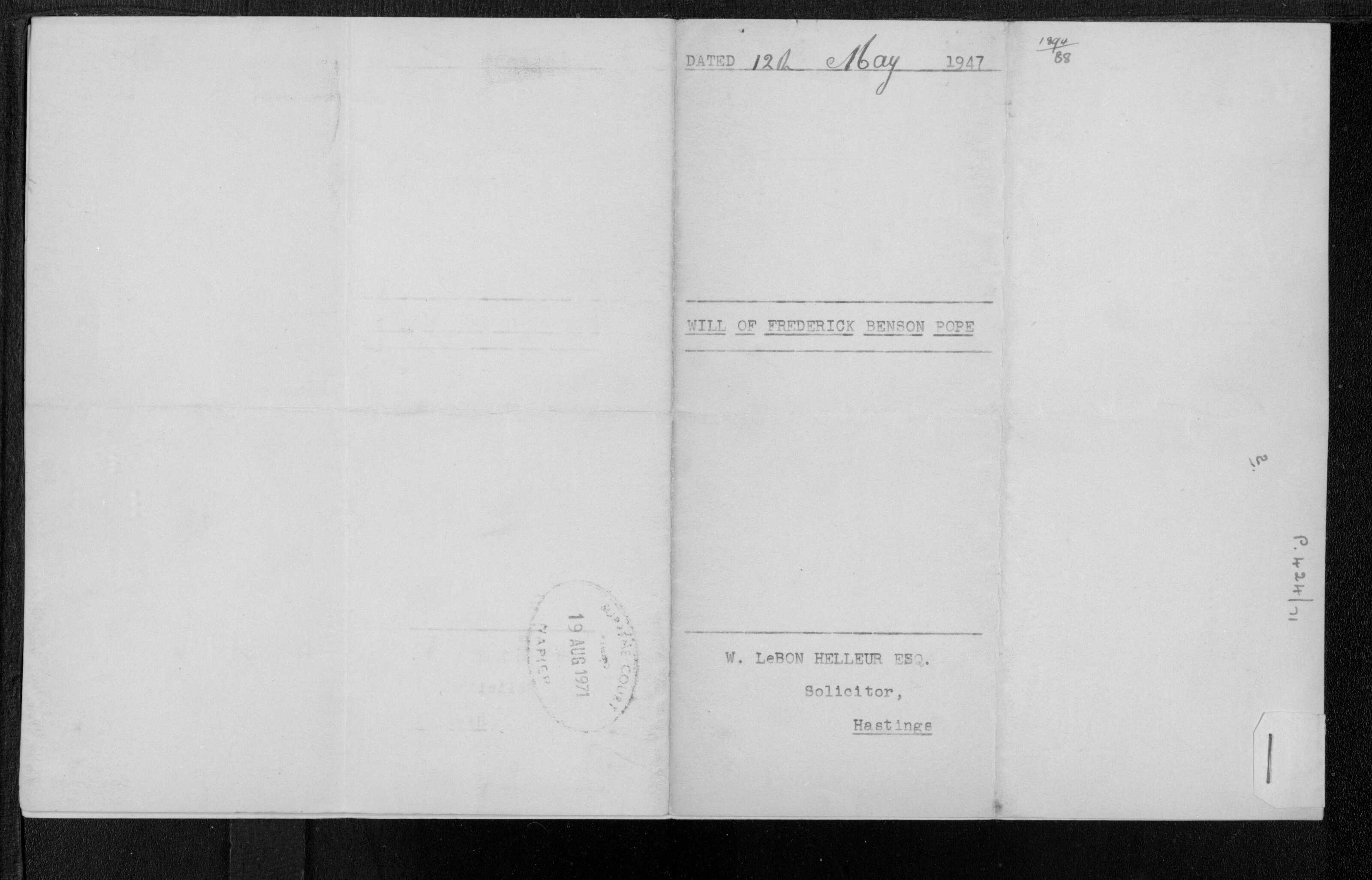
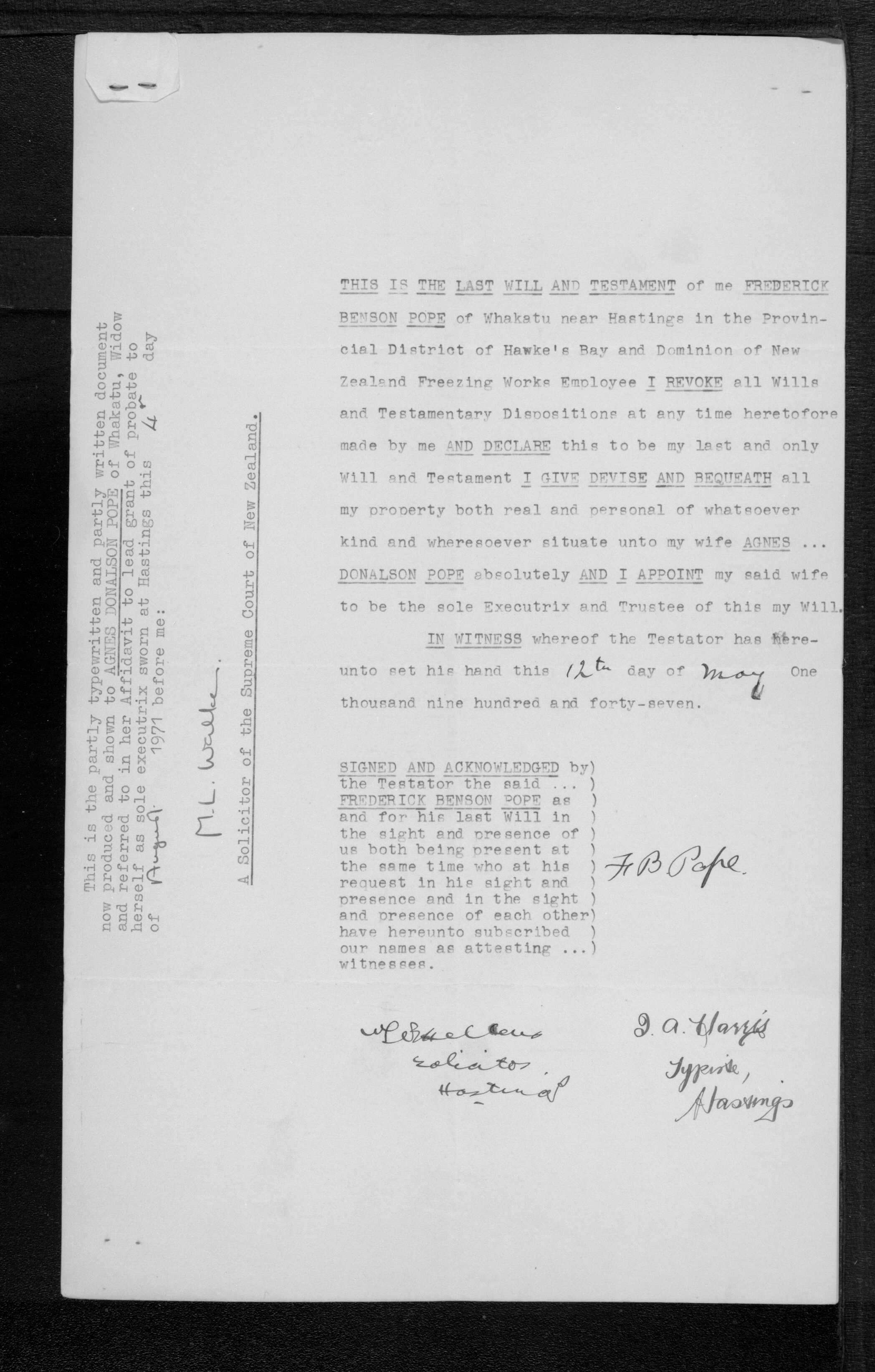
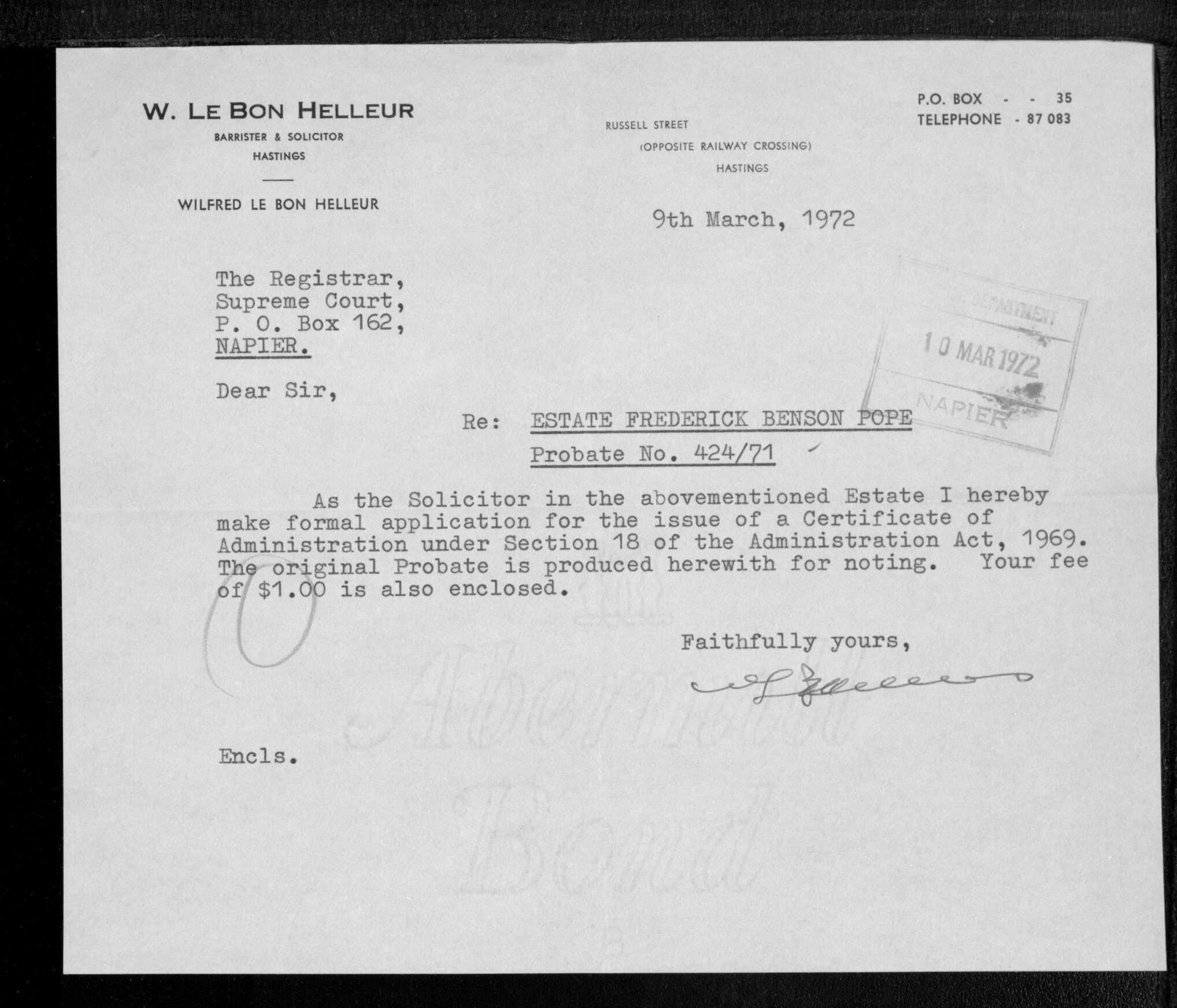
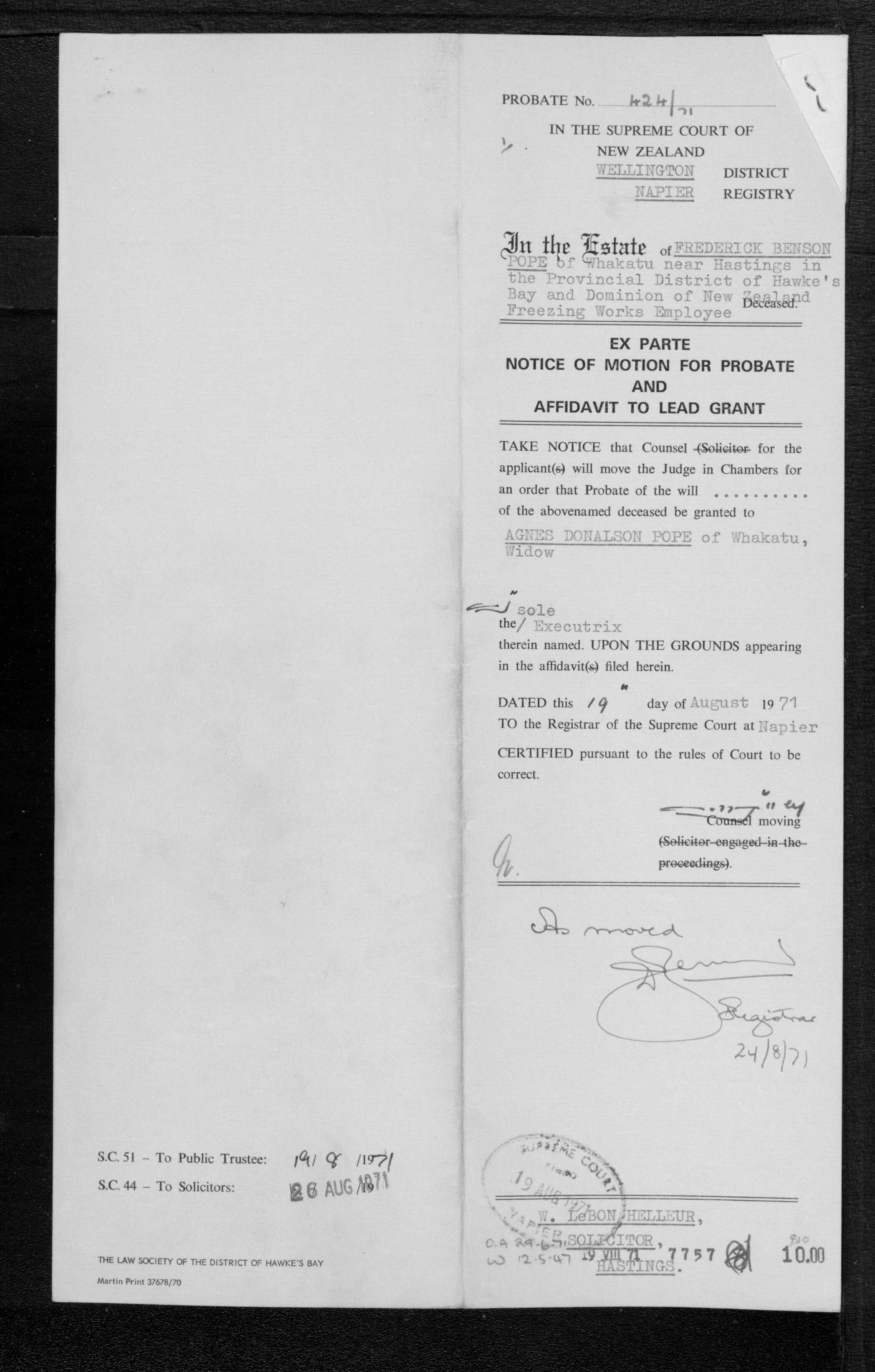
06

Archives New Zealand · R23239886 · 424/71 · 8 pages

Frederick Benson Pope’s estate papers

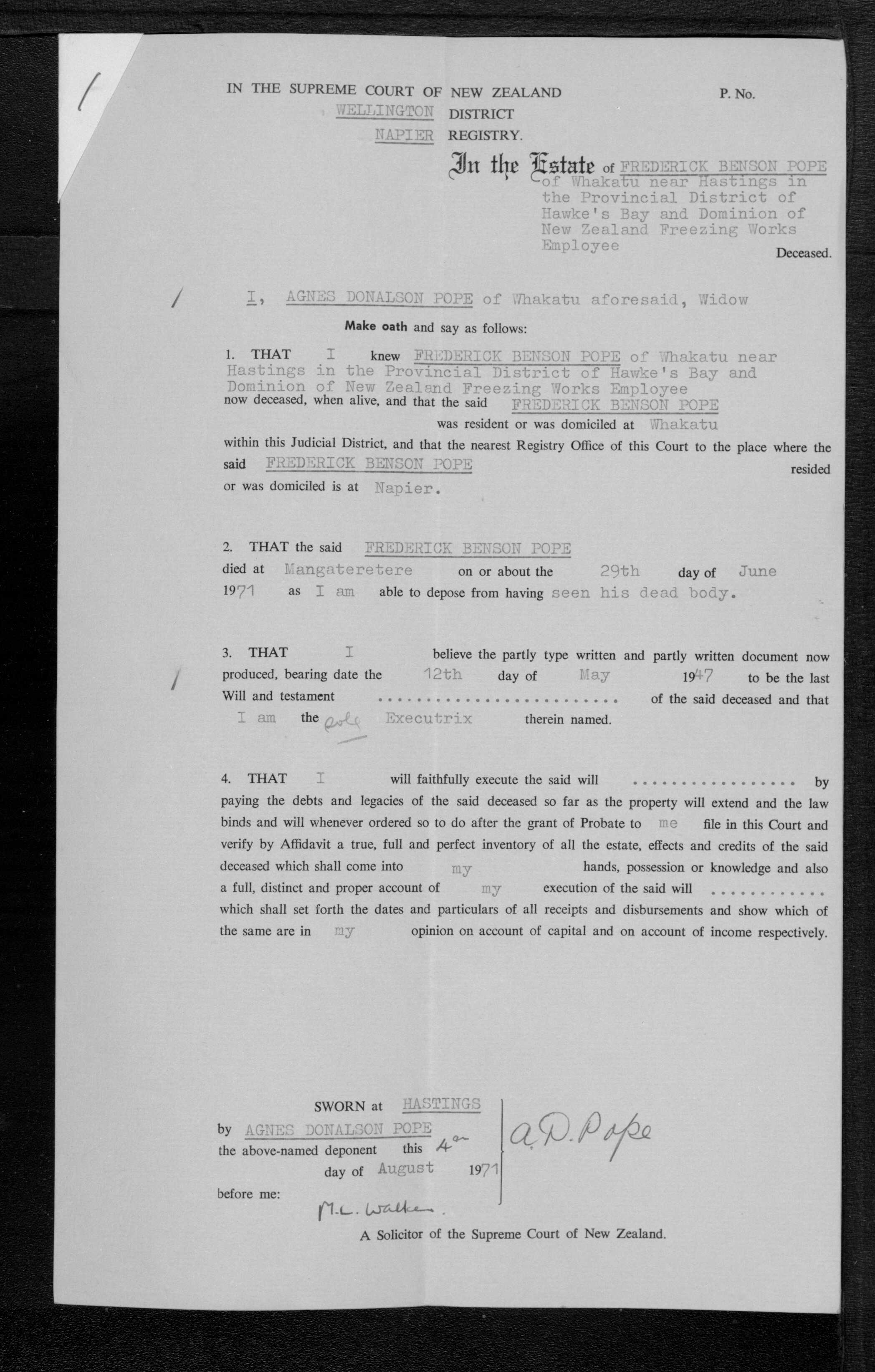
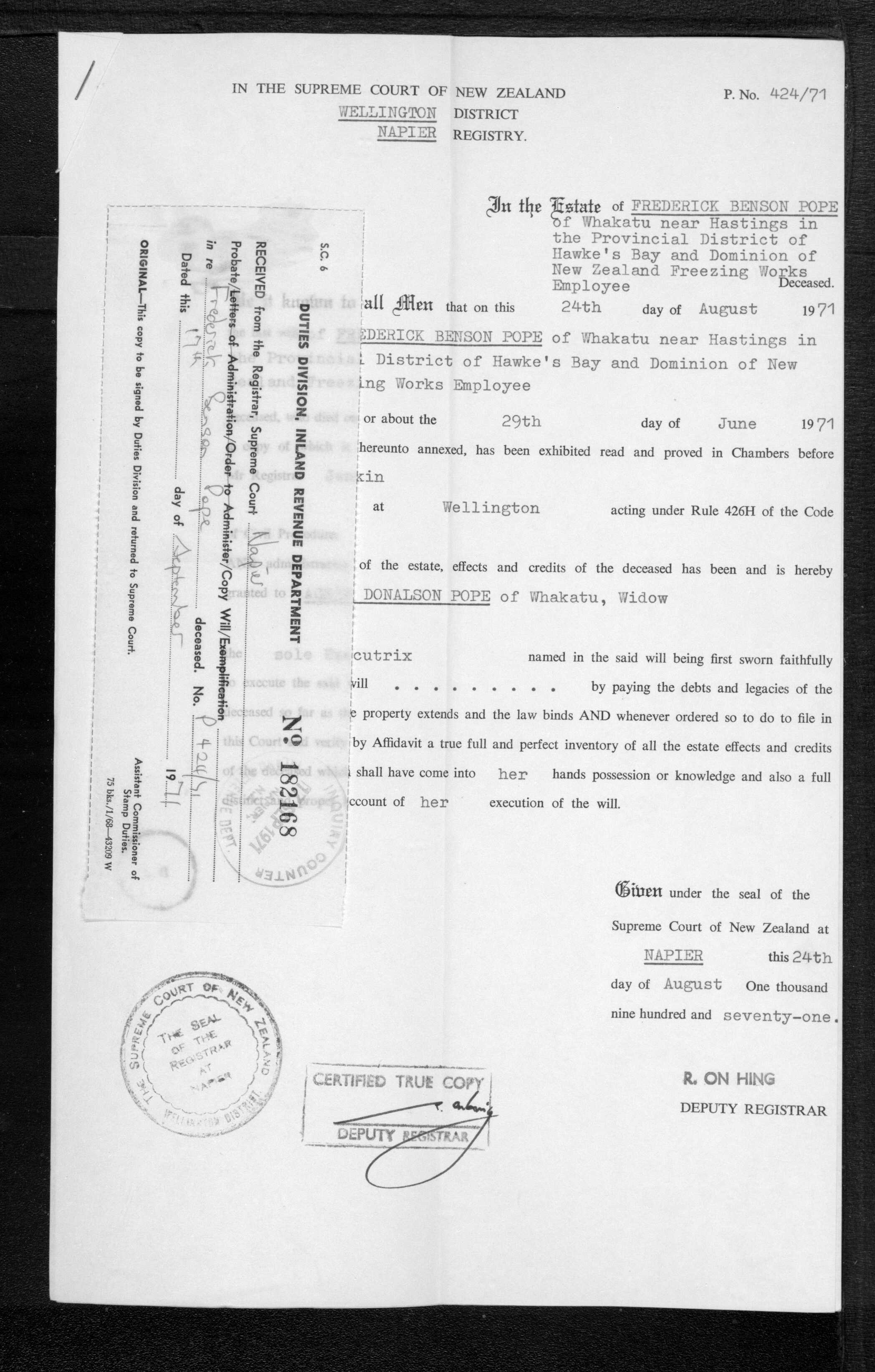
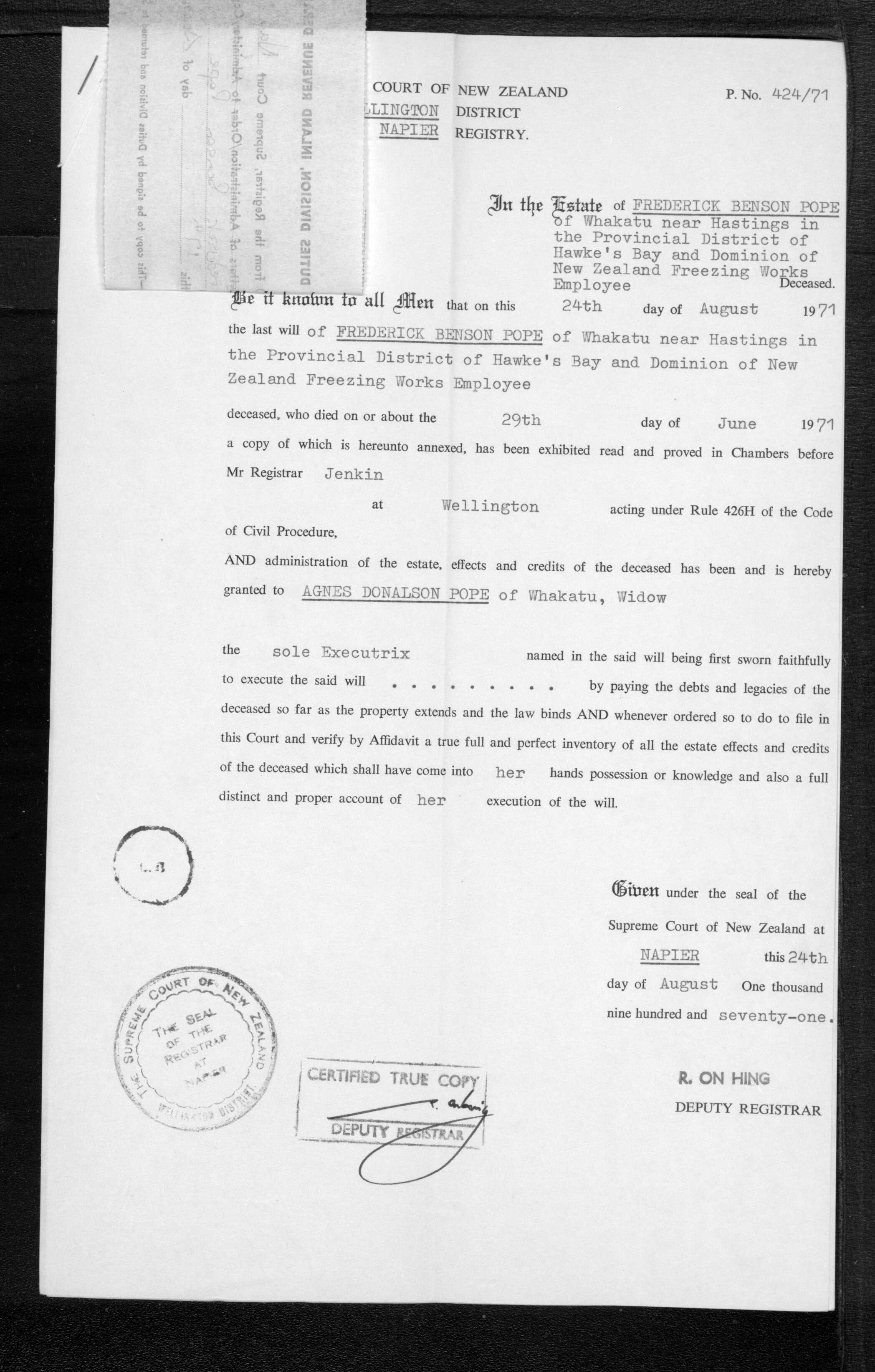
The papers used to settle Frederick’s estate, recording his work at the Whakatu freezing works and his death in 1971.
8 images

The papers used to settle Frederick’s estate, recording his work at the Whakatu freezing works and his death in 1971.

Open the official catalogue record ↗
07

Archives New Zealand · R14712503 · 725/75 · 12 pages

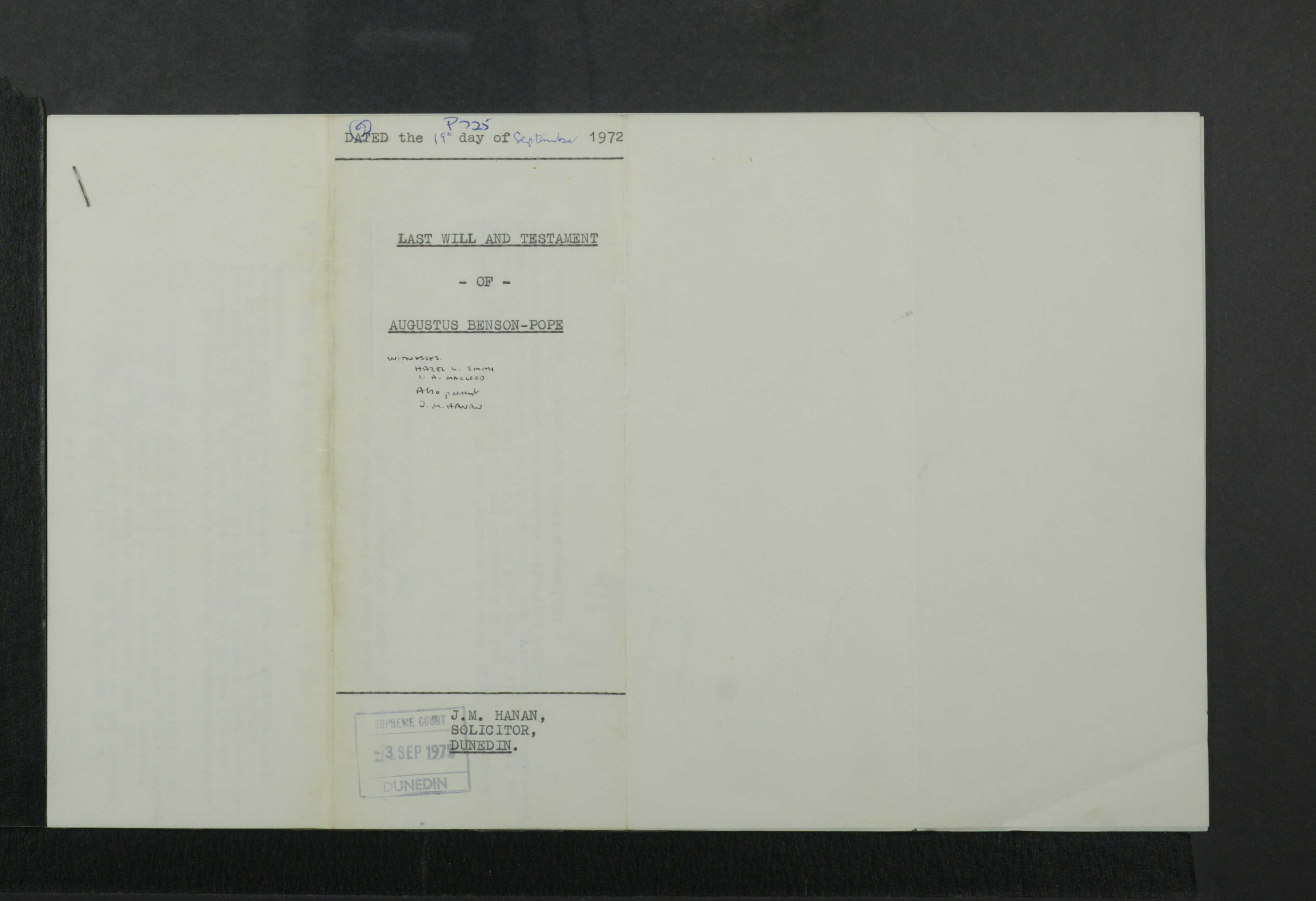
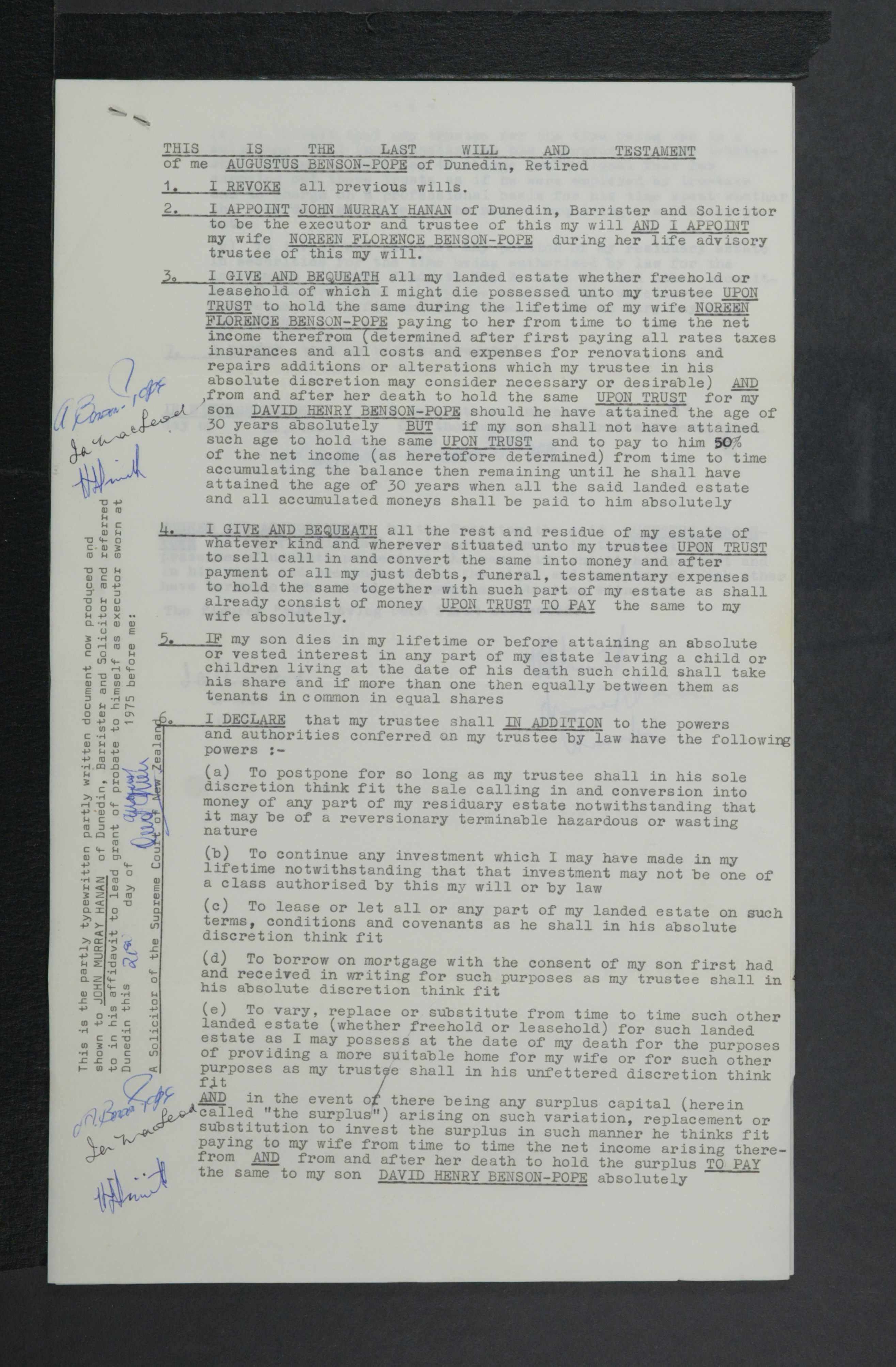
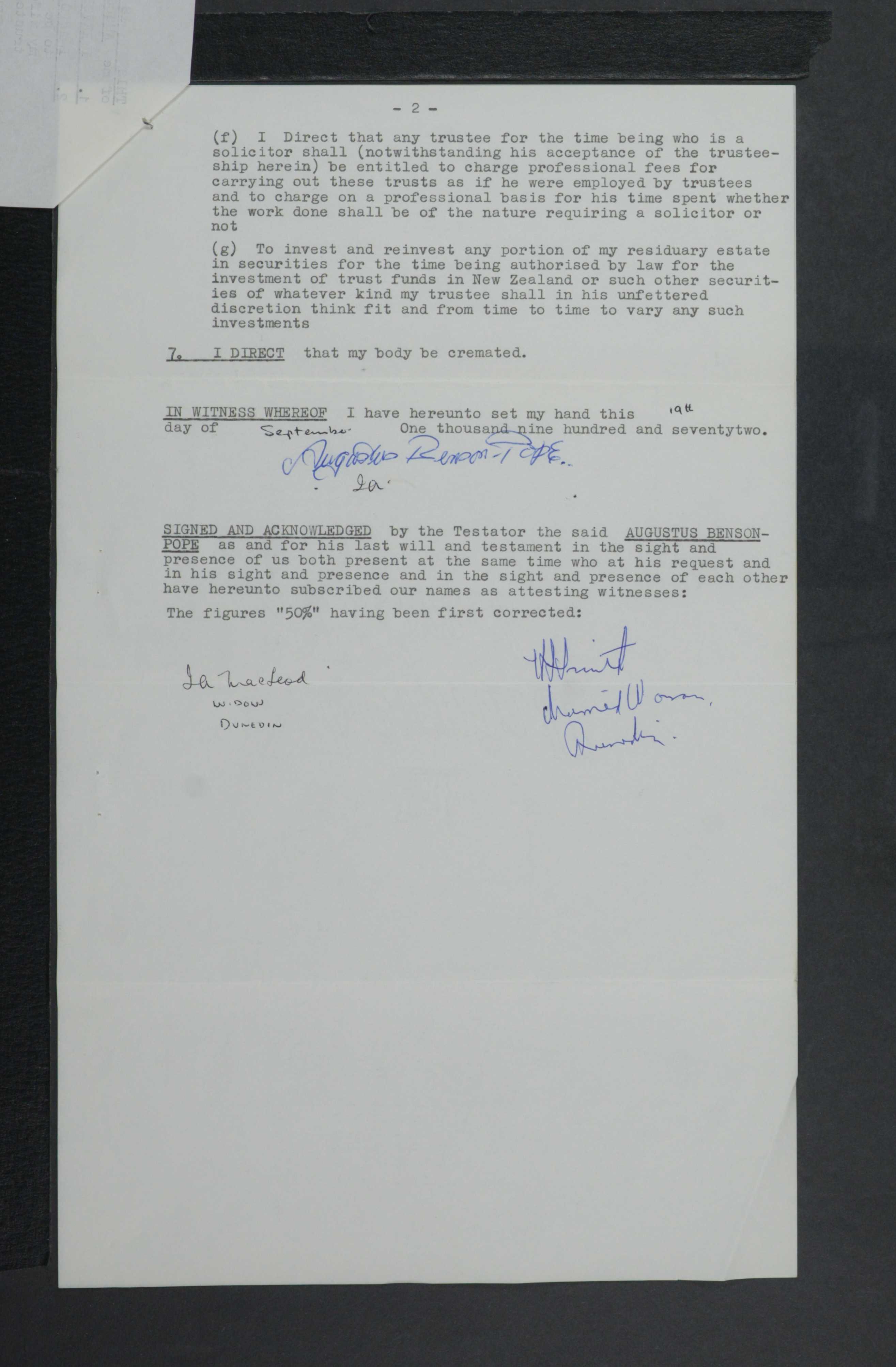
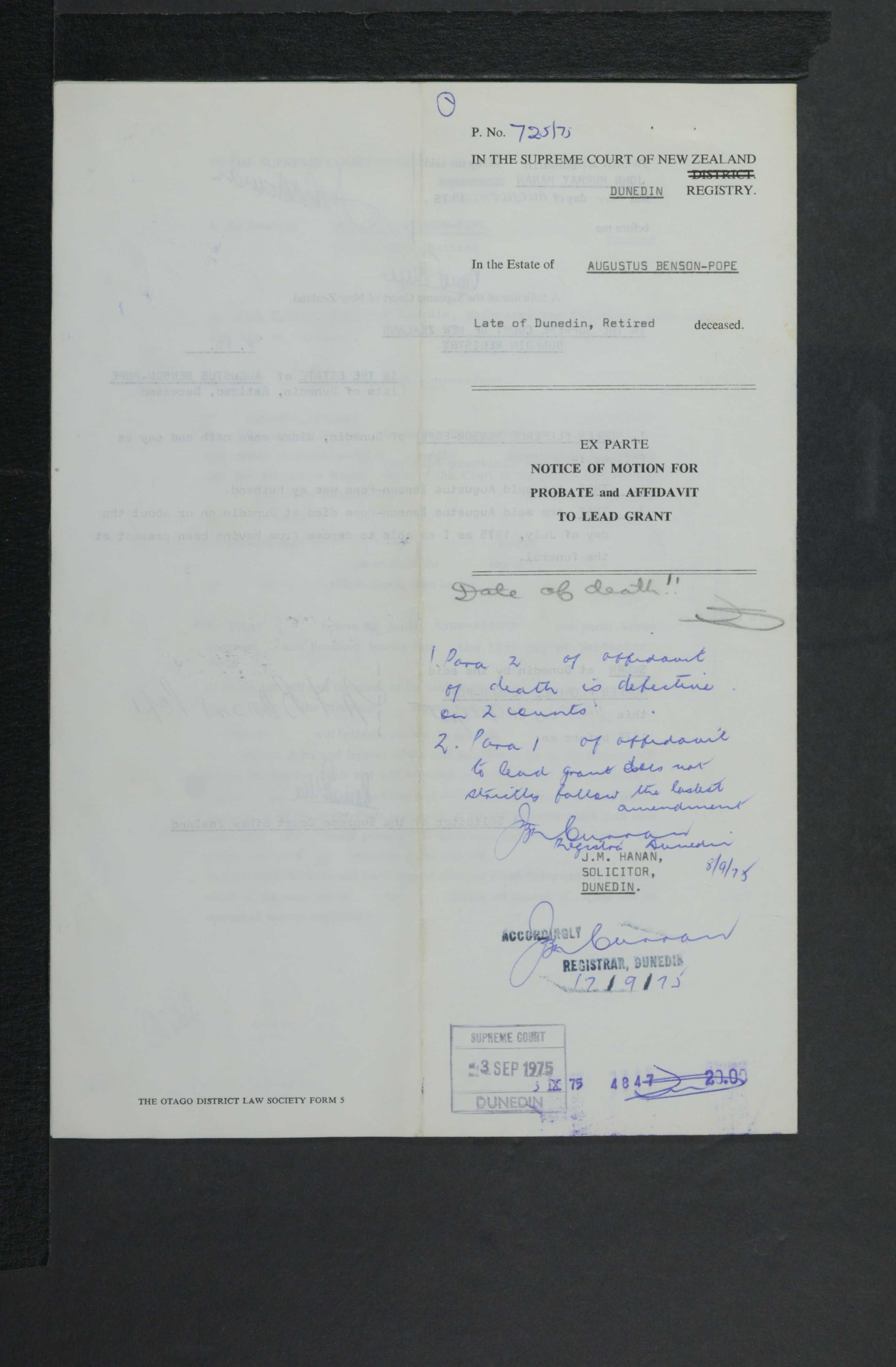
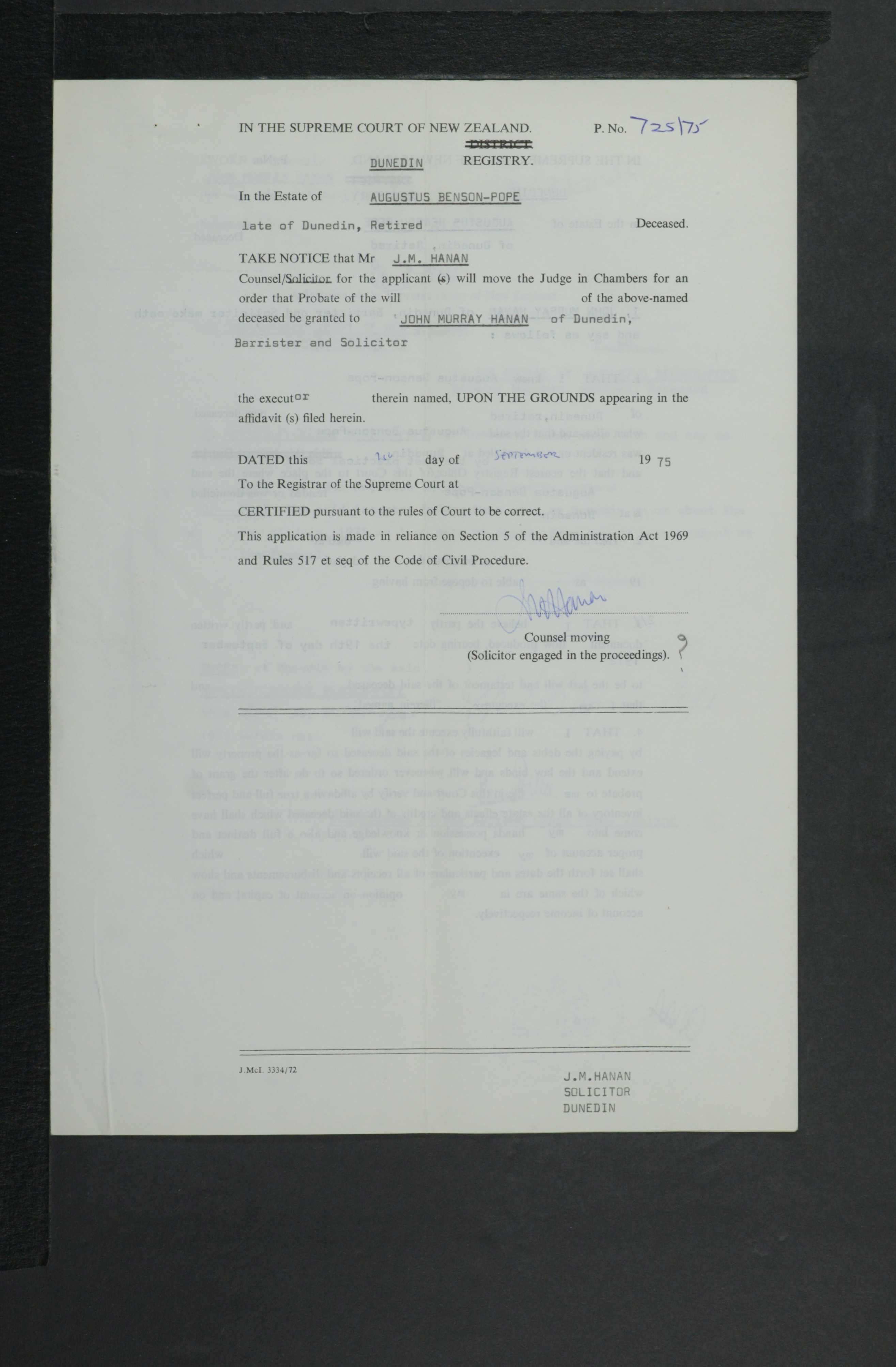
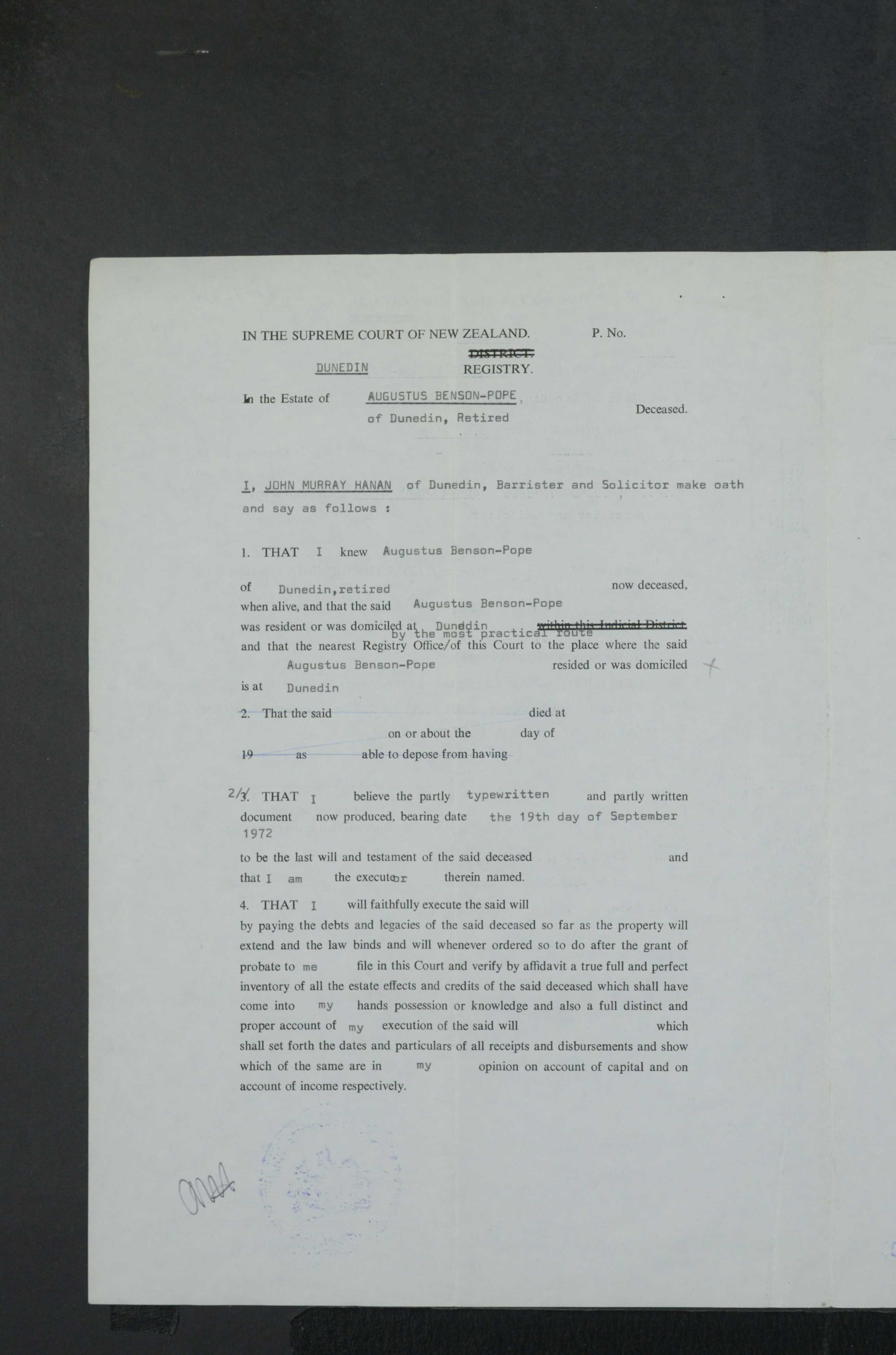
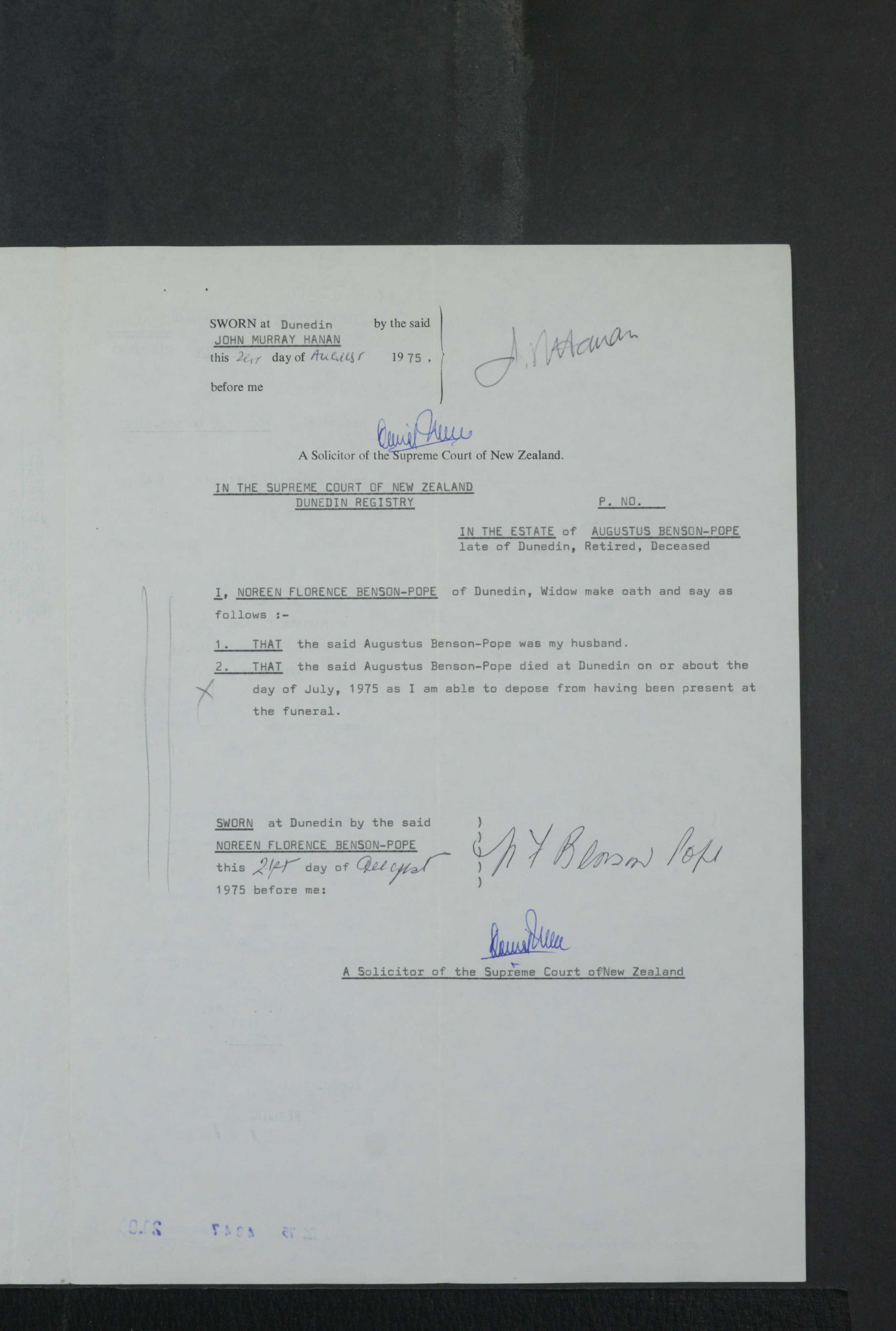
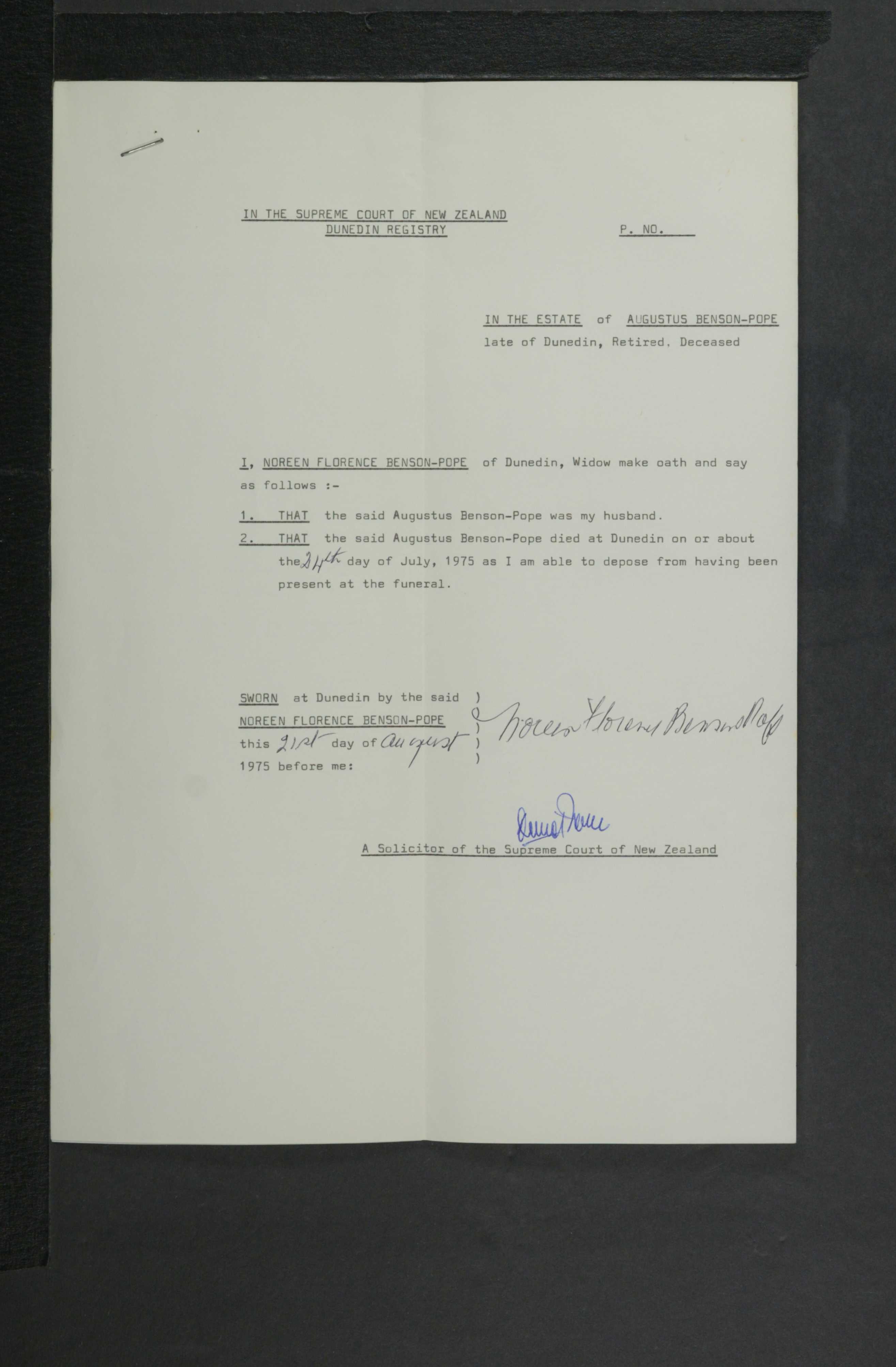
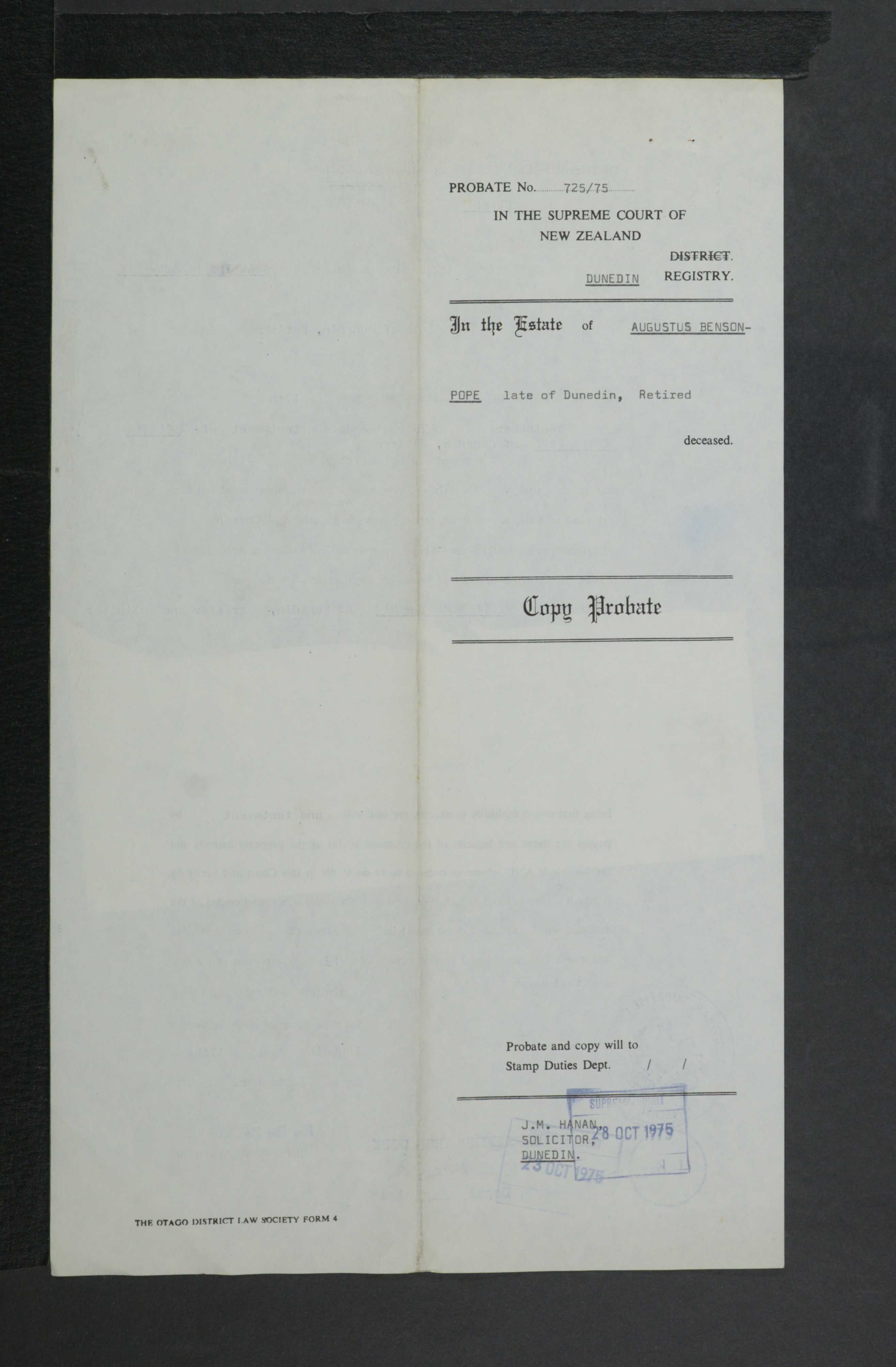
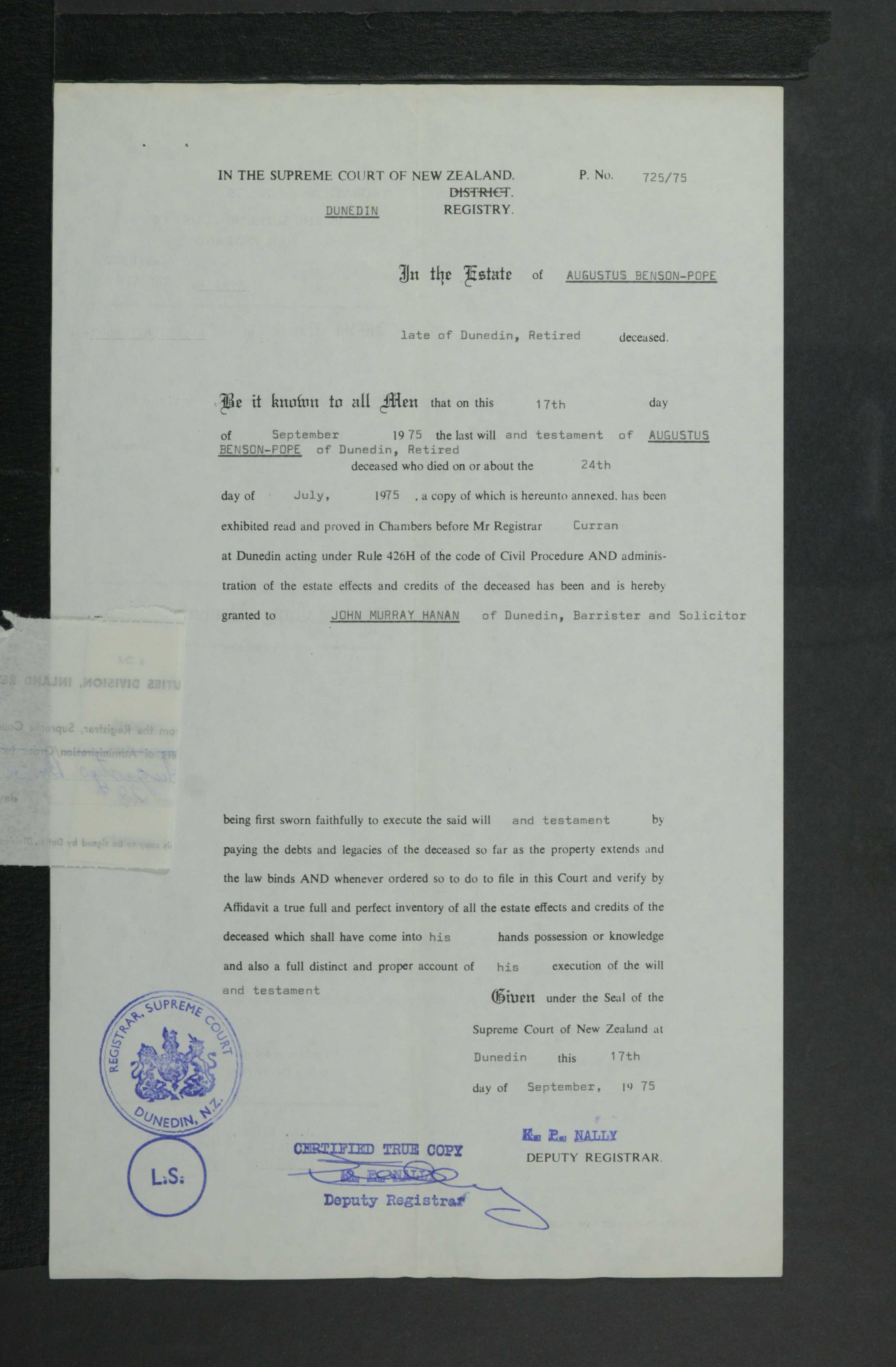
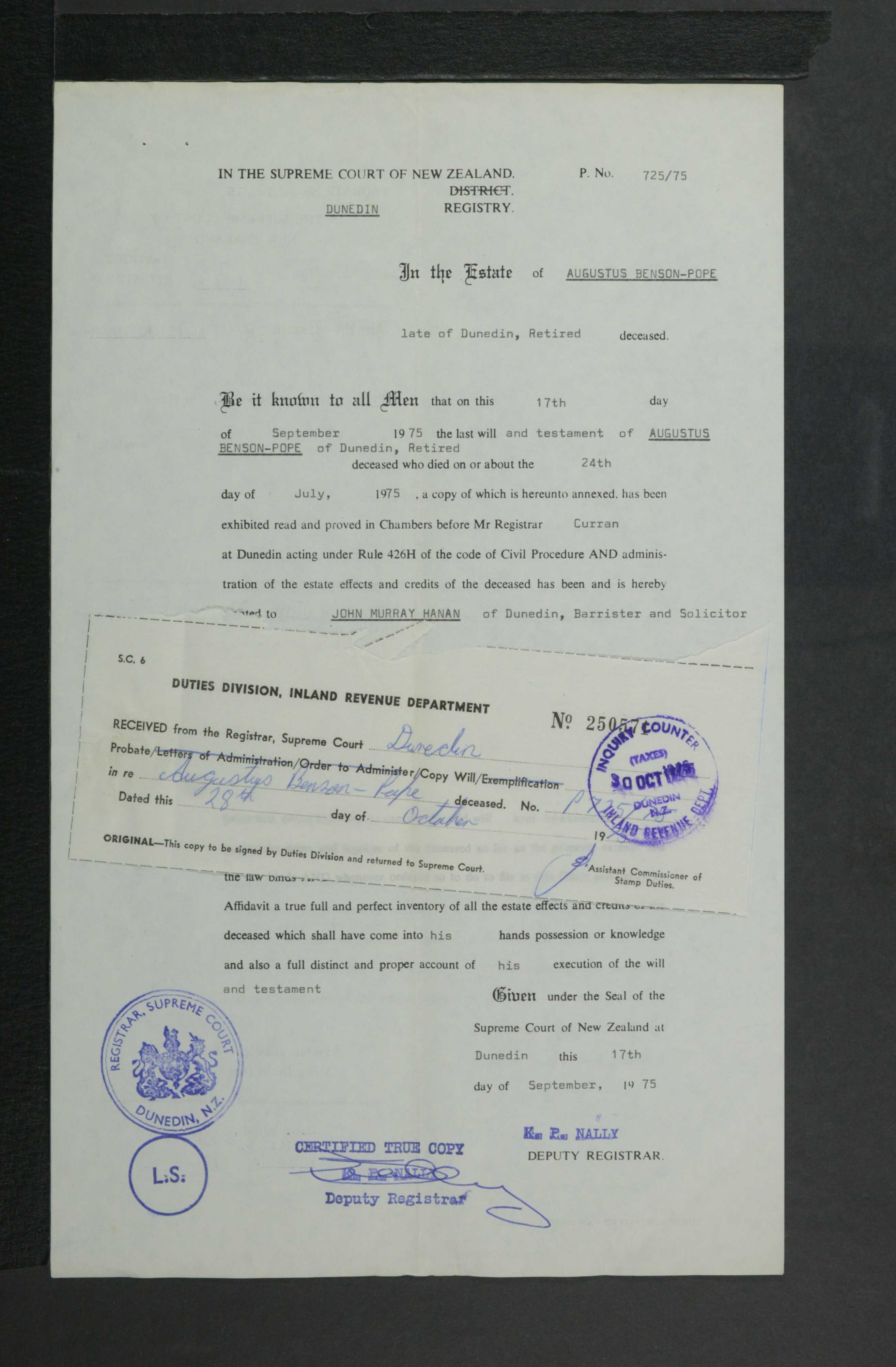
Augustus Benson-Pope’s estate papers

The papers used to settle his estate consistently use the hyphenated surname Benson-Pope.
12 images

The papers used to settle his estate consistently use the hyphenated surname Benson-Pope.

Open the official catalogue record ↗
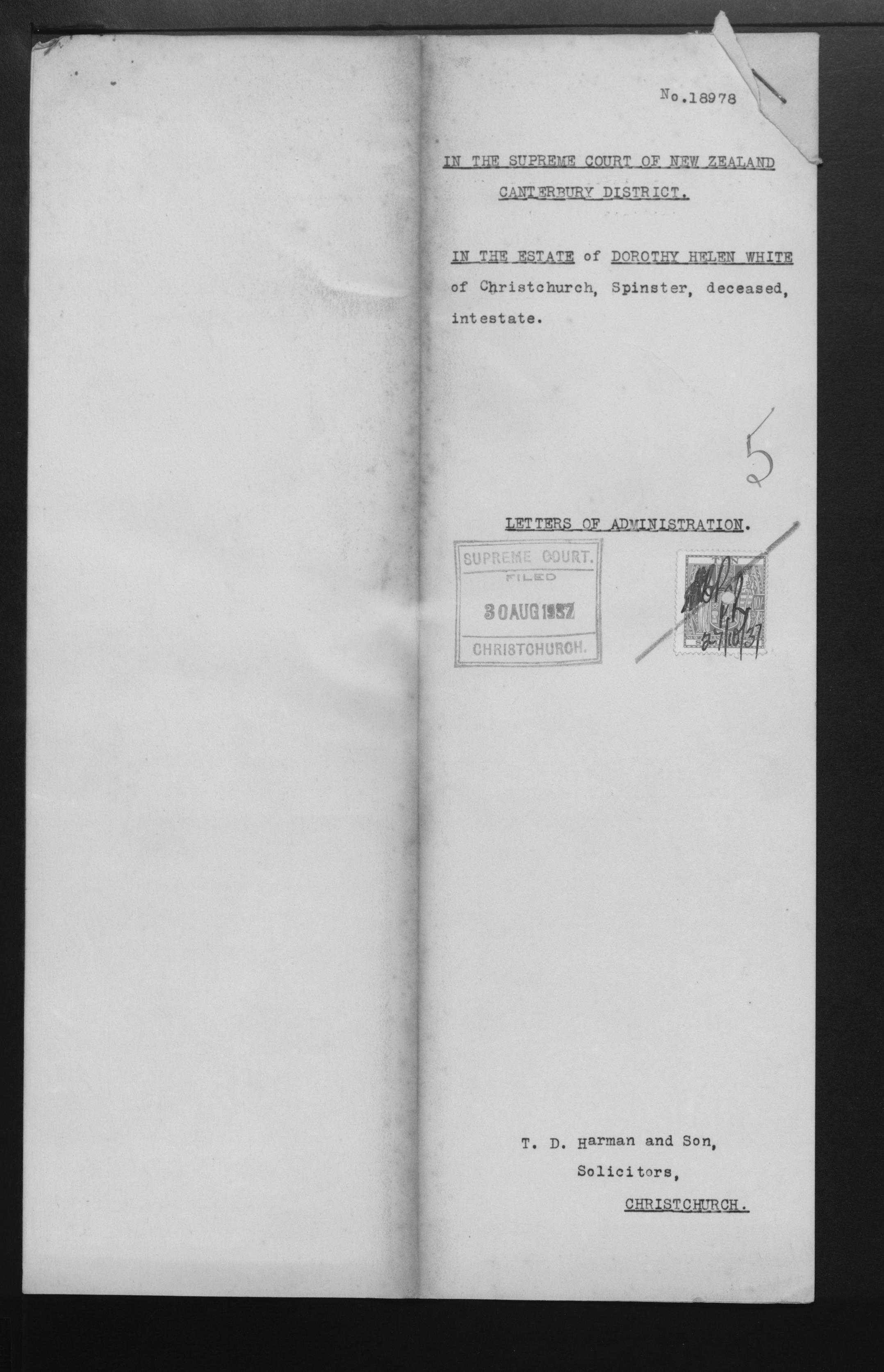
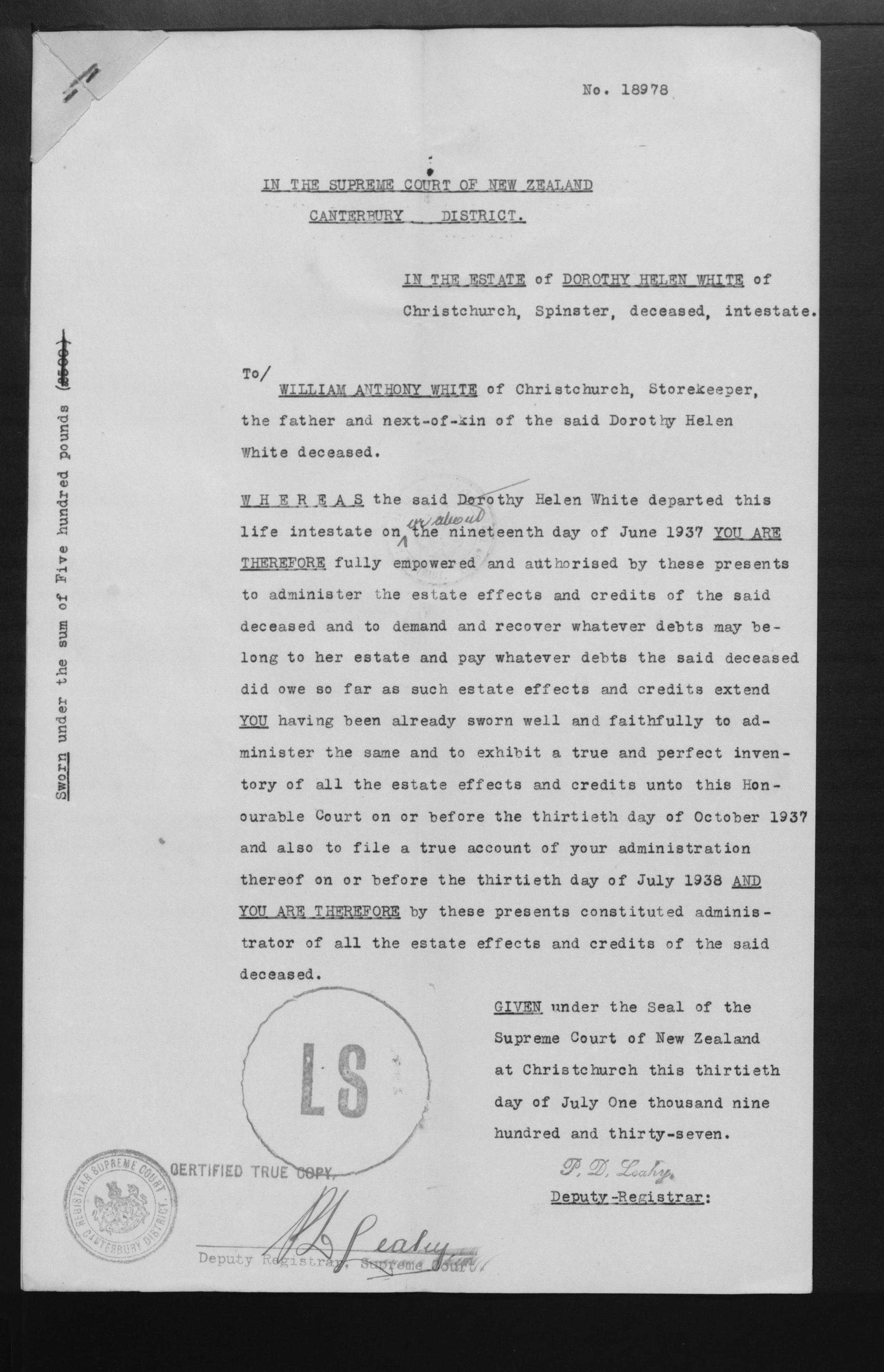
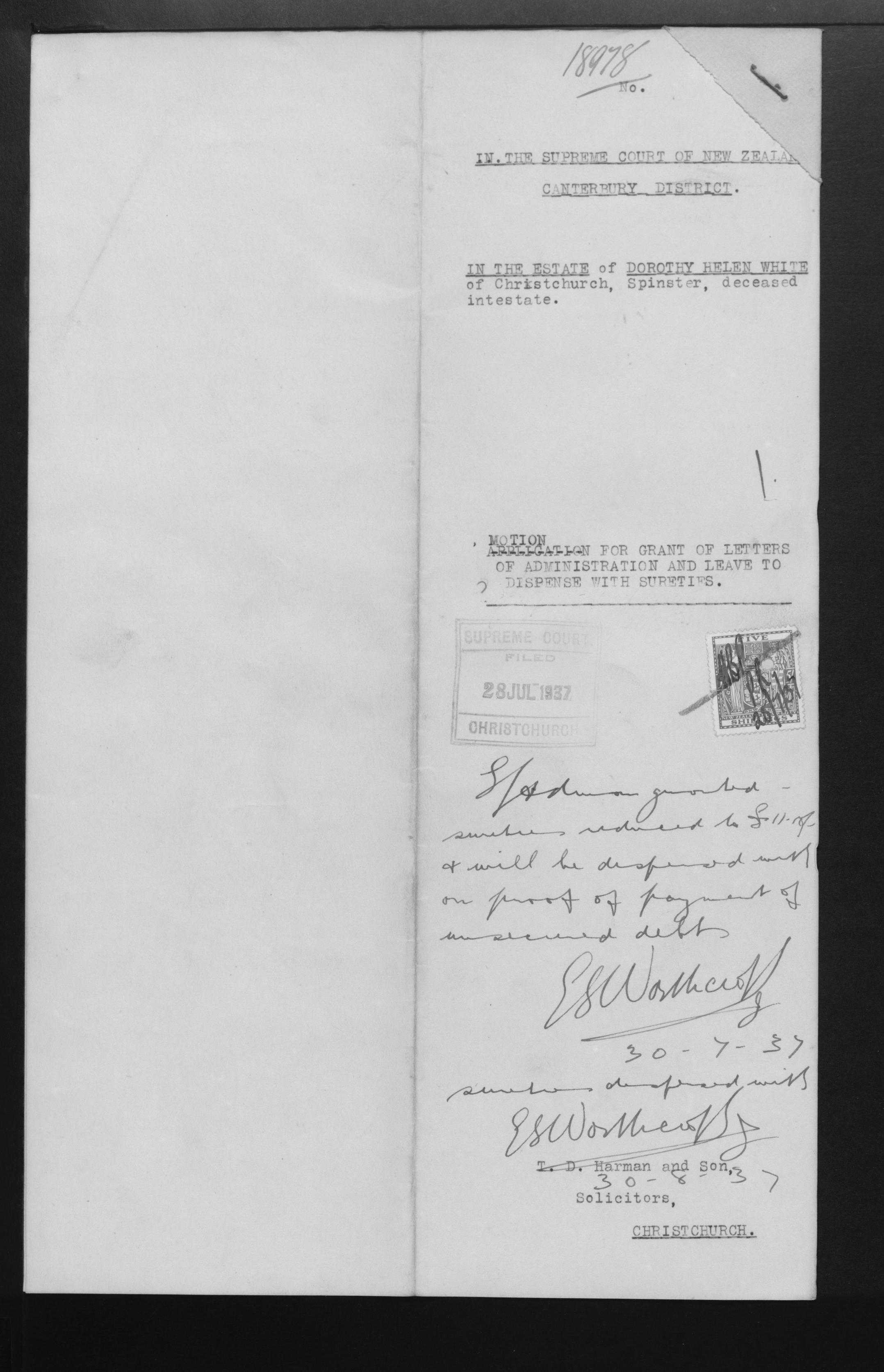
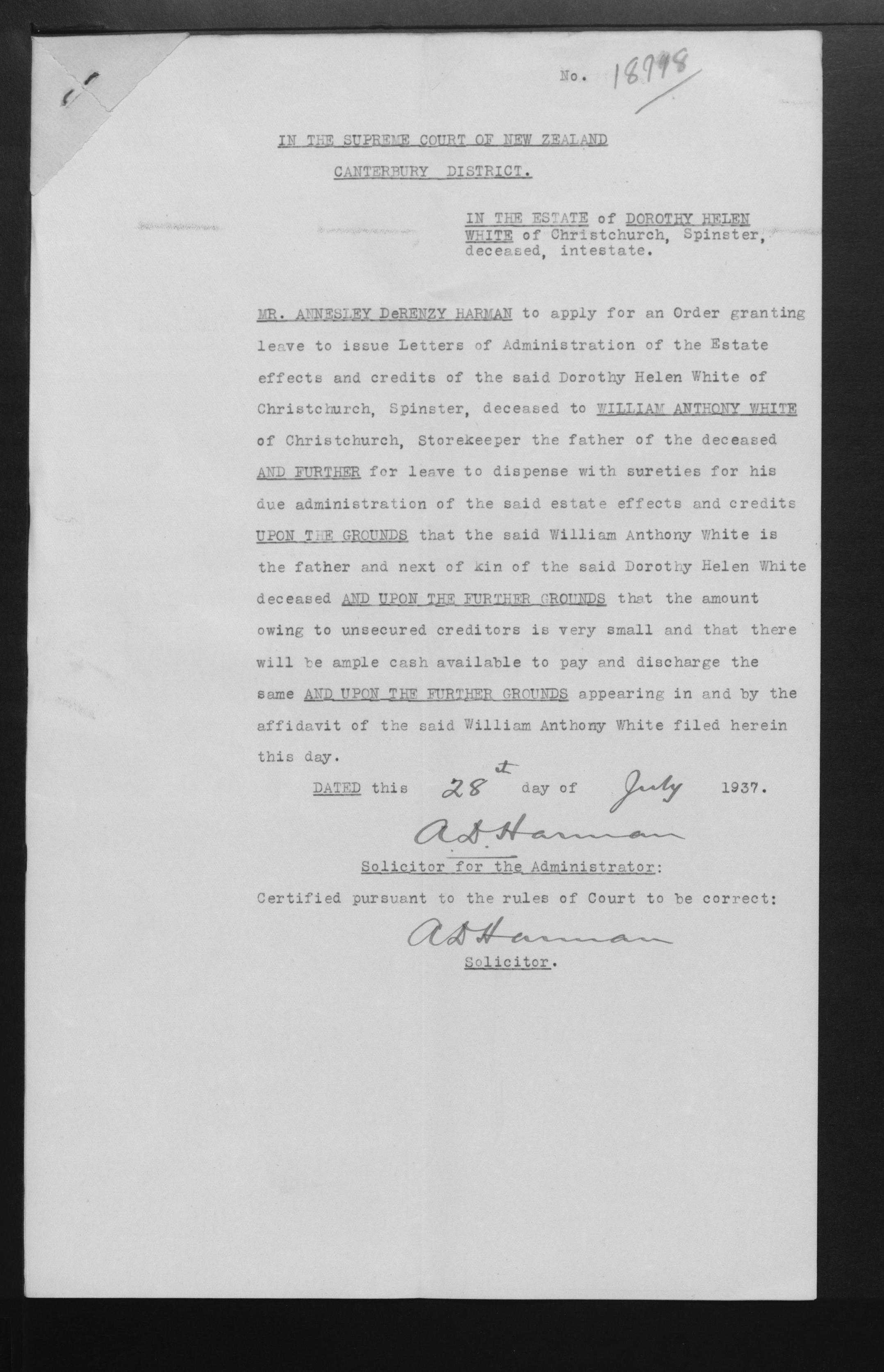
08

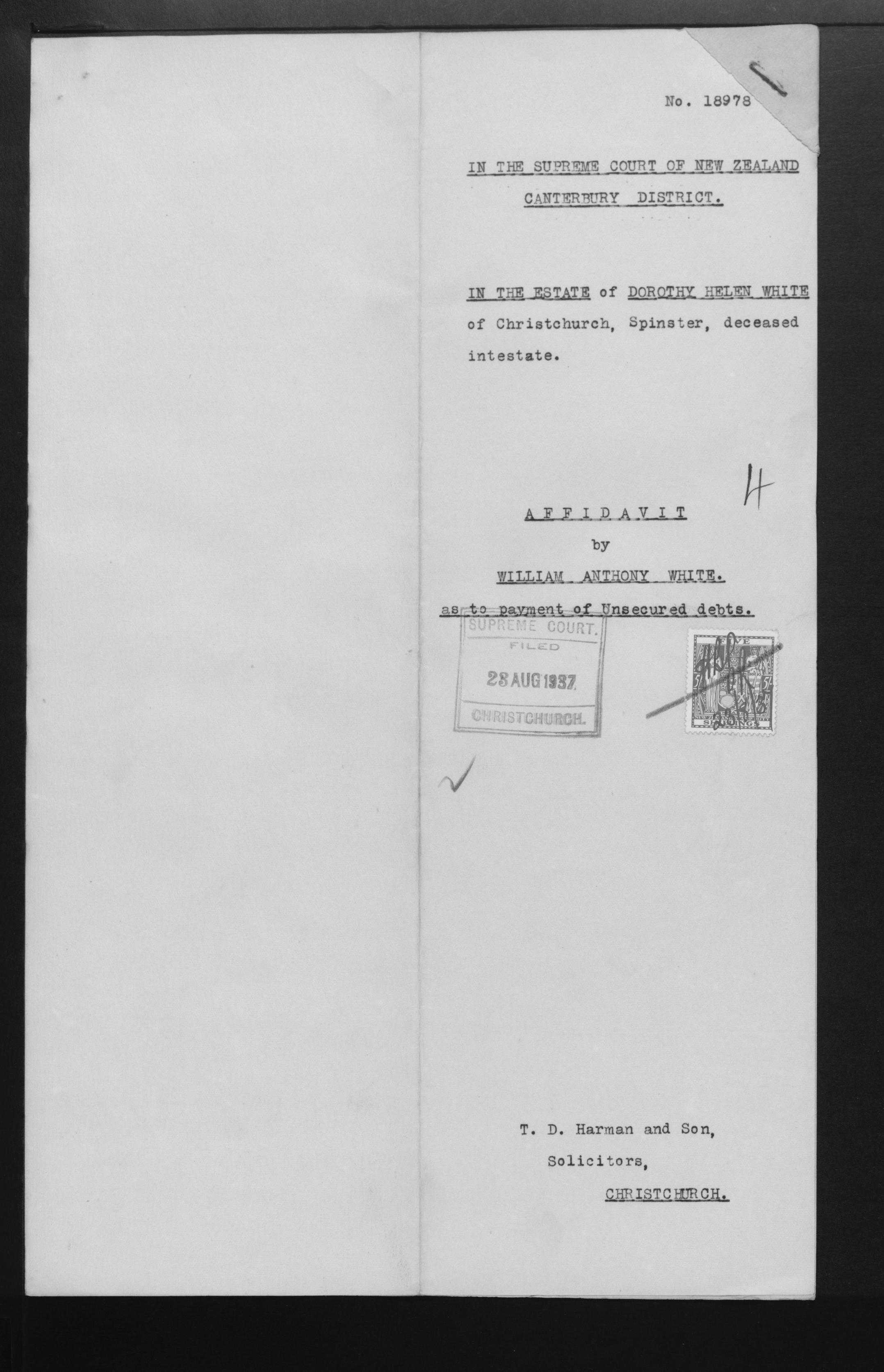
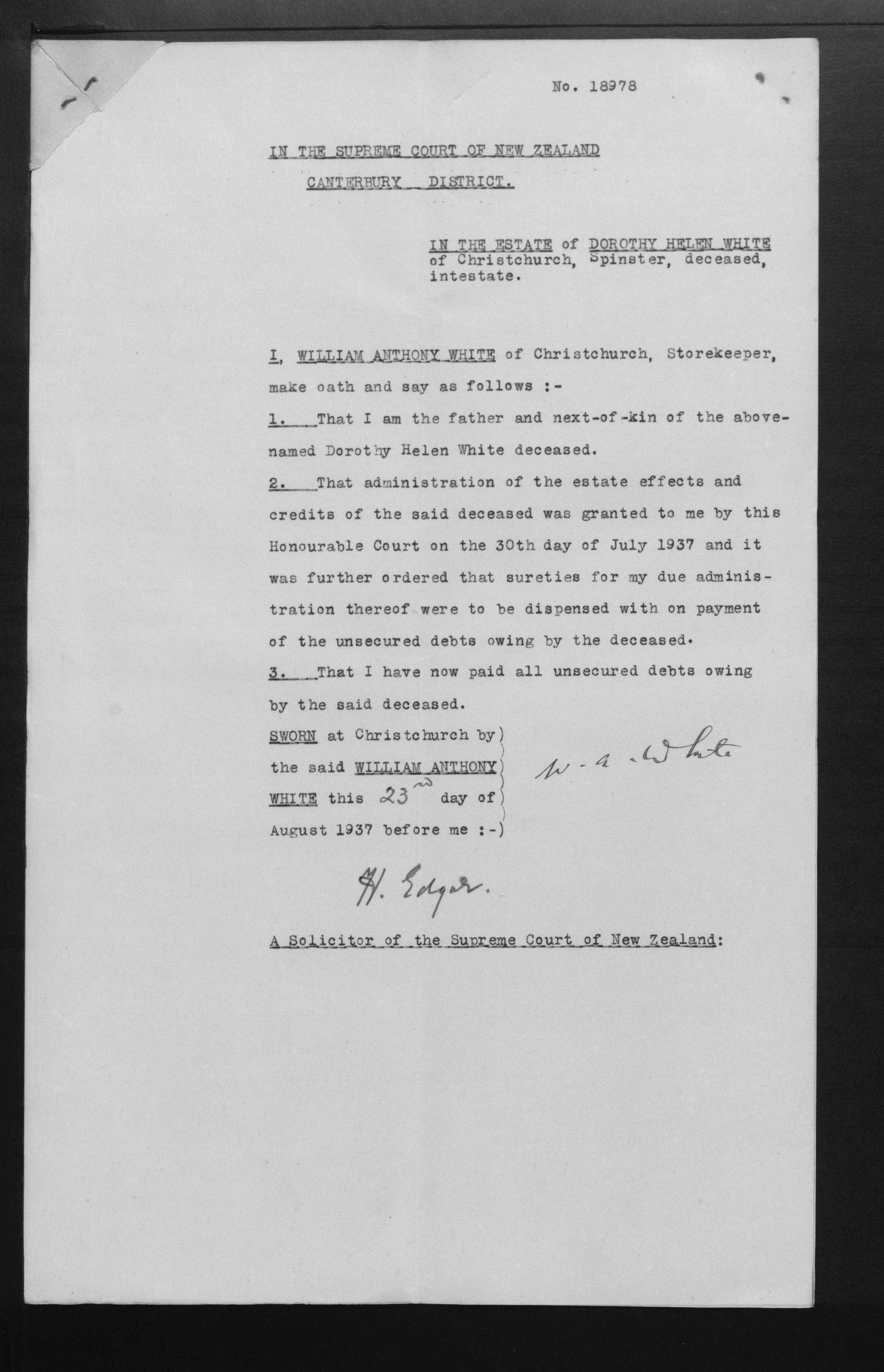
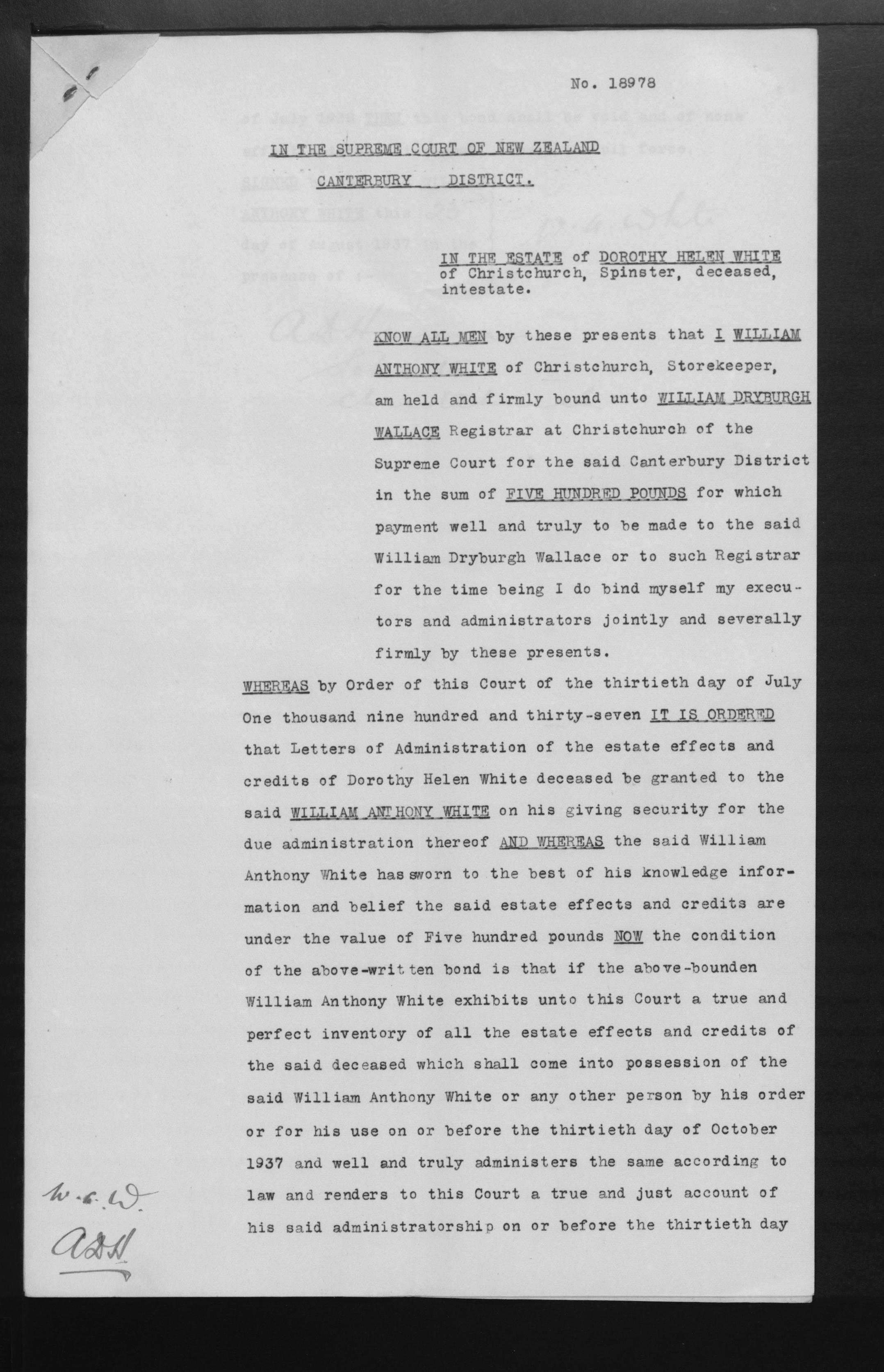
Archives New Zealand · R20187899 · CH18978/1937 · 14 pages

Dorothy Helen White’s estate papers

The papers used to settle Dorothy’s estate record her occupation, Governor’s Bay cottage, insurance and property.
14 images

The papers used to settle Dorothy’s estate record her occupation, Governor’s Bay cottage, insurance and property.

Open the official catalogue record ↗
09

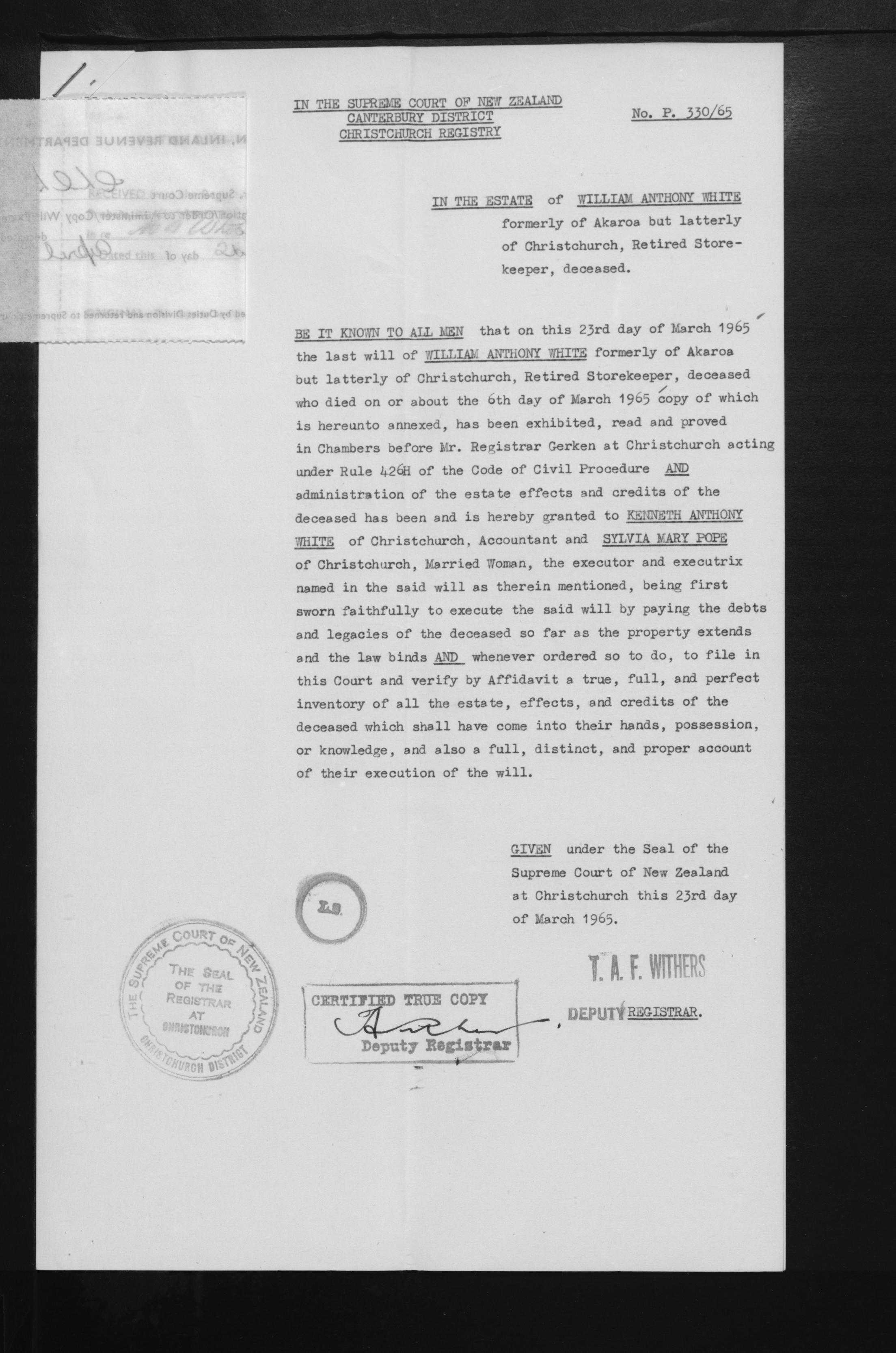
Archives New Zealand · R22351397 · CH330/1965 · 11 pages

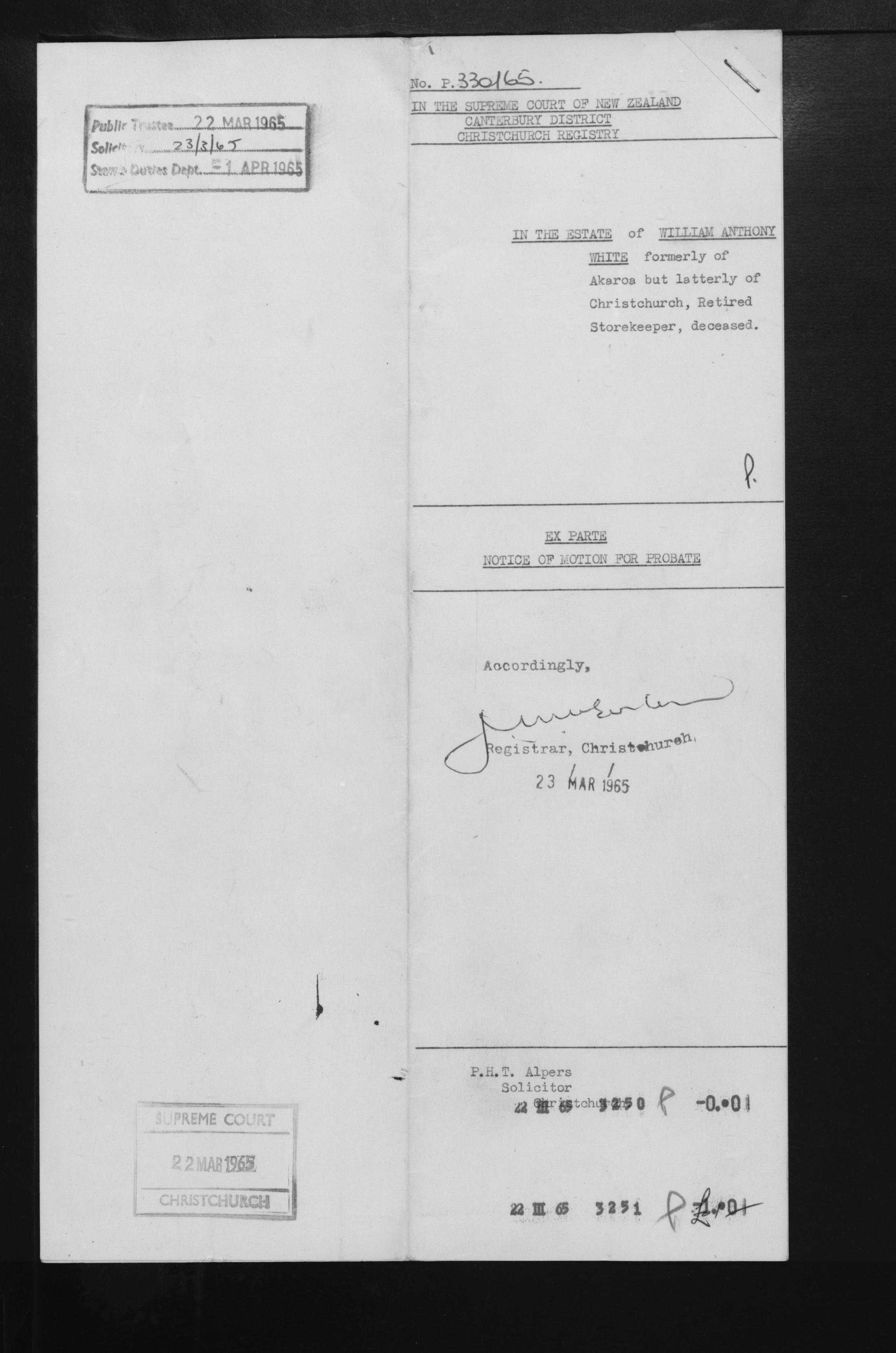
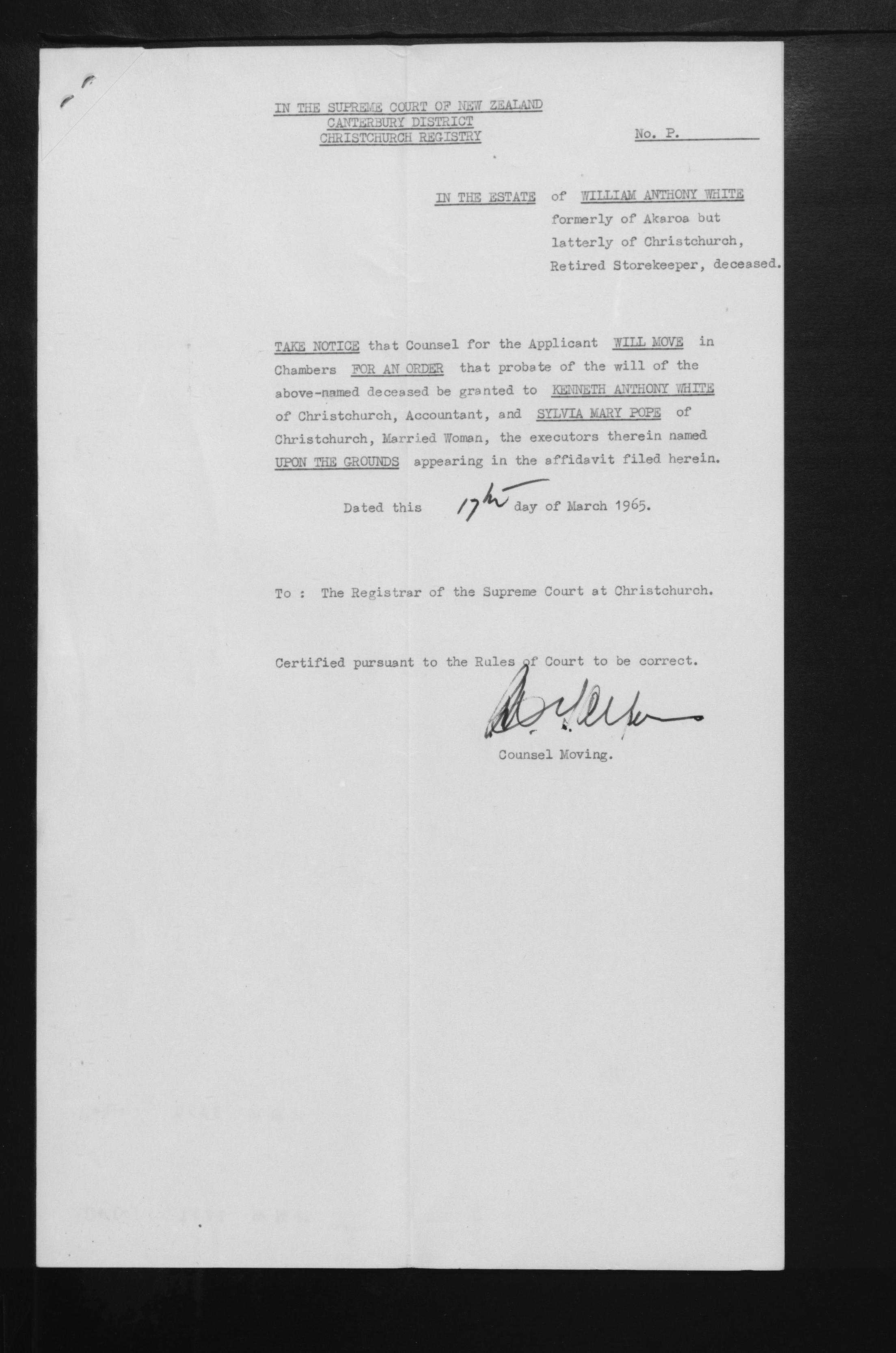
William Anthony White’s will and estate papers

The will names Sylvia Mary Pope and records William as a retired storekeeper, formerly of Fendalton and then Akaroa.
11 images

The will names Sylvia Mary Pope and records William as a retired storekeeper, formerly of Fendalton and then Akaroa.

Open the official catalogue record ↗
10

Library and Archives Canada · RG 76 and 1921 census · 5 selected pages

The White family’s Canadian migration

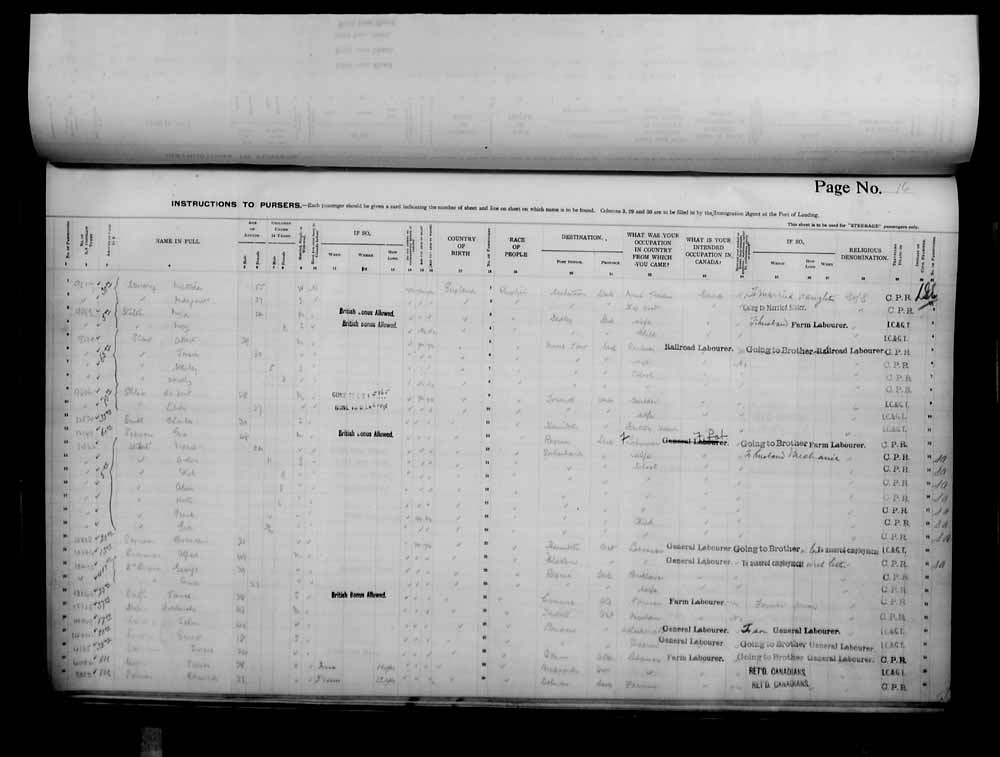
Official Canadian copies tracing Harry’s 1913 voyage and Sarah’s 1920 journey with Maurice, Edith, Edward George and Elsie, followed by the family around Arnprior in 1921.
5 images

Official Canadian copies tracing Harry’s 1913 voyage and Sarah’s 1920 journey with Maurice, Edith, Edward George and Elsie, followed by the family around Arnprior in 1921.

Open the official catalogue record ↗
11

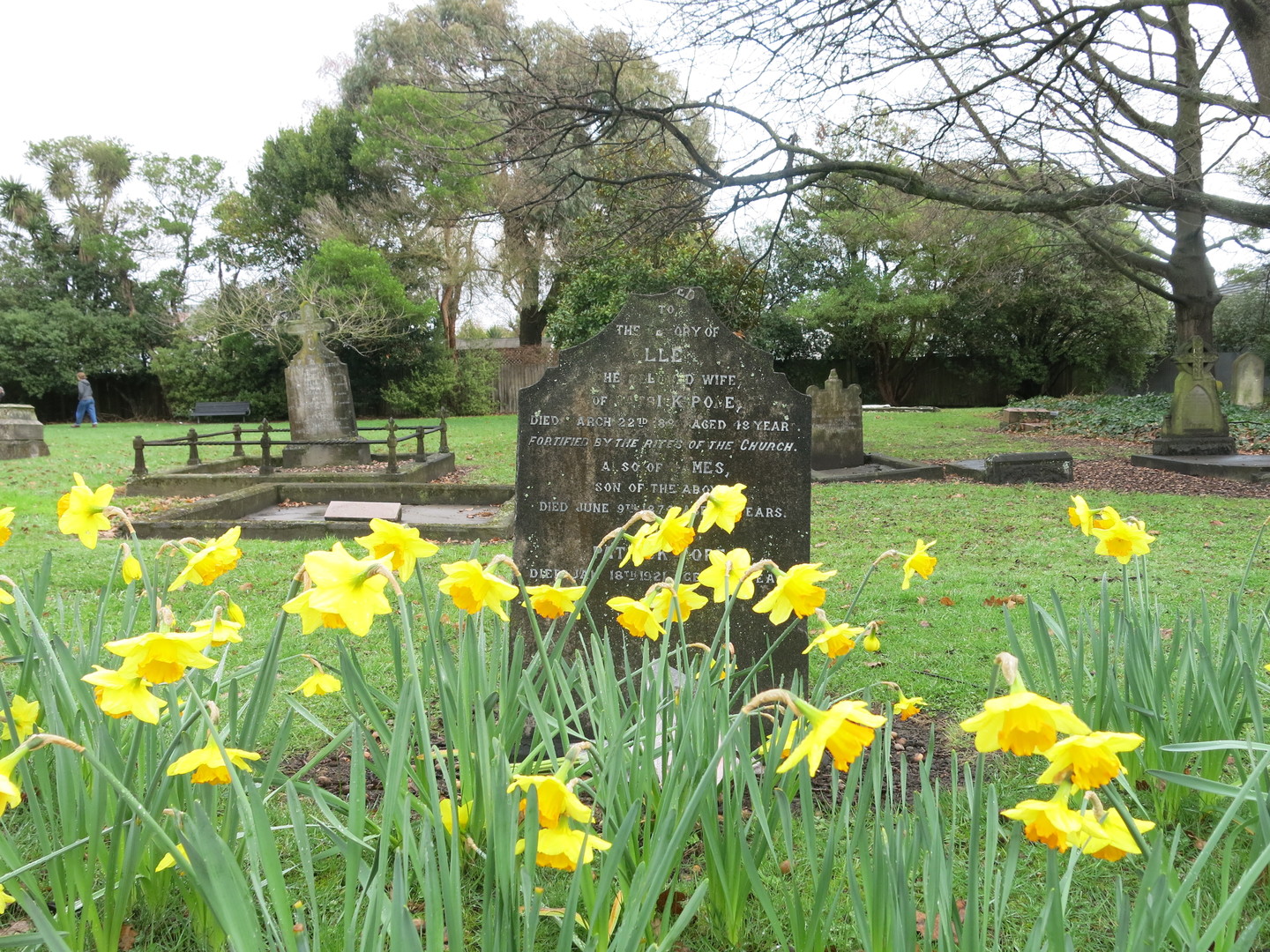
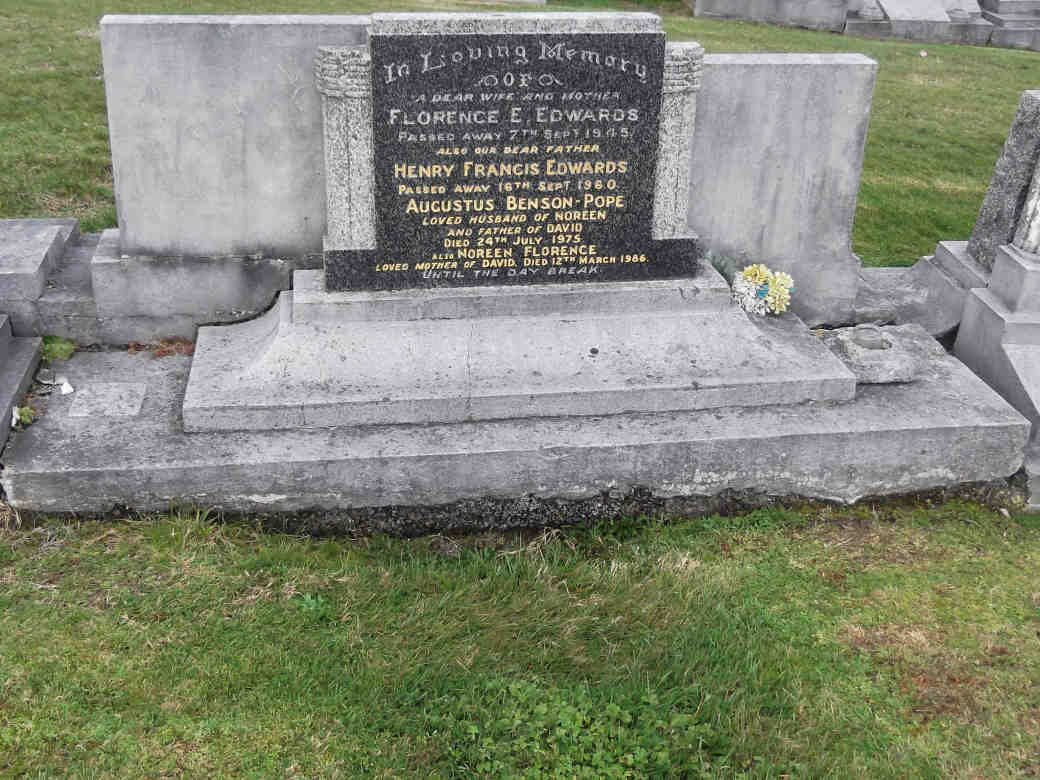
Family photograph · Dunedin City Council image · 2 images

Family memorials

The Barbadoes Street Pope memorial and the Andersons Bay Benson-Pope memorial.
2 images

The Barbadoes Street Pope memorial and the Andersons Bay Benson-Pope memorial.

Using and citing these images

The record room contains only material presently suitable for this non-commercial family site: official Archives New Zealand copies, attributed Government of Canada pages and family or council memorial images. Restricted Ancestry and UK National Archives scans remain in the private archive; this site links to their catalogues and publishes independently written findings instead.

Read the Archives New Zealand reuse guidance ↗

Check the story for yourself

Source index.

These links lead to the archive entry, original newspaper page, church or census record, or historical background used in the story. Ancestry and some other subscription services may ask readers to sign in with their own accounts.

01
White origins, households & workParish, census, licence and migration records
02
William at war & the White siblingsTribunal papers, service records, official notices and Canadian migration
03
Pope origins, migration & workChurch registers, passenger lists, newspapers, wills and estate papers
01
Patrick Pope and Ellen Benson marriageSt Patrick’s, Belfast · 8 August 1852 · original register page
Confirmed
02
Patrick and Ellen’s 1861 lodgingFive Popes in Ann Madden’s nine-person household · 40 St Ninian Street · the online search result misspells Pope as Hope
Confirmed
03
What the 1861 Scottish census recordedUniversity of Glasgow · the original schedule may reveal the number of rooms with windows
Background
04
Hutchesontown’s growthThe Glasgow Story · planned four-storey streets transformed by nearby industry
Background
05
The industrial GorbalsThe Glasgow Story · ironworks glare, railways, tenements and migrant settlement
Background
06
Inside a Glasgow tenement blockThe Glasgow Story · closes, courts and shared sanitation in the nineteenth-century city
Background
07
Irish migration into GlasgowThe Glasgow Story · Famine-era arrivals and the 18.2 per cent Irish-born population recorded in 1851
Background
08
The Catholic Church in industrial GlasgowThe Glasgow Story · Irish Catholic settlement, parish growth and anti-Catholic prejudice
Background
09
The Great Famine and nineteenth-century Irish emigrationOpen University · crop failure, inadequate relief, mass death and migration
Background
10
Glasgow town plans, surveyed 1857–58National Library of Scotland · the contemporary map series for St Ninian Street
Background
11
Sebastopol embarkation listJohn Pope, blacksmith, Lanarkshire · 1861
Confirmed
12
Sebastopol arrival and passenger classesLyttelton Times · 18 December 1861 · about 186 provincial immigrants plus other passengers
Confirmed
13
Echunga migration evidencePatrick and Mary identified as passengers · 1862
Confirmed
14
Echunga voyage reportLyttelton Times · 102 days, gale, births, deaths and the disputed Timaru landing
Confirmed
15
David G Fleming embarkation listEllen and three sons reach Canterbury · 1863
Confirmed
16
David G Fleming voyage reportPress · 10 December 1863 · 107 days, 357 government immigrants and a distilling plant
Confirmed
17
Cambridge Hotel licence noticeCorner of Dublin and Winchester Streets · eighteen rooms beyond family use · May 1888
Confirmed
18
Sunday trading under the Licensing ActLyttelton Times · period law and prosecution context · June 1886
Background
19
Canterbury imports in 1888Beer, ale, wine, spirits, tobacco, tea, coffee, cocoa and chocolate · availability, not Patrick’s stock list
Background
20
Patrick Pope obituaryPress · 25 January 1921 · iron work, tunnel, workshops and farming
Confirmed
21
Inside Addington Railway WorkshopsIllustrated Canterbury Times feature · October 1907 · more than 500 workers and many trades
Background
22
Halswell house firePress · 19 March 1898 · six-room house, nothing saved
Confirmed
23
Patrick Pope’s will and estate papersArchives New Zealand · R20180218 · complete record reproduced below
Confirmed
04
John L. B. PopeMilitary, radio, political, philosophical and ministry evidence
05
The White family in CanterburyEducation, estate, cemetery and newspaper records
06
Places, period context & image rightsSources used to reconstruct the world around the records
01
Egham enclosure and changing landscapeEgham Museum · population, agriculture, roads and development
Background
02
The Red Lion and Egham’s coaching tradeEgham Museum · coaching inn, London–Penzance road and stabling for 72 horses
Background
03
Egham RacesEgham Museum · Georgian race meetings, London coaches, booths and the Red Lion ball
Background
04
Runnymede and Magna CartaNational Trust · Magna Carta was sealed on 15 June 1215 on meadowland belonging to the manor of Egham
Background
05
Magna Carta Island, Egham, 1829George Delamotte lithograph · Egham Museum PR97A · the river landscape known to the early White generations
Background
06
Belfast street plan, 1850John Rapkin map with H. Bibby illustrations · published two years before Patrick and Ellen married
Background
07
A Glasgow close, 1868Thomas Annan · Close No. 193 High Street · a surviving view of the shared urban world around the Pope household
Background
08
The railway comes to EghamEgham Museum · opening in 1856 and effects on trade
Background
09
Prince of Wales public houseEgham Museum · 33 Bond Street · operating 1871–2000
Background
10
Exact pub photographClosed Pubs · 1997 exterior · linked, not republished because no reuse licence is stated
Background
11
Post Office occupationsThe Postal Museum · sub-postmasters and shop-based branches
Background
12
The voyage outTe Ara · steerage and nineteenth-century migration conditions
Background
13
Rotorua refitted for first and third classEvening Post · January 1923 · two-, four- and six-berth third-class cabins
Background
14
Rotorua’s two-class deck planAuckland Star · April 1923 · third-class accommodation on the upper deck, first class above
Background
15
RMS Rotorua in 1923Alexander Turnbull Library PAColl-5471-028 · the ex-Shropshire vessel in service from 1923
Confirmed
16
Rotorua’s December 1923 passageContemporary sailing report · Southampton 6 December, via Panama, due Wellington 10–11 January
Confirmed
17
Rotorua’s next outward voyageApril–May 1924 · Colon, Panama, Pitcairn, gales and onboard entertainments · same-ship context only
Background
18
Another family aboard RotoruaA 1924 account of the same ship · almost five weeks via Panama, used only as a period lens
Background
19
What “carman” meantThe National Archives · a driver of a horse-drawn vehicle carrying goods
Background
20
Drivers of horse-drawn vans and cartsDictionary of Occupational Terms · harnessing, loading, deliveries, receipts and return to depot
Background
21
A carman’s working day in 1877John Thomson and Adolphe Smith · horse care, early start, repeated loads and long hours · one trade example, not William’s diary
Background
22
Lyttelton rail tunnelNZ History · construction and first passenger train
Background
23
Addington Railway Workshops photographsTe Papa · Francis Dutch negatives · no known copyright restrictions
Background
24
Blacksmith at his forgeFred Brockett · Masterton, circa 1910 · Te Papa B.027899 · no known copyright restrictions
Background
25
Grehan Valley in 1911Jessie Buckland · Canterbury Stories · no known copyright
Background
26
The world in 1850George Cruchley · public-domain map used beneath the family movement routes
Background
27
Copying and citing archivesArchives New Zealand · reuse guidance for online digitised images
Background

The next discoveries

What could we still
find out?

01

Frederick’s identity bridge

His commission or Indian Army officer file should give an address, birth date or next of kin. That one detail could turn the strong military match into a proved family history.

02

Maurice’s complete naval career

A clean copy of ADM 188/729/41370 will allow every ship, rating and service date to be transcribed before the story follows him onward through Canada.

03

William’s RAF chronology

AIR 79/503/55225 should show what happened after the tribunal withdrew his exemption and connect his wartime service to the businesses he left behind.

04

Was William also the Egham publican?

Rate books, licence-transfer records, voting lists or trade directories could prove—or disprove—that William the carman was also the William White who ran the Prince of Wales.

05

John’s surviving voice

Ngā Taonga may hold a recording, script or production paperwork for either of John’s two known 3YA radio broadcasts.

06

Church and Theosophy records

Liberal Catholic Church and Theosophical Society archives may contain photographs, lecture programmes, letters and records of the positions John held.